
“Minelaying Bases at Grangemouth, Dalmore and Glen-Albyn”.
Introductory
Object of the Work.
The decision of the Admiralty, arrived at in agreement with the U.S. Navy in November 1917, that the northern barrage should be constructed, necessitated the provision of minelaying bases on the east coast of Scotland, where the large numbers of submarine mines to be used in connection with the work could be stored, and prepared for loading on the minelaying ships.
Selection of Sites for Three Bases.
The new minefield which was to constitute the northern barrage was arranged to be laid by the U.S. Navy, who supplied their own mines, but it was determined that a portion of it, amounting to about 20 per cent., should be laid by the British navy; it was therefore necessary to establish mine depots with corresponding receiving stations and reloading facilities for U.S.N. portion of the work as well as for that part which was to be undertaken by the Royal Navy.
The sites selected for the bases and depots were the following:-
- Grangemouth, in the Firth of Forth, for use as the main Royal Navy minelaying base.
- Dalmore, on the north shore of Cromarty Firth near Invergordon. This base was operated in conjunction with a receiving station on the west coast of Scotland at Kyle of Lochalsh and a reshipping station at Invergordon. The base was provided for the use of the U.S. Navy.
- Glen-Albyn, at the east end of the Caledonian Canal near Inverness, which was used in conjunction with a receiving station at Corpach at the west end of the Caledonian Canal. This base, like that at Dalmore, was provided for the use of the U.S. Navy.
The decision to establish mine receiving stations on the west coast of Scotland to be marked in conjunction with the depots at Dalmore and Glen-Albyn was arrived at in order to avoid the use of the northabout passage to the east coast of Scotland by ships bringing mines from the United States. The scheme, so far as the U.S. section was concerned, involved the transport of the mines from America, landing them on the west coast of Scotland, transporting them across country to the east coast, where they were examined, assembled, and tested at the base depots, and ultimately their shipment on minelayers, which placed them in position in the barrage minefield.
Cost of Work and Responsibility for Construction and Operation.
The whole of the constructional work in connection with the three bases was carried out by the Admiralty, the two northern bases, Dalmore and Glen-Albyn with their subsidiary stations, being handed over to the U.S. Navy on completion, that Navy providing all the personnel for operating purposes.
The total cost of the constructional work by the Admiralty was approximately £610,000; of this sum about £160,000 was expended at Grangemouth and about £450,000 on the Dalmore and Glen-Albyn bases and the corresponding stations on the west coast. The works were carried out under the supervision of the Superintending Civil Engineer, Rosyth Dockyard, in the case of Grangemouth and of the Superintending Civil Engineer, Invergordon, in the case of the northern bases, acting under the direction of the Civil Engineer-in-Chief of the Admiralty.
Grangemouth Base.
Acquisition of site. At an early date during the war, Grangemouth had been used as a mining depot on a comparatively small scale. The works described in this monograph were, however, undertaken to meet the special needs of the northern barrage, and were commenced in December 1917, authority for the works having been given in November 1917. Grangemouth, situated near the head of the Firth of Forth, is approached by a deep water channel from the North Sea, and possesses well equipped modern docks. It had the advantage of affording ample space in the dock area for the erection of the extensive shedding required by the minelaying service.
At the time when the Admiralty proposed to establish the mining depots in connection with the northern barrage, owing to the necessity of closing the River Forth for war purposes, little use was being made of the Grangemouth dock property, and the owners (the Caledonian Railway Co.) raised no serious objection to the occupation of certain dock sheds and the erection by the Admiralty of new buildings in the dock area. It was therefore not necessary to make use of the Defence of the Realm Act in this connection. The Defence of the Realm regulations were, however, used to obtain possession of certain private buildings which were converted for use as offices and quarters.
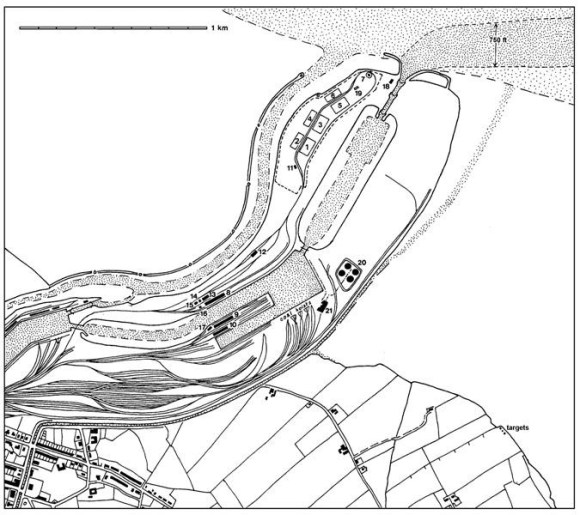
Plan. The general arrangement of the completed depot is shown on Drawing No.1. The whole of the buildings numbered on the drawing, with the exception of sheds 8. 9 and 10, and the offices No.17, were constructed by the Admiralty, together with the railway tracks used in conjunction with the depot.
New buildings. The new buildings erected are as follows:-
- Bulk stores – Nos. 2, 4, and 6, each 300 feet by 123 feet, constructed in bays of 25 feet, 9 feet in height to the eaves. These buildings were used for the separate storage of filled mines and sinkers as received from the factories.
- Ready issue stores – Nos. 1, 3, and 5, each 300 feet by 185 feet, and otherwise similar to the bulk stores. These buildings were for the storage of completed units, ie mines with sinkers ready for use.
- Primer store – No. 7 on plan.
- Two detonator stores – No. 19 on plan.
- Examination room – No. 11 on plan.
- Instruction room – No. 14 on plan.
- Two sheds for gauged mechanisms.
- Locomotive shed for four locomotives and water tank.
- Dining accommodation for 500 men and 100 women.
- Pay and muster stations, latrines, & c.
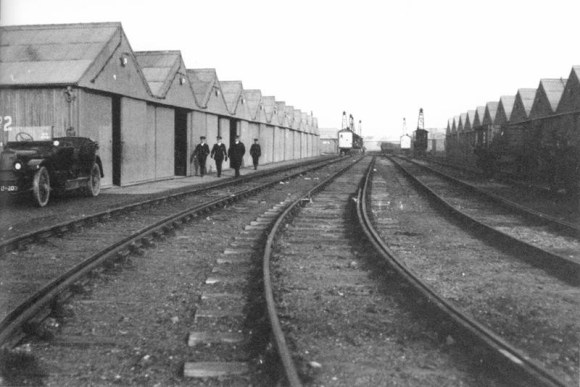
Bulk and ready issue stores. In view of the temporary nature of the buildings and the necessity for the earliest possible completion of the work, the bulk of the ready issue stores were constructed of timber framing, covered with corrugated steel sheets. The roofs of the stores were camouflaged with distemper wash. Drawing No. 2 shows a typical longitudinal section through one of these buildings, the internal arrangements of which are also indicated in the accompanying photograph, Nos. 3.
The bulk stores are laid with concrete floors; the ready issue stores, for completed units, are laid throughout with parallel rows of light railway track on ash floors, the gauge of the rails being adapted to suit the wheels of the sinker carriages.
The stores are arranged, as shown on plan No. 1, in two rows with four lines of railway between, the bulk stores being on one side and the ready issue stores on the other side. The railways are connected with the Caledonian Railway Company’s system and the dock lines.
The erection of the first of the six large sheds was commenced on the 6thJanuary 1918 and the last one was completed on the 30th August 1918.
Travelling steam cranes, working on the two outer lines of railway, were used for transporting mines between the sheds and trucks running on the two centre lines of railway, see photograph No. 4. Portable cranes were used inside the sheds for lifting mines.
Filling and levelling site for new buildings. The site selected for the erection of the sheds had been reclaimed by depositing pumped dredged material. The filling was very soft, and portions of the area were under water at the time of the commencement of the works. 80,000 tons of filling were used to raise the surface in the area to the levels required for the construction of the sheds and railways.
Buildings converted for use in connection with the depot. The buildings taken over from the Caledonian Railway Company including the following:-
- Offices for mining depot.
- Signal station.
- No. 8 shed, two storeys – 400 feet by 60 feet.
- No. 9 shed – 390 feet by 50 feet.
- No. 10 shed – 300 feet by 50 feet.
The three sheds – Nos. 8, 2, and 10 – were formerly used as transit sheds. No. 8 was fitted up for use as an assembling shop. Overhead runways, sinker test rails, and machinery necessary for assembling the parts into complete units and for testing were provided. This shed had a capacity for assembling 300 mines per day. Sheds Nos. 9 and 10 were used for the storage of mines and small mine parts.
Existing premises taken over from private owners were converted into officers’ quarters, mess and sick quarters, R.M. barracks, quarters for the W.R.N.S., and an office for the Rear-Admiral.
Dredging of entrance channel. In connection with the construction of the depot, the channel from deep water in the Firth of Forth to the dock entrance was deepened by dredging from 11 feet to a depth of 15 feet at L.W.O.S.T., to permit the use of large minelayers of the “Princess Margaret” class. The material dredged in this connection amounted to 432,000 cubic yards measured in situ.
Operation of depot. The working of the depot, so far as the mines are concerned, was operated as follows:-
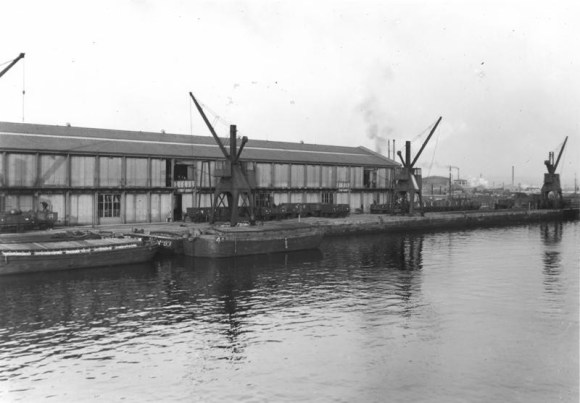
Filled mines, sinkers and other parts received by rail from factories, were stored in the bulk stores and Nos. 9 and 10 sheds. The components passed thence, as required, to No.8 shed, where they were assembled into complete units and tested, after which they were taken to the ready issue stores, 1,000 yards distant, until required by minelayers, which were berthed when loading in Grange Dock. The mines were transported from the stores to the dock side in railway trucks.
Date of completion and use of depot. Constructional work at the depot was completed in September 1918, but the new base had been in use for the reception of mines since April 1918. The number of mines and sinkers assembled up to the date of the Armistice, November 11th, 1918, was 37,000. Of these 27,000 had been sent to sea, leaving a stock in hand of 10,000 assembled units. The total number of mines of all types received in store up to December 1918 was 60,000 with 79,000 sinkers. The maximum number of mines assembled in one month was 5,537.
Contracts. The new buildings were erected under prime cost plus percentage contracts. The contract for the main part of the work, including the filling, the six large sheds and other new buildings and also the railways and roads, was executed by Sir John Jackson & Co., Ltd., Westminster. The contract for the alteration to existing buildings was undertaken by Messrs. J.J. and P. McLachlan, Stenhousemuir, Larbert. The dredging contract was placed with Messrs. Topham, Jones and Railton, Ltd., of Westminster. The work carried out under this contract was supplemented by dredging done by Admiralty dredging craft.”
 Falkirk Local History Society