
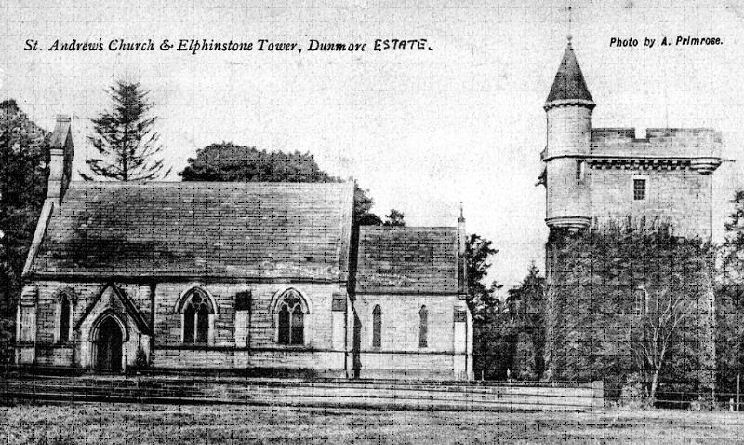
(Dunmore Estate – St. Andrews Episcopalian Church)
St Andrew’s Episcopal Chapel on the Dunmore estate was built and endowed at the sole cost of the Right Honourable the Countess of Dunmore and was essentially a private church. The remains of the west wing attached to Dunmore Tower were levelled and the site was terraced to create a raised platform for the new building. Here it had commanding and extensive views of the Forth, but was sheltered to the north and west by a cluster of trees.
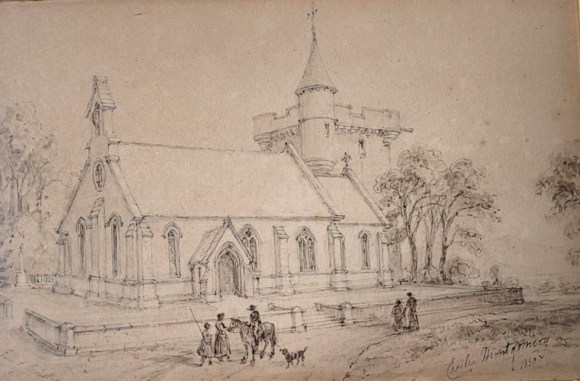
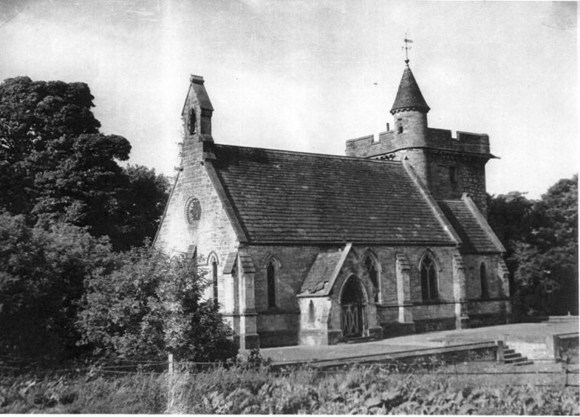
The chapel was designed by the prolific church architect Thomas Henry Wyatt in the pointed or English style of architecture with a small belfry on the west gable and a lower chancel on the east end. The church was oblong in shape with a slightly narrower chancel. A south-facing porch gave access to the nave. The east gable contained two large lancet windows, separated by a chamfered buttress. Above the buttress and central to the gable was a small rosette window. Paired buttresses on the corners were echoed by further buttresses along the north and south walls. There were three two-light windows in the north wall and two in the south, covered by moulded hoods that terminated in human figures.
A plate inside the building read: “To the Glory of God, and in memory of her husband, Alexander Edward, 6th Earl of Dunmore, this church was dedicated by Catherine, Countess of Dunmore, in the year of our Lord, 1850.” It was consecrated by the Right Rev. the Bishop Terrott, of Moray. In the feu disposition of 1850 the Countess granted the Bishop of Edinburgh and his associates the use of the part of the land previously marked “graveyard” for “the erection of a Church or Chapel” and as a burying ground. She reserved burial rights for himself, his family and descendants, as well as the option to construct family vaults. She stipulated that the church was to be called St Andrew’s Church, Dunmore, and that she was to choose the first minister. Thereafter the Earls were to make that decision from candidates in the Episcopalian Church. Half of the sittings had to be free and the church could charge for the others so that the money could be used to maintain the building.
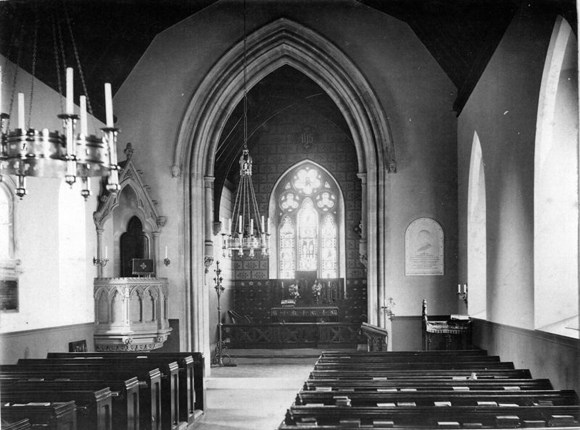
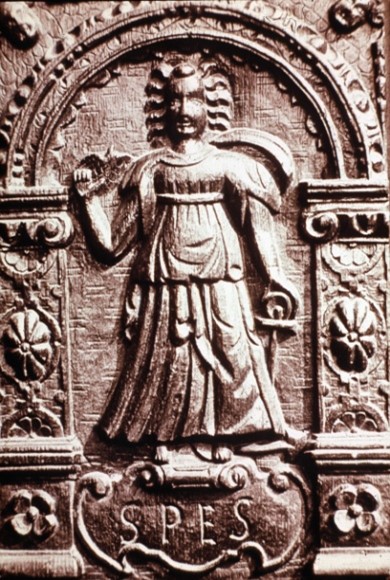
Inside the building, the roof was open, with rafters of an oak shade. The windows, for the most part, were filled with painted Scriptural emblems and along the nave were various Biblical selections of duty and promise. In the chancel a set of five carved oak panels were set in the back of a wooden seat. They measured an average of 1ft 3in by 9in; and were carved in relief with religious scenes and allegorical figures, all set within decorative architectural frames. One contained a representation of the Annunciation and another of the Circumcision, while a third depicted the figure of Hope. The remaining two had unnamed allegorical figures which were somewhat different in feeling from the other three subjects. The work was of a style which spread to England and Scotland from the Low Countries in the 16th and 17th centuries (RCAHMS 1963, 402) and they were probably acquired as antiques by the Countess. This was probably the two Bishop’s chairs made from wood from Oberammergau mentioned later.
The altar, altar screen and reading desk, were of solid oak, while the pulpit was entirely hewn from one block of stone. Behind the altar a large Gothic window was filled with stained (painted) glass. On either side of the window were the commandments of the Decalogue, painted in the old English style; and around the chancel arch was a scroll, in similar characters, lettered in bronze, with the words; “Let us come boldly to the throne of grace, that we may obtain mercy to help in the time of need.” The organ and choir occupied a place to the west end of the building, and two stained glass windows adorned other parts of the chapel (Alloa Advertiser 27 June 1863, 2).
One of the most touching of the artistic works was a memorial of marble to Elizabeth Wadsworth, wife of Charles Augustus Murray, who died at Cairo, 8th December, 1851. The Angel of Death pointed the mother heavenwards; but she, with a compliant look, yet clung to the babe she left behind. (Gillespie 1868, 142). Murray had married Elise on 12 December 1850 during a visit to Scotland while he was counsel-general in Cairo. After they married, the couple returned to Egypt together where she died shortly after giving birth to their only child. It was early in April 1852 by the time that her remains arrived in Dunmore.
The Murray family commemorated many of its important events at the church. In November 1860 Lady Susan Murray married Lord Southesk there, witnessed by a large crowd of locals. The nobility arrived in carriages. The girls attending Dunmore and Airth schools were all dressed in white and lined the bride’s path; and upon entry more of the children in the choir sung a hymn. On 26 February 1862 their son was baptised in the church. In June 1864 the second daughter of the 6th Earl, Lady Constance Murray, married William Elphinstone at Dunmore. Over the following years more marriages took place and several of the Murrays’ children were baptised in the church. One of the more famous people to take part in a church service at St Andrew’s was the Prince of Wales who attended there in September 1876 and the next day departed for Doncaster Races.
The first baptism in the church’s register was actually of Andrew Watson on 23 March 1851 and sadly he was buried in the adjacent churchyard just two months later. The last baptism was of Janet Spencer on 22 August 1922. The first marriage had been on 17 October 1851 when Emmanuel Walters married Mary Towers of Alloa; and the last was a couple from Throsk on 19 March 1949 (Mitchell 2012, 79).
The church was also used for the burial services in connection with those interred in the graveyard or in the adjacent mausoleum. The mausoleum had been installed in the basement of the sixteenth century tower in 1850 and the bodies of the earls, countesses and their family were carried the short distance by pall bearers.
During the 1850s and early 1860s the rector at Dunmore ran Episcopalian missions at Carron and in Falkirk before the latter erected a church of its own. The pastor had the nearby parsonage for a well-appointed residence, which he shared with the estate factor. The Countess established a fund to pay for his post and the upkeep of the church. The first rector was Charles Hinxman, whose wife, Emmeline, published a book of poetry in 1856.
During the 1850s and early 1860s a mission was run at Carron and in Falkirk before the latter erected a church of its own.
Claud Hamilton and his wife, Henrietta, bought the part of Dunmore estate containing the church in 1892 and keenly promoted its interests. One of their daughters married Rev W A Carroll, vicar of Bickley in Kent, at St Andrew’s Church, and he occasionally performed his duties at Dunmore. When Claud died in 1903 Mrs Hamilton decided to place a stained glass window in the chancel in his memory, replacing the original painted one. The three-light window was dedicated by Rev. Walter Scott of Dunmore that July. The artists were Bartison & Grylle, Newman Street, London. It represented the Adoration of Christ in glory. The principal figure in the central light was that of Christ arrayed in robes as the High Priest, reigning from the Cross, no longer the cross of suffering. Beneath were figures of the archangels, Michael, Raphael, and Gabriel, with their well-known emblems – “To thee all angels cry aloud; the Heavens and all the powers therein.” On the left or north light the glorious company of the Apostles was depicted above a panel containing the noble army of martyrs, and in the corresponding space in the south light the goodly fellowship of the Prophets and a representation of the Holy Church throughout all of the world, united in their praise of Christ. In the trefoils above these lights were angels swinging censors, and in the cinquefoil at the head of the window angels adoring the Lamb of God, while the four emblems of the Evangelists were represented at the head of the two side lights and at the foot of the Cross itself.
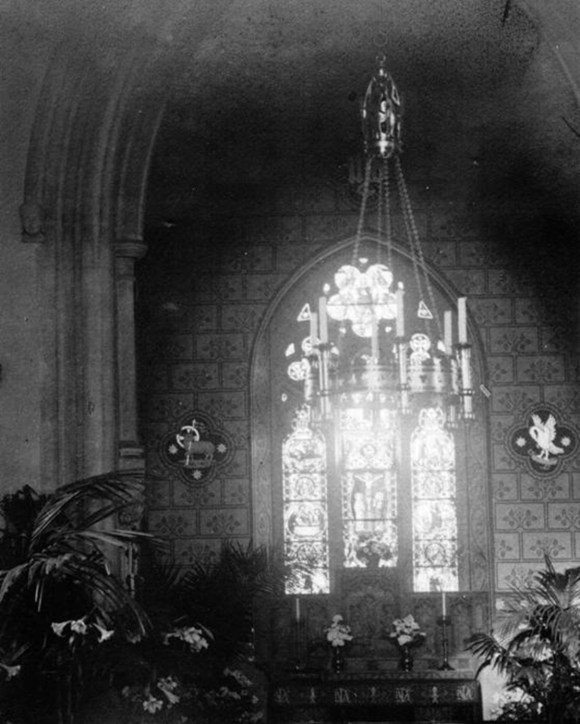
The legends below the different groups of figures read thus down the north light, and then down that on the south side, finishing with a scroll beneath Our Lord in the centre:-
“Thou sittest at the right hand of God, in the glory of the Father;” “We believe that Thou shalt come to be our Judge;” “We therefore pray Thee, help Thy servants, whom Thou hast redeemed with Thy precious blood;” and “make them to be numbered with Thy Saints, in glory everlasting.”
Mrs Hamilton followed up this gift in November with that of three beautiful brass lamps which were suspended from the roof of the sanctuary. They were modelled in Florence, after a very old ecclesiastical pattern, by Signor Emilio Ercolani in that city. He had already placed sets of lamps of a similar pattern in two well-known churches in the west and south of London. The following month two further gifts for the festival of the Incarnation were presented – one a set of brass vases for the altar flowers and the other of a litany desk in oak.
On 1 June 1907 the estate factor for Mrs Hamilton wrote to the Earl of Dunmore pointing out that the fund set up by Lady Dunmore to support the church was almost exhausted and asking who was responsible for its upkeep. In November 1908 the following contributions were made:
| Countess of Southesk | £50 |
| Lady Elphinstone | £50 |
| Lady Alexandria Cunliffe | £50 |
| Lady Grace Barry | £15 |
| Lady Dunmore | £10 |
| The Dowager Countess of Dunmore | £30 |
| Charles Murray, The Grange, Old Windsor | £100 |
“Our thanks are due to Major Griffiths of Polmont Park to giving a handsome seven-branched candlestick to St Andrew’s where it is appreciated for its usefulness no less than for its beauty by those who attend Evensong in the picturesque little church. Mr Main has set up in the pews, six well-designed lampstands of wrought iron, and he is making more seven-branched candlesticks for the church” (Mitchell 2012, 72).
In all, this brought the number of candles used on such occasions to 85.
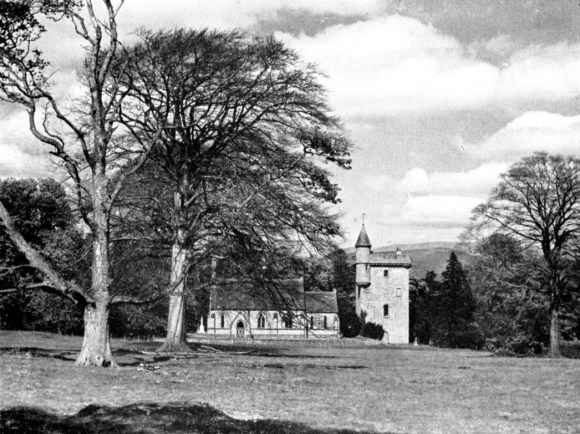
From 1938 until 1947 St Andrew’s was attached to Christ Church and only occasional services were held there. These comprised a Eucharist and Evensong at 3 o’clock in the afternoon on every other Sunday. In 1947 St Andrew’s was attached to St Mary’s in Grangemouth, but it finally closed for worship in 1948. The building fell into disrepair and inevitably dry rot developed. The Trustees decided to demolish it and in 1962 this was approved. It was deferred to 1976 with parts taken to the Episcopal Church in Falkirk. The wooden seat with the carvings went to St Mary’s Cathedral in Edinburgh. Several silver communion items which had been gifted to St Andrew’s by Sidney Herbert in 1850 in memory of his brother-in-law, the 6th Earl of Dunmore, were taken to the Grangemouth church, as were the font, organ and the two Bishop’s chairs.
One of the painted glass windows, depicting Christ as the Good Shepherd, was taken out by O’May and then exported via Grangemouth Docks to Australia, where it was incorporated into the north porch of the new St John’s Church in Torrens near Canterbury.
The grounds ceased to be tended and became overgrown. In 1980 the churchyard and the adjacent tower were sold to Antoni Zawadski of Edinburgh for £2,500.
Look downward o’er that tangled bank,
Thou shalt behold a mournful scene,
The triumph of ruin rank
Where hands of art and care have been:
Ruin by tender charm ungraced,
A shapeless, stagnant over-growth,
Where nature on her own wild waste
Lies in dull luxury of sloth.
(Poem by E Hinxman 1856)
MANSE
A large parsonage was built to the east of the walled garden that houses the Pineapple, facing the main road north from Airth, in the 1850s.
FITTINGS
The elaborately carved panels are fully described in the Stirling Inventory.
WINDOW
See separate entry for stained glass.
CHURCHYARD
The church was surrounded by a family graveyard that also contains some of the family’s dependants. The Elphinstone Tower to the north-east was converted into a mausoleum.
RECTORS OF ST. ANDREWS
| 1858 | Hinxman,C. | 1861 |
| 1861 | Hill Smith, T. | 1862 |
| Mar 1862 | Cave-Brown, W.H. | 1875 |
| Nov 1866 | Sutcliffe, J. G. (Falkirk) | Aug 1900 |
| Jan 1901 | Griffiths, Alfred | 1901 |
| Aug 1901 | Scott, Walter | |
| 1905? | Grubb, Provost | 1916 |
| 1917 | Jones, Hugh | 1938 |
| 1938 | Ramsay, Ivor E. St.Clair (with Falkirk) |
SITES AND MONUMENTS RECORDS
| St Andrew’s Church, Dunmore | SMR 740 | NS 8900 8890 |
| St Andrew’s Churchyard, Dunmore | SMR 1444 | NS 8989 8890 |
| Dunmore Tower | SMR 188 | NS 8902 8892 |
| Dunmore Park House | SMR 200 | NS 8848 8920 |
BIBLIOGRAPHY
| A2131 (Falkirk Archives) | Register of deaths, birth, marriages, etc. | |
| Gillespie, R. | 1868 | Round about Falkirk. |
| Mitchell, A.E. | 2012? | Dunmore |
| RCAHMS | 1963 | Stirlingshire: An inventory of the ancient monuments. |
 Falkirk Local History Society