
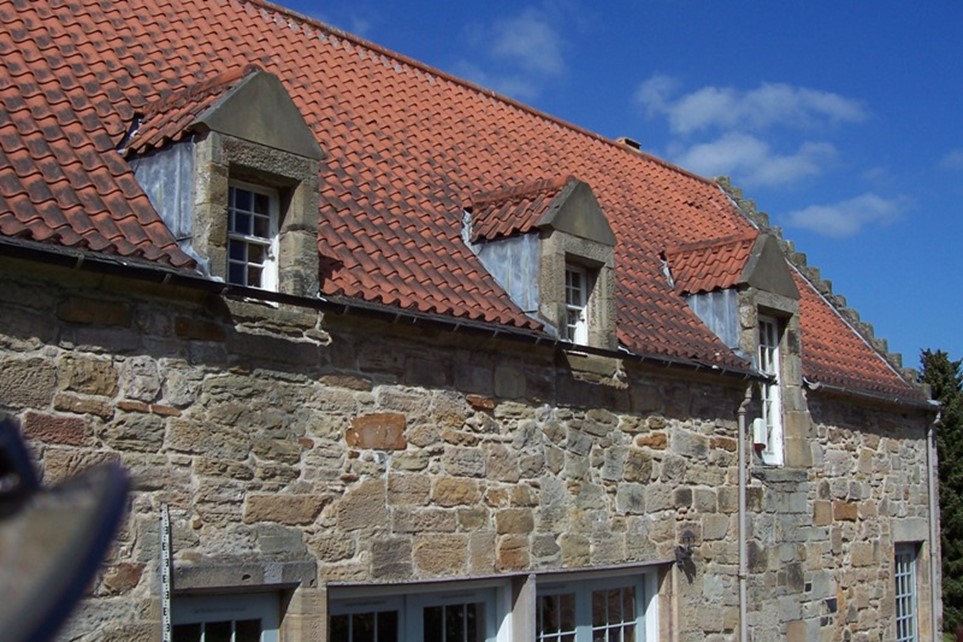
There is a long-held tradition that the predominance of pantiles in the older coastal villages of the Forth is due to their importation from Holland with which this area once traded extensively. The story goes that they were brought here as ballast in ships that had made the outwards journey with salt or coal. They thus gave the east coast of Scotland a common cultural inheritance with the Low Countries. This version of the story has always seemed a little incongruous as it involved transporting the valuable cargo of coal so that it to be consumed elsewhere to fire clay, of which there is a plentiful supply here, and then bringing back a relatively low-value and bulky commodity. Usually, there is a kernel of truth is such traditions, and such seems to be the case here.
John Shaw has pointed out that in the last three decades of the 17th century several ships based at South Queensferry brought in cargoes of pantiles from Holland, ranging in number from 650 up to 7,000 tiles. At that time that haven came under the precinct of Blackness (Shaw 1990) and this was just one of many ports. The listings in the Blackness customs import books clearly show that these loads were not considered to be ballast – they were a valuable cargo.
It appears that tile was a relatively new roofing material in the 17th century, though a 1621 Act of the Scottish Parliament, repeated in 1681, required houses in Edinburgh, Glasgow, Aberdeen, Dundee and Stirling to the theicked with “lead, sclait, scailzie or tyle.” The choice of these materials was to do with the flammable nature of the wooden buildings in these urban centres which were huddled close together. Tiles had the advantage over thatch and turf roofs of being more fireproof and durable, and over stone roofs in weighing less. The design of the pantiles seems to have originated in late-medieval Holland. As pantiles only required a single overlap their roofs weighed about two thirds of an equivalent flat tile roof. The pantiles were, however, expensive, and so tended to be used in major buildings – private and public. They were particularly well adapted for use in industrial buildings where the working practices produced heat and humidity, such as paper mills, soapworks, smithies, and particularly saltpans. There is, however, no validity in the claim that the word “pantile” derives from their use in the latter industry in the way that “panwood” was used for small coals. “Dakpan,” is Dutch for “roof tile.” The earliest reference to the term pantile appears in 1669 (A Dictionary of the Older Scottish Tongue). Vessels from the Forth took coal, salt and herring to Denmark, Flanders, and the Baltic ports and returned with cargoes of timber, hides, wines, ceramics, bricks, and “holle dakpan,” or “roof tiles with hollows,” as the concave pantiles were described. These Flemish tiles, and bricks, did not attract any excise duty, making them a popular commodity to import, but discouraging home manufacture.
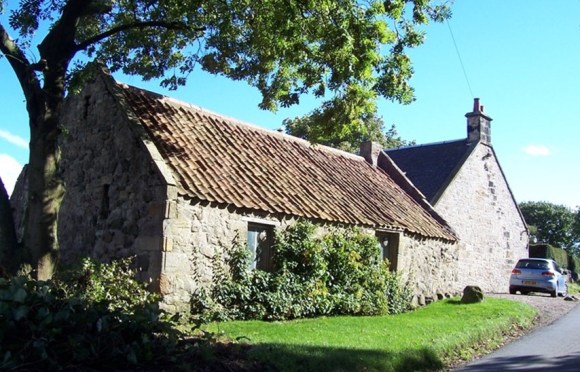
It was shortly after this that an indigenous industry developed. One of the earliest references comes from 1709 when Moses Lawes, brickmaker at Blackness, was granted permission to dig clay for making bricks and tiles at the Braehead there (Binns Papers, 499). These must have been pantiles. However, Clark of Eldon claimed that in 1714 William Adam “brought… the making of Dutch Pantiles in Scotland” to the Abbotshall works in Kirkcaldy which he ran with William Robertson. Clark just happened to be Adam’s son-in-law. Tiles from the Abbotshall works were used to roof outbuildings at the Aberdour Manse in 1722.
Pantiles are also found in Lincolnshire and East Anglia in England and a parliamentary paper of 1674 described them there as
“a commodity only made in Holland.”
This was not quite true as English patents had been granted in the early 17th century, though production must have been on a rather small scale. Even as late as 1695 when a very large factory was built at Newmills near Haddington the pantiles, some 24,000 of them, were acquired from a merchant trading with Holland (Shaw 1990, 27).
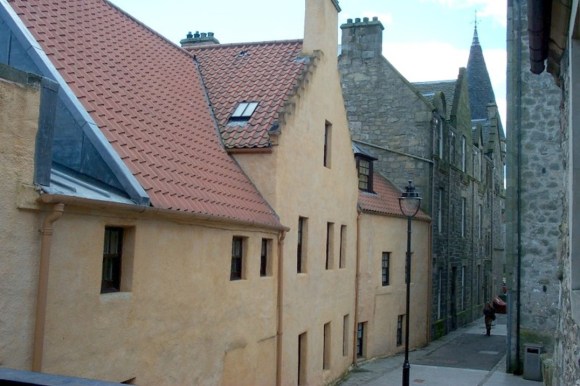
Another early tile work had already been established at Prestonpans by 1716 when William Pearson supplied the saltworks at Cockenzie with tiles – again a link with the salt industry. And the following advertisement appeared in 1729:
“At the Tyle-work in Prestonpans, there is to be sold the best PANTYLES made in this Kingdom for Fifty Shillings sterl. The Thousand, on 6 Months Security give. And for Encouragement to the Buyer, for Forty-five Shillings the Thousand, ready Money; or, on Demand, several other Sorts of Tyles and bricks, of all Sizes, at reasonable Prices.”
(Caledonian Mercury 21 January 1729, 4).
That same year we also have:
“That at the Pan-tvle and Brick Manufactory in Leith at the Back of the Brick-house opposite to the Church. Made and Sold PAN-TYLES, PAVING-BRICKS, other Bricks of all Sizes, as good, and at as reasonable Rates as any in the Kingdom, by JOHN KYELL, tyle and Brick-maker there.”
(Caledonian Mercury 28 April 1729, 4).
Evidently this business also prospered for 14 years later it was boasting that its pantiles were “as good as any ever came from Holland:”
“That there are PAN-TYLES, STOCK-BRICKS and small Bricks for Chimneys, made at Leith, as good as any ever came from Holland; also Paving-Tyles for laying of Floors after the Dutch Form, Flower-pots for Gardens, and Vases for ornamenting Gates and Parapet-walls, &c. The Pan-tyles at 40s per thousand, the Stock-bricks at 20s per thousand, the small Bricks for Chimneys at 15s per thousand, the Paving types of 9 Inches square at 16s and 8d per hundred; the Price of Flower-pots and Vases are in proportion tot heir Size and Ornaments, Enquire at the Tyle work at the back of the Trinity-Hospital, opposite to the Kirk of South Leith, or at John Gowan at the Marble work, near the Timber-bush.”
(Caledonian Mercury 15 March 1743, 4).

The prices indicate the high value placed on these products and demand was growing at an amazing rate. A rival merchant in Leith in 1739 noted “the great Scarcity of TYLES” and advised the public to buy his Esdale slates (Caledonian Mercury 22 January 1739, 4). Despite this, the trade in tiles from Holland quickly became uneconomic and unnecessary.
One of the largest Scottish producers of pantiles was in Aberdeen where in 1749 John Auldjo had
“for some Years continued a Manufacture of Pan-tile and Brick”
(Aberdeen Press & Journal 3 October 1749, 3);
it is interesting that the pantile manufacture was, at that time, more important than the brick. We are fortunate that the local newspaper for Aberdeen, the Aberdeen Press and Journal, reported some of the shipping movements from the port there. From these we glean:
| DATE | CARGO | TO | SHIP | MASTER |
|---|---|---|---|---|
| 25 Sep 1750 | pantiles | Murray Firth | Mary of Aberdeen | Gilchrist |
| 4 Dec 1750 | pantiles | Leith | Isobel of Kincardine | Crokat |
| 18 Nov 1751 | pantiles | Leith | Mary of Airth | Anderson |
| 26 May 1752 | pantiles | Mary of Stirling | Morrison | |
| 4 Aug 1752 | pantiles | Leith | Christian of St Margaret’s Hope | Cromarty |
| 25 Aug 1752 | pantiles | Bo’ness | George | Muir |
| 25 Aug 1752 | pantiles | Jean | Watt | |
| 31 Oct 1752 | pantiles | Bo’ness | William | Bathgate |
| 7 Nov 1752 | pantiles | Bo’ness | George | Mair |
| 24 April 1753 | pantiles | Portsoy | Ann | Pert |
| 25 Sep 1753 | bricks & pantiles | Montrose | Betty | Fotheringham |
| 6 Nov 1753 | pantiles | Portsoy | Margaret | Nicol |
| 8 Jan 1754 | pantiles | Leith | Union of Leith | Primrose |
| 15 Jan 1754 | oats & pantiles | Dundee (from Stockton) | Flora of Dundee | Crichton |
| 19 March 1754 | bricks & pantiles | Perth | Margaret | Berry |
| 9 April 1754 | pantiles | Dundee | Catherine of Dundee | Clark |
| 16 April 1754 | fruit & pantiles | Expedition of Kinghorn | Leighton | |
| 6 Aug 1754 | pantiles | Inverness | Expedition of Kinghorn | Kirkcaldy |
| 26 Nov 1754 | pantiles | Montrose | Margaret | Monroe |
| 10 Dec 1754 | pantiles | Leith | Union of Leith | Primrose |
| 10 June 1755 | pantiles | Firth of Forth | John & Jean of Don | Herd |
| 23 June 1755 | pantiles | Peterhead | Euphame & Peggy of Leven | Kay |
| 28 Oct 1755 | dressed flax, bricks & pantiles | Montrose | Margaret of Montrose | Mills |
| 11 Nov 1755 | wood & pantiles | Leith | Union of Leith | Primrose |
The shipments of pantiles to Bo’ness in 1752 are particularly interesting from a local standpoint because that was the year that Charles Addison erected his large granary in East Pier Street.
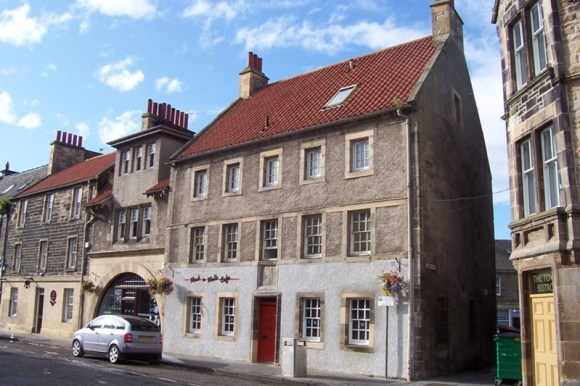
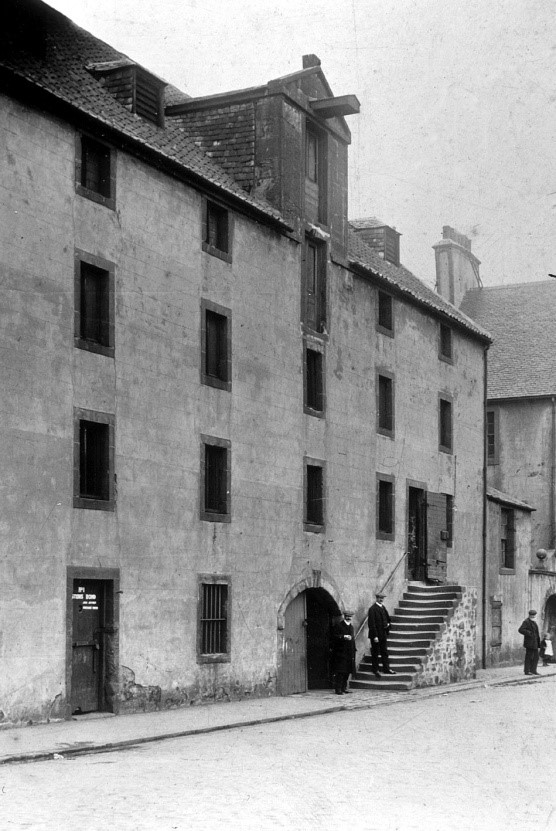
As the industry grew so too did the tax and in 1784 a new tax forced manufacturers to increase the price of pantiles. By then there were two works producing them in Aberdeen – at Clayhills and Old Aberdeen. For the Falkirk area there were at least three manufactories. That at Blackness still made pantiles, but in the first quarter of the following century its greatest output was in field drains. The largest was at Throsk, to the north of Airth, which in 1788 was run by William Deas. His letter of that year to William Forbes of Callendar makes interesting reading:
“Throsk 29th July 1788
Sir,
I’m told you want a quantity Pantiles at present, I have a Manufactory of that Article at Throsk allowed to be the best in Scotland, and will deliver you what you want at Bainsfoord or any place on the Canall most convenient for you, sed tiles at 4/6 Pr Ct and glazed tiles all 7/ Pr Thousand wt 2½ Pr Ct desioR for Pr sompl payR, the Tiles I will uphold to stand the Weather for seven years, but your Slater or, any other persons who know the Tiles, will give you a Character of them, if you want the tiles please direct for me near Stirling.
I very respectfully Am – Sir
Your mo hble Sert
Will Deas”
(Forbes Papers 320/34).
The third of the large tile works was just to the west of Grangemouth and was probably established so that the buildings in the new town there could be constructed in the most substantial manner in accordance with the feus granted by the Earl of Zetland. Kerse Brickworks was located on the Forth and Clyde Canal so that its products could be transported throughout central Scotland. Bricks and tiles were advertised for sale at the works in 1776:
“There is just now lying at the second land lock, about a mile from the entry to the Canal, for sale, a large quantity of bricks and tyle: the bricks to be sold at 10s per thousand, and the tyle at 1 L. 15s per thousand, ready money. They can be shipped on board of vessels at 6d per thousand. NB Both brick and tyle acknowledged by the best judges to be of as good quality as any in Scotland.”
(Caledonian Mercury 18 May 1776, 4).
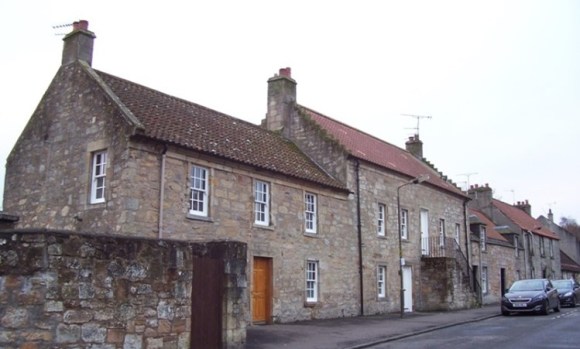
From this time on most places in eastern Scotland rapidly developed their own works to produce large quantities of this simple tile. And as the number of tile producing works increased the use of pantiles grew to become more widespread until they became the most common roof covering in the 19th century used on dwellings and farm buildings alike. Indeed, until about 1990 it was common to see stacks of pantiles piled up beside disused agricultural sheds ready for re-use elsewhere.
Bibliography
| Gifford, J. | 1989 | William Adam 1689-1748. |
| Shaw, J. | 1990 | Dutch – and Scotch – Pantiles. Some evidence form the seventeenth and early 19th centuries,’ Vernacular Building 14 (1990), 26-29. |
 Falkirk Local History Society