
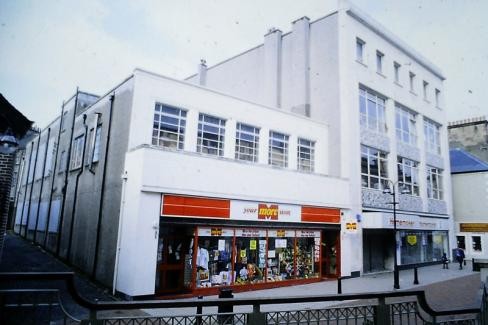
of the Falkirk District
Introduction
Falkirk seems to have been early on the scene for the experimentation and usage of coal gas. A Falkirk tradesman, William Leishman is said to have investigated the production of coal gas and upon the news of Nelson’s victory at Trafalgar reaching Falkirk in October 1805, he made a brilliant display with “the new light” (Love 1908). He left Falkirk for Liverpool and then Archibald Cochrane, ironmonger, produced his own gas. Some of the weavers and shoemakers in Laurieston even got in on the act and, according to one reminiscence, they tried, sometime in the 1820s, to make gas using a home-made retort with a herring barrel for the gasometer (Falkirk Herald 27 December 1902, 6). The term “gasometer” had been coined by William Murdoch, who carried out early experiments on the production of gas for lighting mills at the Soho Works of Boulton and Watt. As it was not strictly speaking a form of meter, the trade preferred the term “gas-holder.” It was said that Murdoch first conducted experiments on marsh gas on the mudflats at Grangemouth (Porteous 1994, 108) but that is not likely.
The Falkirk Monthly Magazine of 1827 contains a long section on the making of gas and its utility. Typical of its time, it uses flowery language to extol its virtues at length. The preamble begins:
“As Conductors of the Falkirk Magazine, we congratulate the public that it is now in contemplation to furnish them with Gas to illuminate their shops and dwellings, and, we trust, also their streets and churches. We are glad that, in order to this, a subscription has been opened, and, short as is the time since its commencement, the amount requisite is nearly, if not fully subscribed. Such an establishment, there is little doubt, will be advantageous both to the proprietors, and the community at large; the former receiving a liberal per centage for their money; the latter experiencing increased comfort, in the enjoyment of superior light, at a less expence than that to which they are at present subjected. We acknowledge, on our parts, a feeling of brotherhood towards these spirited individuals, with whom this useful and economical project originated; we regard them as fellow labourers, striving with us for the enlightenment of our birth-place. In our humble sphere, we provide light to the mind, while they propose furnishing light to the eye; and entertaining this feeling, we would, as far as we are able, help them onward in their praise-worthy endeavours.”
Gas was introduced to Falkirk by the Falkirk Gas Works Company, a joint stock company, formed by local businessmen and tradesmen for the purpose of lighting the High Street, Robert’s Wynd and Kirk Wynd. The works were constructed at a cost of £1,646 and ‘lighted’ on 18 January 1830. As was usual, many consumers paid for gas on a time contract basis, but where meters were in use the charge was a whopping 12s 9d for a thousand cubic feet.
Gas was quickly introduced into the churches at Falkirk for lighting. Indeed, these churches led the way in using gas for heating as well in an experiment which was widely publicised. It even appeared in the Bolton Free Press of 23 January 1841:
“Heating churches. The stove has been the means generally used to raise the temperature in churches during the winter season. The expense and danger, however, have prevented its general use, so that still the great majority of congregations meet for Divine service with all the disadvantages of a cold and humid atmosphere. At a late meeting of the managers of the First United Associate Congregation, Falkirk, it was agreed to try an experiment to heat the church by means of gas. Twelve argand burners were attached to the brackets with iron funnels seven inches long, and lighted two hours before the forenoon service commenced, during which time the thermometer (which stood at 30 degrees at the commencement) rose to 45 degrees in the lower part of the church, and in the gallery it rose to 50, i.e. 20 degrees, while the congregation were as comfortable as during the spring months. The gas consumed during the hours of burning was only 140 cubic feet, at 1s 5d worth, at the rate of 10s 6d per 1000 feet, the price charged by the Falkirk Gas Company. It is but a few years since St Stephen’s Church, Glasgow, was burnt, the wood having been ignited by an over-heated stove; and only last week three churches were burnt at Dundee in consequence of a similar cause… The plan having succeeded, the sub-committee have recommended the use of argands three inches in diameter, to burn a two-inch flame, four of which are considered sufficient to heat an ordinary sized church – so that where gas is introduced, it is an easy, cheap, and safe mode of heating a church during the winter season.”
Bo’ness too went down the commercial avenue and in 1844 the Borrowstounness Coal Gas Light Company was set up and funded by the sale of shares. However, many of its chairmen were provosts of the burgh and not a few of the directors were councillors. It was therefore run not only for the benefit of shareholders but also of its customers. A 5% return on the capital was considered reasonable and this was set as the annual dividend. For decades, gas was sold so as to yield a profit of five per cent on their capital. If the profit was more, they reduced the price of the gas and if less, they increased it so as always to yield the fixed dividend. All such companies which were funded by shareholders struggled in their early years to return any dividends. Elsewhere, as the interest on their loans decreased and their customer base increased, the dividends gradually rose to the maximum allowed which was 10%.
The capital investment required to establish a gasworks was large enough to put potential rivals off setting up works in areas already supplied with gas, meaning that many operated as virtual monopolies. Without competition they were able to fix high prices. These became so high in Denny that in 1861 a socialist, John Robertson, set up a rival gas company, appropriately named the Denny Gas Consumers’ Company (Ltd). Robertson had been a radical in 1820 and had been arrested by dragoons for his support of the uprising of that year. There then followed what was called the “Denny Gas Wars.” With the demise of the old company in 1875, and the departure of Robertson, the new company took on the mantle of monopoly provider and prices and dividends increased. A letter to the Falkirk Herald of 14 April 1883 pointed this out:
“Weel, the Company wis formed tae provide gas tae the consumers at a moderate price – no like the auld Gas Company ava’, who wir jist a lot of greedy dawgs! So it was said, ye ken. Weel, the twa Companies focht each ither fur aboot seventeen years – gie like the twa Kilkenny cats we read about – and then the auld Company gied up the ghost decently. Weel, this wis gran’ wark fur the new Company, which wisna’ lang before it commenced to pay big dividends, and the ther year actually gien back ten shillin’s o’ every pound to the ordinary shareholders. Noo, Mr Editor, div ye no think that they should hae gien us cheaper gas this year whin they were able to gie ten per cent dividend? Bit altho’ this could hae been done, it hisna’ been done, and we hae tae pay awa’ at the auld price… instead of ca’in it the Denny Gas Consumers’ Company they micht ca’ed the Denny Gas Shareholders’ Company, an’ ta be a wee bit nearer the mark…”
This drew a sharp response from one of the shareholders:
“Your numerous correspondents about the price of our gas may keep their minds easy, as so long as we have the power we will make no reduction. It would be a different matter if there were two or three companies here to compete against one another; but it would be foolishness on our part to reduce the price when we know the consumers cannot get it elsewhere. We do not force them to buy our gas; if they do not wish it they need not burn it, and they are at perfect liberty to use either candle or paraffin in its place…” (Falkirk Herald 12 May 1883, 3).
Times had changed, indeed, they had gone full circle!
A similar circumstance occurred at Falkirk where the Falkirk Joint Stock Gas Company was established in 1845 to compete with the Falkirk Gas Light Company of 1829.
| COMPANY | DATE ESTABLISHED | DATE CLOSED | NOTES |
|---|---|---|---|
| Borrowstounness Coal Gas Light Co | 1842-44 | 1949 | Nationalised |
| Smith & Wellstood (Bonnybridge) | 1870s | 1924 | Bought by Denny and Dunipace Town Council |
| William Cuthill (Denny) | 1838 | 1852 | Bought by Denny Joint-Stock Gas Co |
| Denny Joint-Stock Gas Company | 1852 | 1875 | Liquidation |
| Denny Gas Consumers’ Company (Ltd) | 1861 | 1887 | Bought by Denny Gas Commissioners |
| Denny Gas Commissioners | 1887 | 1949 | Nationalised |
| Falkirk Gas Light Company | 1829 | 1887 | Amalgamated with Falkirk Joint Stock Gas Company |
| Falkirk Joint Stock Gas Company | 1845 | 1895 | Compulsory purchase by Falkirk Town Council |
| Falkirk Town Council Gas Commissioners | 1895 | 1949 | Nationalisation |
| Grangemouth Gas Company | 1834-36 | 1906 | Bought by Grangemouth Town Council |
| Grangemouth Town Council Gas Commissioners | 1906 | 1949 | Nationalisation |
| Polmont District Gas Co | 1906 | 1949 | Nationalisation |
Even though gas, like water, became seen as a public utility, few were in the hands of local councils. In 1910 there were some 1,014 gas works in England owned by private companies, and only 223 by local authorities. Scotland had 203 against 55, and Ireland 87 against 24.
Denny was one of the first burghs to adopt the Burgh’s Gas Supply (Scotland) Act of 1876 and in February 1886 sent official notification to the Denny Gas Consumers’ Company (Ltd) of their intention to purchase its gas works. This action had been prompted by Thomas Shanks, the chairman of the Denny Gas Consumer’s Company (Ltd), who was also the provost of Denny. The year before he had recommended a dividend of 7.5% which was rejected by the majority of the shareholders and the usual 10% was taken. The directors of the Company subsequently agreed to treat with the Police Commissioners for the burgh of Denny and Dunipace and an amicable agreement was reached on the price to be paid.
Falkirk Town Council seems to have been loath to follow in Denny’s footsteps but was forced into action when the Falkirk Joint Stock Gas Company applied in 1893 for a Parliamentary Act to secure its monopoly in providing lighting in the burgh and to acquire powers to dig up roads. Using the Gas Supply (Scotland) Act of 1876 the Council applied for its own Act and was thereby compelled to take part in a binding arbitration process to fix the price of the gasworks. As a consequence Falkirk Council had to pay costs for the parliamentary process, the arbitration, and conveyancing, which Denny had managed to avoid. By comparison, the enlightened policy of the Borrowstounness Coal Gas Light Co meant that there was insufficient incentive for the Council there to take it over.
The outlying settlements were gradually supplied with gas from the works as the mains of the different companies were extended to gain additional consumers. At its establishment on 1845 the Falkirk Joint-Stock Gas Co had a lead pipe under the Forth and Clyde Canal so that it could feed that district. Camelon was placed on the system around 1857 and in 1862 Carron, Stenhousemuir and Larbert were added, but customers there had to pay a higher price for their gas. The Polmont District Gas Company had been supplying Polmont, Redding, Rumford and Laurieston, and in 1914 extended its gas mains to Shieldhill, California and Blackbraes. The Bo’ness Coal Gas Light Co whose mains covered the town, Corbiehall, Kinneil and Grangepans, extended the short distance up the Carriden Brae to Muirhouses in 1914. In 1912 Denny Gas Commissioners extended their supply to the villages of Dennyloanhead, Longcroft, Haggs, Hollandbush and Banknock. Then, in 1924 they took over the supply for Bonnybridge and in 1931 they extended that to the new houses at Greenhill, and then to Seabegs in 1942.
The supply and type of coal was crucial to the operation of gas works. The colliery owners marketed the coal for its gas-producing qualities and Bo’ness Gas Coal was highly sought after. In 1890 the steamer Abbotsford delivered Bridgeness Gas Coal to France for the gas works in Paris. From 1910 onwards miners’ strikes became more frequent and the depression of the 1920s led to a shortage of supplies. The response of the gas producers was to lay in stocks when they were available and covered stores were built.
The by-products from the destructive carbonisation of coal to make gas were coke, tar and ammonical liquor. The coke was always a commercial product and could be readily sold. Latterly it was marketed to homes as a smokeless fuel. Tar was used to prolong the use of ropes and coating the hulls of boats. Gradually the value of the tar and ammonical liquor increased as chemical research and methodology improved, resulting in their distillation into various products such as toluene. Accordingly, the tar and ammonical liquor were put up for tender each year. The sale of all of these “residuals” could amount to 50-70% of the cost of the coal. In 1845 James Ross left the shipbuilding trade at Lock 16 and entered into a partnership as a chemical manufacturer at the east end of Camelon. Recognising developments in the industry he wanted to take up tar distillation – he had used tar in the boatyard – but his partners were reluctant to invest. He therefore took over the company and moved the works to Limewharf on the south bank of the Forth and Clyde Canal to the south-west of the village. Crude tar arrived by barge from gas works along the east coast from Lerwick, Leith and Newcastle, as well as Falkirk and Grangemouth. As the years passed the number of by-products increased and so did the size and complexity of the works – and the profits.
Toluene, benzol and other hydrocarbons distilled from the tar were essential to the production of high explosives and in 1915 the gas works throughout Britain came under the restrictions set by the government using the Defence of the Realm Act. There was a shortage of coal but gas works were prioritised and the population was actually encouraged to switch from cooking on coal fires to using gas cookers. The high rate of gas leaks was no longer acceptable and much work was executed to reduce them. The Government requested that gas manufacturers scrub the gas before sending it to consumers in order to extract certain further constituents therefrom. This reduced the illuminating power and to a lesser degree the calorific value and so enrichers such as oil were used. This led to minor interruptions in supply while the work was carried out. Land adjacent to the gas works at Bo’ness was set aside for allotments during the war and lime for these could be obtained from the works.
More and more gas was being used in industry, a process accelerated by the First World War. Four gas furnaces were installed in Bo’ness at premises undertaking war work, including the horse shoe factory. Ballantine’s Foundry there also introduced a core drying kiln at this time, and a japanning oven at a later date.
By the 1920s the Americans had developed long distance pipelines for the transmission of gas and in 1932 the Linlithgow Gazette correctly predicted that “many gas works could cease to produce gas and concentrate on its distribution” (30 September 1932, 3). Some Scottish companies amalgamated in the 1930s and the beginnings were made to a gas grid. This was brought about by the purchase of neighbouring works or by the sharing of bulk supplies. In 1935 the directors of the Bo’ness Gas Company turned down a tempting offer to buy it. A national grid only came about as a result of the nationalisation of the industry in 1948-49. Settling the valuations of the various gas works for the Gas Council took quite some time. Many, like Falkirk, opposed the move, but in 1949 all the property of the Falkirk Gas Department was vested in the Scottish Gas Board.
Bibliography
| Love, J. | 1908 | Local Antiquarian Notes and Queries. Volume 1. |
| Love, J. | 1910 | Local Antiquarian Notes and Queries. Volume 2. |
| Porteous, R. | 1994 | Grangemouth’s Modern History, 2nd ed. |
| Waugh, J. | 1981 | The Vale of Bonny. |
 Falkirk Local History Society