
Smith & Wellstood
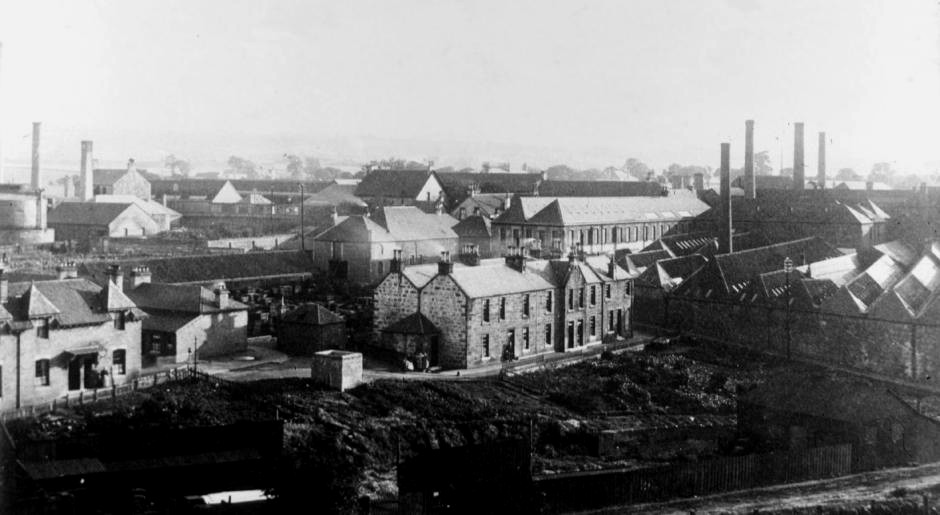
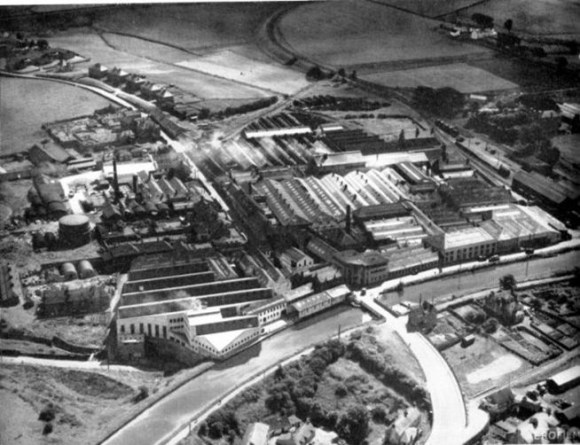
Gas was first manufactured in Bonnybridge by Smith & Wellstood at its Columbian Stove Works. The gas producing plant was located a little to the south east of the foundry and was solely for the use of the firm and therefore had a limited capacity. The date of its construction is uncertain but it appears to have been the late 1870s. Before long a few nearby homes were connected to the works to provide them with lighting. As the years went by more and more people in Bonnybridge requested to be put onto the system but the supply was restricted and expensive. In 1886 the Temperance Hall in Bonnybridge was fitted with gas lighting.
In 1887 two residents from Bonnybridge approached the Denny Gas Works to ascertain if its managers would be willing to supply gas to the village. The gas mains for Denny extended about half way to Bonnybridge and they received a favourable reply from some of the Burgh’s Commissioners, but no action was taken. Meanwhile, public attention had been directed to the desirability of having the streets of the village lit during the dark nights of winter. The south side of the canal pend to the foundries was already partly lighted by two lamps, the expenses of which were defrayed by the firms of Smith & Wellstood and George Ure & Co. A Pend Committee arranged a concert to raise funds for the erection of an additional lamp between the pend and the Temperance Hall.
It soon became evident to the management of Smith & Wellstood that it might be economic for them to bring the existing plant at their works up to date and to increase its output in order to supply a public need. Accordingly, in 1890, the gas work was rebuilt and domestic sales of gas were promoted. Unfortunately, a leakage occurred in one of the new purifiers and when a workman from Glasgow was conducting repair work the accumulation of gas suddenly ignited and he was badly scorched about the head and face. He was taken to the house of James Ure, the manager, where he was treated by Ure and his son, an ambulance student, until Dr Baird arrived. He was able to proceed home two days later (Falkirk Herald 14 February 1891, 6). The new works prompted further improvements in street lighting:
“Bonnybridge is gradually being equipped with modern improvements. The lighting of the pend and the streets has been attempted by voluntary subscription, and so successful has been the effort that additional lamps are in course of erection. The sites of those at present being erected are admirably chosen – namely, Barleyhill Entry and the Church; the expense of the lighting of the latter to be undertaken by the church managers” (Falkirk Herald 15 August 1891, 6).
By October of that year it was supplying gas to the Caledonian Railway Company’s Canal Station and this made quite an impression:
“The passenger station, with ladies’ and general waiting rooms are lit up by large jets, as also the goods shed and loading bank. In addition, two lamps are placed on the canal bank, which must be of great public benefit, and greatly facilitate the work of the station” (Falkirk Herald 24 October 1891, 7).
The gas works was now a commercial concern in its own right and this is shown by the appointment of Robert Fleming of the Coatbridge Gas Works as its manager in 1910.
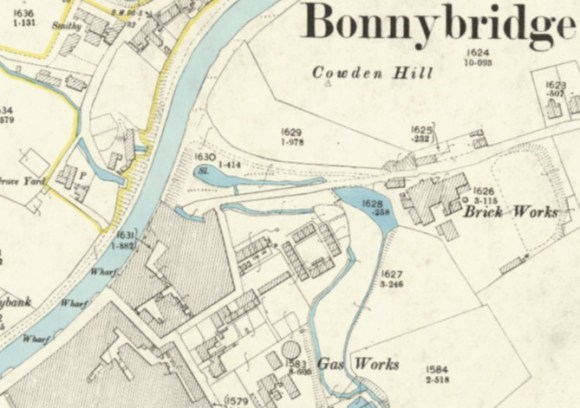
1923 brought an opportunity for the Denny and Dunipace Town Council to acquire the gasworks of Smith & Wellstood at Bonnybridge and the sale went through on 11 March 1924. The purchase price of £4,950 included the gas plant with the mains, the two gas-holders, service pipes in the village, and the meters, but did not include the buildings. The offer was conditional on the Town Council providing gas to Smith & Wellstood at 10% lower than what it charged the ordinary customers in Bonnybridge. That price was slightly higher than what was charged to the customers in Denny in order to cover the costs involved in extending the mains from Denny – but was still lower than what Smith & Wellstood had had to charge.
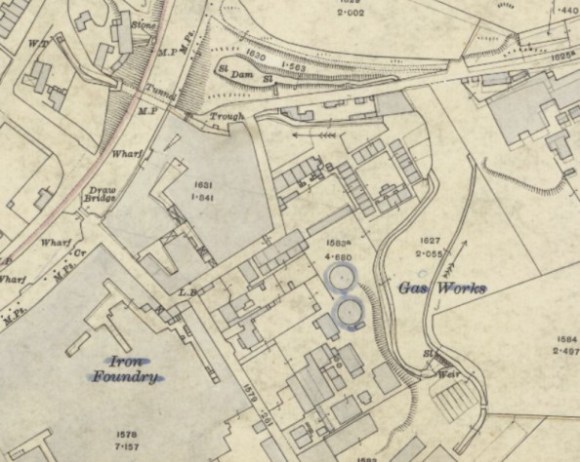
A 4ins high pressure steel main was laid from the existing high-pressure main at the Head of the Muir via Drove Loan to Loanfoot in Bonnybridge, where a governor house was erected to house governors supplied by Peebles & Co, Edinburgh. From the governor house an 8ins low-pressure steel main was laid to the Toll and connected there to the existing mains. The Bonnybridge gasworks was then dismantled with only the gas-holders being retained. A year later the whole of the Bonnybridge gas mains were renewed.
In January 1931 the County Council agreed that the gas main at the Canal Bridge would be extended to its new houses at Greenhill, and this was further extended in 1942 to Seabegs.
A gas showroom was opened at 14 High Street in Bonnybridge in December 1937 and continued until its closure on 1 November 1969, when the staff were transferred to the Falkirk showroom.
One of the two gas-holders at Bonnybridge was dismantled in the 1930s and the life of the remaining one was limited by the restrictions placed upon it by the 1924 agreement which prohibited major repairs or renewals to it. In 1946 Smith & Wellstood reorganised its works and as a result required part of the ground upon which the existing governor stood. It was therefore arranged with Denny and Dunipace Town Council that a new governor would be constructed nearby and the restrictions on repairing the gas-holder were removed. The gas mains in the area were re-routed under the road (Waugh 1981, 141-142).
From 1948 the gas was provided as part of the nationalised industry and the remaining gas-holder was eventually removed in the late 1970s.
 Falkirk Local History Society