
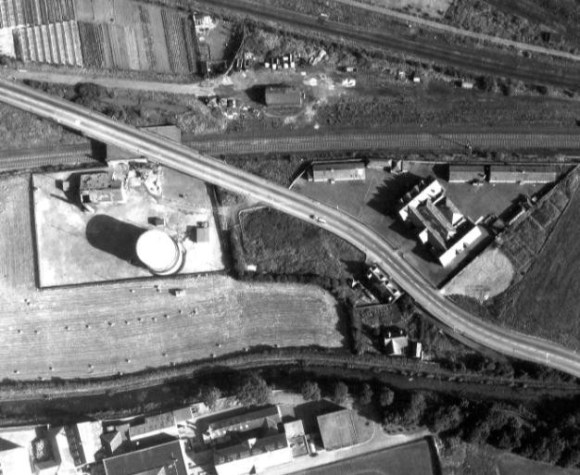
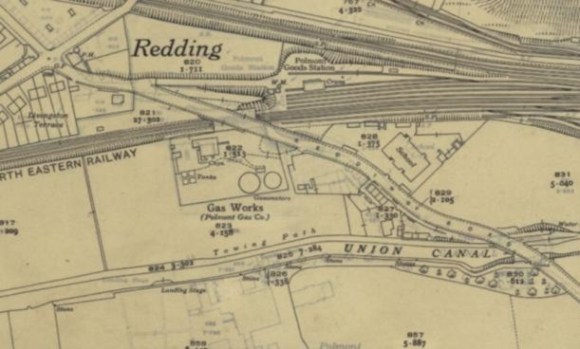
Information on the Polmont District Gas Company is somewhat sketchy. It appears to have been formed in 1906 with works on the south side of the Edinburgh to Glasgow Railway opposite to Redding School. It was probably for this reason that it was sometimes referred to as the Redding Gas Light Company; and often as the Polmont Gas Company. The intention at its establishment was clearly to serve a wide district including Redding, Polmont, Laurieston, Brightons and beyond.
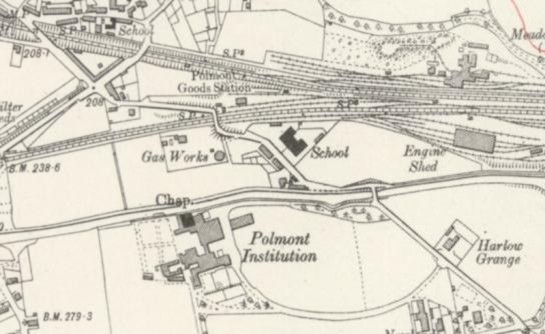
These works were completed in September 1906 and included a telescopic double-lift gasholder capable of holding about 50,000 cubic feet of gas. The retort house contained four retorts fitted with Balfour’s patent mouthpieces, with centre locks. Accommodation was provided for six additional retorts in order to meet the probable increase in the consumption of gas. The chimney-stalk connected with the boilers was 50ft high, and 4 ft in diameter, and was fitted with smoke consuming apparatus. There were three purifiers.
It so happened, that Laurieston Village Association was investigating the possibilities of introducing a limited number of street lights at the time. Estimates of the probable cost of lighting the village streets during the winter months were sought from the Polmont District Gas Company and Falkirk Town Council. The latter was very dilatory whereas that September the Polmont Company obtained permission from the county council to dig up the streets and lay gas pipes in the village at its own expense, estimated at around £2,500. The Falkirk Town Council’s gas engineer estimated that it would cost £3,000 to take a pipe to Laurieston, which made it an uneconomic proposition for it. The Polmont Company agreed to provide gas for lighting Laurieston at 5% cheaper than it charged domestic users – the contract being renewable each year so that the village could still consider alternative suppliers; though, of course, there was no prospect of there being such a supplier. The county accepted the offer of the Polmont District Gas Co to erect 30 gas lamps, including lamp pillars, pipe, lampcock, lantern, incandescent burners, mantle, chimney, and the fitting up of same at a capital cost of £97 10s. The annual sum for the upkeep, price of the gas, and interest and repayment of capital for instalment was put at £43 12s 6d.
Polmont District Gas Company actively promoted the consumption of gas and in March 1907 set up a series of cookery demonstrations. It bought in a stock of “Main” gas cookers and gas fires which customers could hire and which were fitted into their homes free of charge. The contract for the lighting of Laurieston was renewed each year and in March 1910 the Polmont District Gas Company agreed to donate a handsome lamp to the village for the centre of its new bandstand in the Square.
1911 witnessed a flurry of activity with regards to the gas supply of Laurieston. The Falkirk Town Councillors made a bid to extend the burgh limits to include the village. As this would normally entail the Council providing such services as water, gas and electricity, it is not surprising that the necessary legislation was opposed by the Polmont District Gas Company. Its stance threatened to scupper the whole project and so at the last moment urgent negotiations were entered into between the two organisations. The night before the order’s hearing in Edinburgh an extraordinary council meeting was held in Falkirk at which councillors were asked to vote on giving power to the relevant sub-committee to treat with the gas company, but were not given any details. This meant giving them a blank cheque to pay the company off – and it was agreed! The figure that the gas company accepted was £6,000 for the undertaking, fittings, apparatus and goodwill. Its annual income was £400. If the order did not pass the bargain would fall. It fell.
In 1914 the Polmont District Gas Company extended it mains to Shieldhill, California and Blackbraes. That same year the Polmont, Redding and Rumford Special District sub-committee of the county council agreed to form a special lighting district comprising the villages of Polmont, Brightons and Wallacestone, and reviewed its lighting provision. It obtained estimates from (1) the Scottish Midlands Electricity Supply Co Ltd which proposed to light the district by electricity at a cost of £2 5s per lamp per annum, and (2) the Polmont District Gas Coy to light the district with gas at a cost of £1 1s per lamp per annum. After consideration, and in view of the difference in the cost, the latter offer was accepted. 1919 saw a further extension of the mains from Laurieston to Thornbridge. Not surprisingly, the Scottish Electric Power company failed to quote for a supply to the tenements there. The gas mains of the company now exceeded 20 miles.
After the Second World War, in 1946, the Polmont District Gas Co Ltd made an application to the Ministry of Fuel and Power for permission to extend its retort plant, but was advised to enquire on what terms Falkirk Town Council would give a bulk supply for a portion of that company’s district. The Town Council of Falkirk agreed to grant this supply at a cost of an annual payment of £113 to cover standing charges in respect of an 8ins main approximately 700 yards in length, and a charge for gas supplied at a rate of 3s 1½d per 1000 cubic feet. This was accepted. The mains in the village of Laurieston were due for an overhaul, but nationalisation was on the horizon and this was held back.
March 1947 saw blizzard conditions in the area and the snow blocked the roads for weeks on end. The severe weather conditions were made doubly hard by a fuel shortage. It was common during this period to see Whitecross people travel to the Redding Gas Works to purchase coke, taking their fuel home by pram, barrow or cycle. As this entailed a journey of fully six miles, it called for great effort, but such was the need to have a fire, especially where there were children in the house.
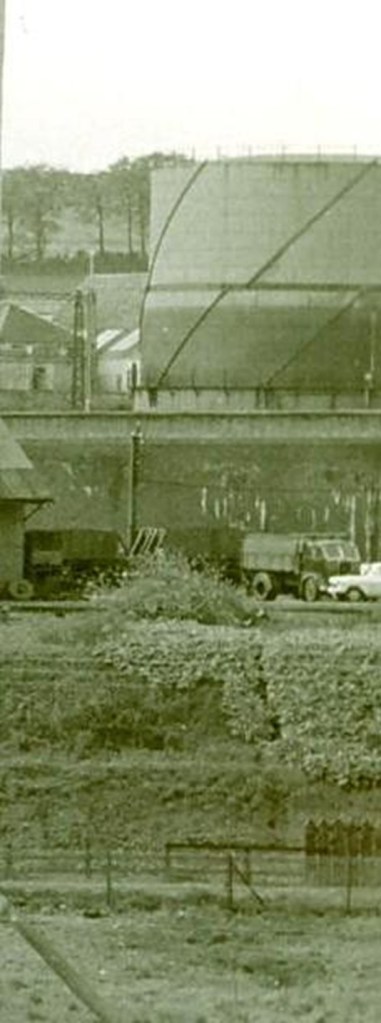
With nationalisation in 1948 the shareholders of the Polmont District Gas Company were financially compensated. Production of gas at Redding soon ceased and the bulk supply was obtained from the Falkirk Gas Works. The gasometers were retained for an extended period in order to balance the system.
 Falkirk Local History Society