
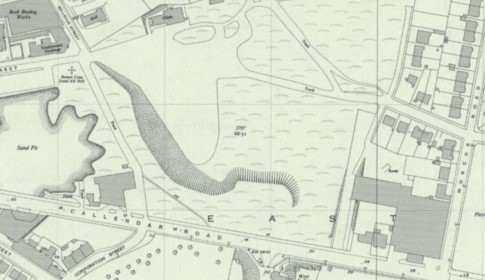
The meadows on either side of the East Burn of Falkirk were known as Bellsmeadow. The soft water in the stream and its proximity to the town centre meant that the area contained the site of an early curative well called “Pilliwanton Well” and in the nineteenth century of a public washhouse and a curling pond.
The land to the east had long been in the possession of the owners of Callendar House and after 1783 that meant the Forbes family. By the 1930s the western side belonged to Falkirk Town Council and each year part of it was let for the use of show people, often associated with the Falkirk Fair or a travelling circus. Large meetings could also be held in this natural amphitheatre. In June 1935, for example, the Christian Endeavour Union held a grand rally there. By the end of 1937 the councillors had started to discuss the possibilities of creating a children’s playground at Bellsmeadow. However, much of the area had been dug to extract the good quality building sand. It was pot-marked by huge pits and mounds. It was agreed to allow a small area of the Council’s ground to be set aside for that purpose from 1 May 1939, though apart from the addition of two seats there was little other provision. Further thoughts of development were put aside with the outbreak of war in September that year. During the war, circuses still appeared periodically, as also did a military camp used by a motor transport unit and Polish soldiers. A decontamination centre and first aid post was erected in the north-west corner of the main field.
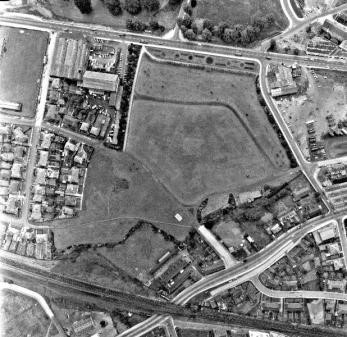
After the war, in 1946, Colonel Forbes offered to gift 7.24 acres of Bellsmeadow in his ownership to Falkirk Town Council for use as a public park for the special benefit of the residents of the Burgh of Falkirk for all time coming. The offer was a tribute to those who had served in the war. It came with certain conditions, such as laying down grass and fencing the area off. At the same time the decontamination centre building was converted into a health clinic and used to provide inoculations.
In September 1949 the Parks Superintendent and the Burgh Engineer submitted provisional plans with indicative costs for the necessary work. These included a new road leaving Kerse Road just west of the old slaughter house, crossing Bellsmeadow to Cromwell Street, to act as a bypass to the town centre. The road was rejected by the councillors as hazardous to the children in the playground. They considered that the proposed road from Kerse Lane to Callendar Road, which became Meadow Street, was more than sufficient for that purpose. The following year estimates from Messrs Glibrans Ltd, Altrincham, and Maxwell M Hart, 39 Victoria St, London, landscape architects, came in at £20,000 and £18,430. Clibrans Ltd were engaged. An ingeniously-lit scale model of the proposed recreational centre was made which, by alternate lighting, could show the appearance in the daytime and in the hours of darkness. Work on site began in December 1951 and was to proceed in phases. The park was to contain bowling greens, tennis courts and other recreational facilities. On 20 October 1952 a feu disposition by Colonel Forbes of Callendar Estates was made in favour of the Provost, Magistrates and Councillors of the Burgh of Falkirk. Progress was woefully slow. The construction of tennis courts nearby at Kerse Gardens negated the need for them at Bellsmeadow and before long the bowling green was also dropped. In March 1953 it was reported that
“After months of levelling the ground and preparing the soil, those responsible for the improvements to Bellsmeadow are at last beginning to see some of the results of their labours. Part of the ground has been marked off with broad paths, and this week saw the planting of small shrubs and trees” (Falkirk Herald 21 March 1953, 8).
The park became the venue for the town’s November bonfire celebrations and featured firework displays. In 1991 the construction of a new shopping centre at Callendar Square meant the pedestrianisation of Callendar Riggs and so a new north/south bypass road was cut across Bellsmeadow Road to replace it. The decision to do so was quite controversial and in subsequent years was used by developers to demonstrate how little impact their own schemes would have by comparison.
National Grid Record
NS 893 798
 Falkirk Local History Society