
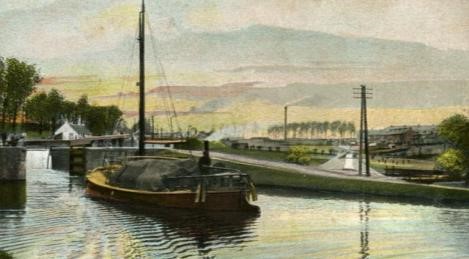
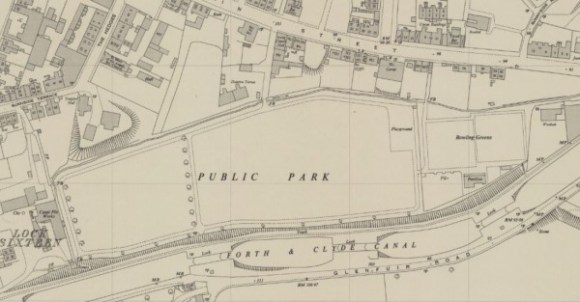
In the mid-nineteenth century Camelon was well-served with civic leaders who helped to provide the village with water, drainage and lighting. One of their early goals had been the provision of a public park in which the children could play safely. Practical as ever, they combined this purpose with that of bleaching! In 1862 the “town council,” properly called the “School and Well Committee,” leased a large field on the north side of the Forth and Clyde Canal. In the first week of June that year the King of the Nailers declared the park open “for the purposes of recreation and bleaching.” The copious water from the Tamfourhill Burn and the south-facing slope made the field ideal for the bleaching and the hedge along the northern perimeter could be used to place the linen on for drying – this area was already known as The Hedges. Quoits were popular at the time and a pitch was laid out.
The lease was renewed from time to time and by 1905 the Falkirk Town Council had taken on the role of the earlier committee. It had the option of purchasing the land in 1910 but decided not to exercise it. A bowling club had been set up at the east end of the park some decades earlier. The Camelon Co-operative Society used the park for its gala days.
In 1917 the park was still owned by Miss Watt of Helensburgh and in 1917 she readily consented to the use of part of it for allotments for the duration of the war. It was actually towards the end of the growing season in 1921 before the Town Council informed those working the allotments to leave. The burn was now seen as a liability and the Council would have liked to have placed it underground – if it had the money. The water attracted young children which they considered to be a risk. Those urchins enjoyed guddling for the fish. There was a higher level of vandalism in the park than in neighbouring settlements and this persisted well into the following century. In 1924 it was noted that park seats had frequently been thrown into the burn and consequently requests for additional facilities were often turned down. The lack of direct ownership also meant that the Council was loath to invest in the park. So, in 1929 it offered Miss Watt’s Trustees £650 for the land, eventually settling on £725. As a consequence there was a large capital expenditure on the park in the mid-1930s. Further work was brought to a halt by the commencement of the Second World War in September 1939. That October trench shelters were dug in the park but these were also the subject of vandalism. Late in 1942 land was again set aside for allotments.
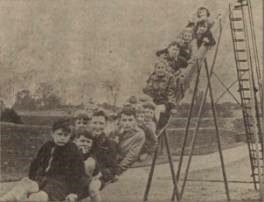
,
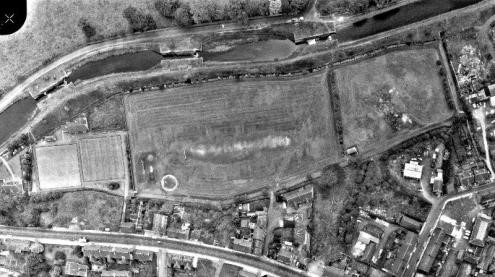
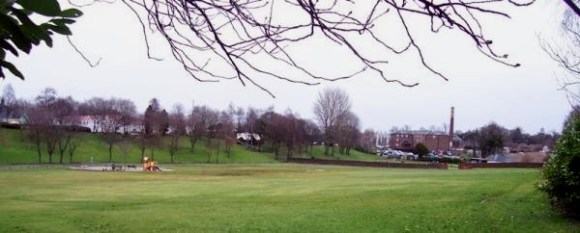
These took the form of playground equipment consisting of a slide, an ocean wave, a whirling platform, a plank swing, plane swings, and a rocking boat. Full implementation was delayed due to a government ban on borrowing. The play facilities were installed at the end of the park adjacent to the bowling greens and late in 1949 the hill at the west end was levelled. A small avenue of lime trees was then planted. In the end the improvements at the park cost around £4,500.
Upon the return of peace, the parks superintendent suggested in 1946 that the park should be properly drained, that walks should be cut round by the side of the burn, enclosing the burn and laying out the hill suitable for recreational purposes with seats and children’s playing equipment. He estimated the cost at £2,000. This large sum was never going to be allocated in one go but it was agreed to make progress. In March 1947 the Parks Committee recommended the expenditure of £375 10s plus purchase tax of 33½% on improvements at Camelon Old Park (to distinguish it from the New Park in Nailer Road).
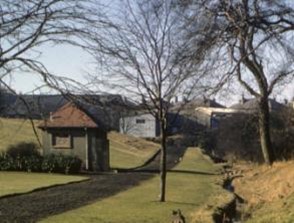
Owing to the considerable amount of work which had been carried out and the amount of trees and shrubs which had been planted, a full-time park-keeper was appointed. The park was now used for the Mariners’ Days celebrations. The new conveniences, erected at a cost of £730 in 1950, were an asset for such events. The brick structure was modern in style with a Rosemary tile roof and glass brick “windows”.
The perennial problem of vandalism was immediately evident when a number of the newly planted trees were broken and the glass bricks were smashed.
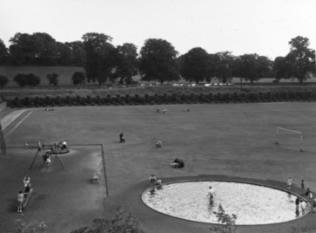
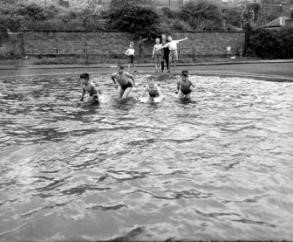
Around 1952 £600 was spent on a new paddling pool near the play equipment.
The 1950s also saw visits from various circuses. In May 1955 it was the circus and zoo of Harry Cody. In August 1955 it was the turn of Chipperfield’s Circus and after a break of over one and a half thousand years Roman chariot racing returned to Camelon. The circus also boasted of 16 elephants, 70 horses, 18 polar and brown bears, 14 lions, 6 camels, 6 zebras, 6 llamas, and George the giraffe.
By the late 1960s an informal path had been formed up the canal bank so that pupils could get to the new Falkirk High School using the lock gates. This was subsequently formalised and steps were inserted along with a footbridge over the canal.
National Grid Reference
NS 872 802
 Falkirk Local History Society