
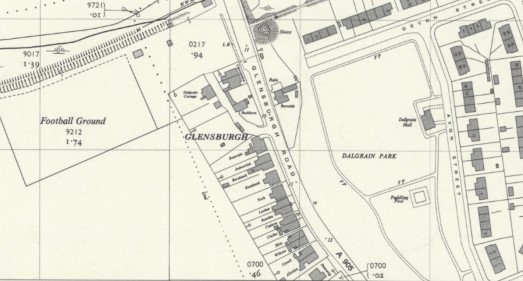
Dalgrain Park lies on the east side of Glensburgh road as it approaches Kerse Bridge over the River Carron. It is flat and low lying, being on the flood plain of the river. Indeed, an old meander of the river passes along the western and southern edges of the park. This meander was still represented by a small stream at the time that the park was created in the late 1940s and early 1950s. So, the ground on those sides was considerably built up and the open drain was placed in a culvert.
The name of the park is taken from that of the area and means gravelly meadow (Reid 2009, 63) – it was this gravel that led to the early ford across the river at this point. However, there was an earlier “Dalgrain Park.” That was the name of the football field a little to the east at Clyde Street. This had been the home of the Forth Rangers Football Club since 1895 and only went out of use in the 1990s.
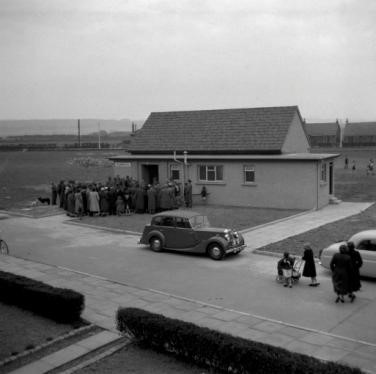
As part of its programme of providing community halls, a small building was erected on the eastern side of the park fronting Avon Street in 1955 to serve Ward 1 of Grangemouth Burgh. The Dalgrain Community Hall was designed by H.H. Wilson, architect, and cost in the region of £3,000. It was officially opened on 25 April 1955 by Bailie James Cornwall. The main hall was about 33ft in length and had a platform at one end. There was also a committee room, a cloakroom, toilets and a kitchen equipped with a gas cooker and water heating facilities.
The Grange Amateur Football Club immediately requested permission from the Town Council to use Dalgrain Hall for dressing-rooms when playing on the adjoining public park, but this was turned down. The made-up ground was still settling and the park was developed over the following years. Paths were laid out and a large square paddling pool constructed to the south of the hall (photograph in Falkirk Herald 14 July 1956).
Borrowing consent in connection with the expenditure of £l,600 for an extension to the Dalgrain Hall was refused in 1956, but the additions were subsequently undertaken, making it a meeting place capable of serving the whole area.
The demolition of Burnside house in the 1960s allowed an entrance to the park from Glensburgh Road opposite to Devon Street. Trees were subsequently planted around the periphery. In 1986 a children’s play area was fenced off at the south-west corner of the park and equipped with climbing frames, a slide and swings.
National Grid Reference
NS 911 820
 Falkirk Local History Society