
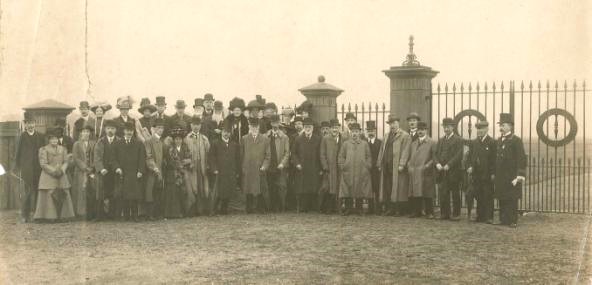
In 1902 Falkirk Town Council appointed a committee to look for a suitable piece of ground in the North Ward for use as a public park and recreation ground. After negotiations it was announced in July 1904 that Miss Dawson of Powfoulis had generously agreed to feu 12 acres of the Gairdoch estate on the east side of Carronside Street at a feu-duty of £5 per acre instead of the commercial rate of £10-15. There were a few conditions attached to the offer. These included that the Town Council should erect a substantial fence around the ground with suitable gates. No buildings were to be erected on the ground except a shelter or open pavilion for the accommodation of children in wet weather – any plans to be submitted to the Dawson Trustees for approval. The ground was to be laid out in permanent grass, with plantations and walks or paths, and to be used solely as a recreation ground. No alcohol was to be sold or consumed on the ground, and there were to be no ice-cream vendors or hawkers of refreshments. Streets were to be laid out in the vicinity. The Council gratefully accepted this generous offer and suggested that the park be called “Dawson Park” in recognition. That name was soon extended to the “William Dawson Public Park” to commemorate Miss Dawson’s father and brother.
The feu charter was ready by Whitsunday 1907 but entry was delayed in order to avoid paying the tenant farmer for un-exhausted manure and to fit in with his crop rotation which included a sowing of grass. It also meant that the Council could budget for the large expenses that it would still incur. This would involve a sum of £1,100 to lay out the park and a further £2,000 for the streets and pavements. After further negotiations the Dawson Trustees agreed to let the latter expenditure be deferred for five years. It was Martinmas (11 November) 1908 before the council took possession. The country was in depression and money was tight. A national Distress Fund helped to pay for 30 unemployed workmen to help with the manual labour at 15s per week. They also helped to lay new gas mains for the housing development. Miss Dawson was even more generous and offered to pay for the iron railings and gates to a design that she chose, as well as lamp standards and gate pillars. Her offer was unsurprisingly accepted as the cost was put at over £600. The castings were undertaken by her family firm – the Carron Company. They were to prove costly to the Council as well. The functions of the Distress Committee ended on 31 March 1909. By the end of September that year some 200 tops had been broken from the iron railings and many of the lamp standards and a stone pillar had been vandalised. It was a pattern which was to continue for over 20 years.
At the end of October 1909 all of the gates and railings were in place and the Council collected the keys from the manager of the Carron Company. Things proceeded slowly. In May 1911 offers were opened for the repairing of the railings of the William Dawson Park from Grahamston Iron Co., Falkirk Iron Co., and Carron Co and it was agreed to accept the offer of Grahamston Iron Co. It was 14 June 1912 before the park was formally opened by J.J.S. McLaren of Ratho Park. He was a cousin of Miss Dawson who had died in the meantime.
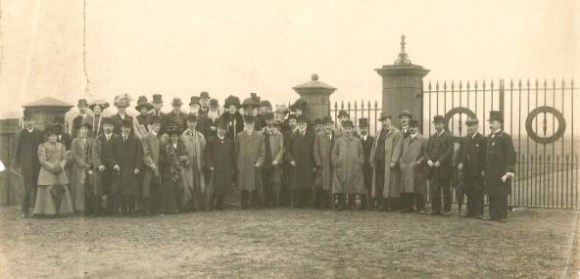
The vandalism to the railings continued worse than before and one councillor pointed out that it would have been cheaper to have paid the full price for the field without any conditions attached! Part of the problem was that the park was locked in the late evening denying access to the young folk. Later that year it was realised that the terms of the feu charter would not even allow for a football pitch to be laid out, though that did not stop the teams from improvising one on the grass field.
During the First World War part of the Park was used for growing food. With the return of peace the Council tried once again to get permission from the Dawson Trust to put in a football ground but the Trustees received objections from some of the neighbouring feuars in 1920 and would not relax the terms of the charter. By 1922 a football pitch was present. On Sundays no ball games were allowed in the park, though that was difficult to enforce. In April 1922 ten lads were found guilty of playing football and using obscene language on a Sunday – though perhaps the language resulted from their arrest (Falkirk Herald 26 April 1922, 2)! Despite such happenings the park saw many brass and pipe bands playing in it.
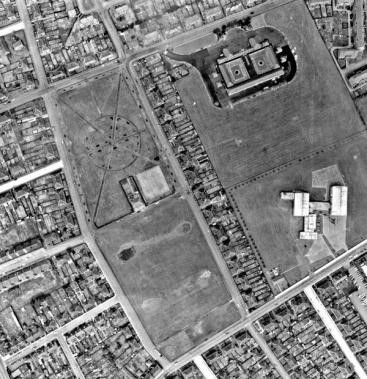
There were constant discussions about improving the amenities at the park, though in 1930 there was not even a single swing. In 1931 the long-promised improvements came and to protect the investment and maintain the paths and new flower beds a park keeper was appointed and given subsidised lodgings at a nearby Council house. Four years later a central pavilion with changing rooms and toilets was erected. It was officially opened in February 1935. The plans had been prepared by the burgh engineer, Mr Gibson, and he supervised the work. The main façade faced south and a veranda allowed the sport of the field to be watched. From here the entrance led into a lobby, the walls of which were done in shades of black, marigold, and green, with a cream frieze which formed the colour scheme for most of the building. Leading off the lobby there were two dressing rooms with foot bathrooms attached. An old man’s room had seating round the walls and a fire. This room was well lighted and was used for games of dominoes and the like. There was also a gardener’s store and ladies’ and gentlemen’s conveniences – all illuminated with electrically. One of the boys that grew up in the vicinity, John Reid recalled that it was an elegant building.
Local football teams had been using the park for some time but the provision of changing rooms was a game changer. They now asked that the spikes on the boundary rails behind the goal posts be covered with something to prevent the balls being damaged!
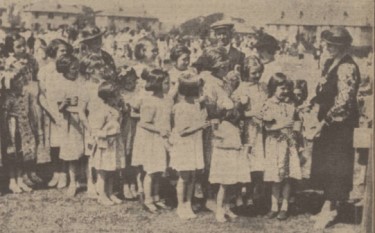
In 1938 a children’s playground was inserted at the southern end of the park where it was fenced off. This contained the usual swings and a see-saw. The park was growing on the locals and became the focus of many events including an annual gala.
International events once more halted progress. In 1939 the pavilion became a First Aid post and slit trenches were dug as shelters.
In 1940 the park acted as a depot for the collection of aluminium pots and pans to be melted down for aircraft production. A travelling cinema occasionally parked in the park to show Ministry of Information films. Allotments again appeared. And finally the troublesome railings were disposed of. At the end of 1942 they were requisitioned and taken down.
The park was also still locked in the late evenings, so some of the children hoisted an empty tyre over the perimeter and climbed over the railings (some becoming impaled). The tyre was filled with sand from the play pit and rolled up the slide. When released it went at speed towards the railings – the intention being to bend them for easier access.
Despite the war the northern compartment of the park was titivated up in 1943 and this helped with the Holidays at Home Campaign. After the war a tennis craze was prevalent and in 1950 two tennis courts to the east of the pavilion were made available at an estimated cost of £1,100. This included a hut for taking the money to use them.
In the 1950s the swings were padlocked on Saturday nights so that they could not be used on the Sabbath. This turned them into a climbing frame!
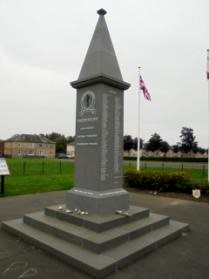
Sites and Monuments Record
| Dawson Park | SMR 1625 | NS 886 818 |
| Bainsford War Memorial | SMR 2334 | NS 8882 8194 |
 Falkirk Local History Society