
In 1928 the Duke of Hamilton gifted 14 acres of ground at Bankhead to Bo’ness Town Council for use as a public park. The land lay to the north of Dean Road and east of Kirk Wynd and was still agricultural at the time. The fields were put into grass and on the afternoon of 2 June the Duke’s son, the Marquis of Douglas and Clydesdale, officially “opened” the park. That morning he had flown over the site piloting an aeroplane and circled the area. The park was to be known as “Douglas Park” in his honour. The ground was surveyed and then slowly fenced and entrances selected. Unemployed men were taken off the dole over the winter of 1929/30 to plant trees and shrubs and to level the football pitches at a total cost of around £400.
Additional facilities and ornamentation were even slower to arrive. In 1933 part of the park was divided off for use as allotments, but by 1934 some of the socialist councillors were arguing to use at least 4 acres of the site for housing. It was pointed out that there was a provision in the charter that if the site of the Douglas Park was built upon the Town Council had to pay a feu-duty of £120 per year. These councillors argued that the so-called free gift was costing them in the amount of money required for the upkeep of the park.
The park was reasonably central to the expanding urban area and in 1935 part of the Bo’ness Fair Day was staged there. This was repeated in the following years. Any potential plans for the park were scuppered by the Second World War. In 1940 it was requisitioned by the War Agricultural Committee, and the Council received a rental of £2 per acre from a local farmer named Robert Pow who planted potatoes and oats there. The young trees and shrubs were removed by the Council in preparation for this. With the threat of invasion the park was immobilised in 1942 – that is to say anti-glider poles were erected to deter enemy troops from landing there. A Royal Observer Corps post was established just 20yds east of the flag post, taking advantage of the good views. At the end of that year sheep over-wintered on the ground. As a result of its agricultural usage the iron railings that had been put around the park were allowed to remain. At the end of the war there were still many shortages and so the Town Council decided to continue to lease the park to Robert Pow. 1946 saw a bad harvest due to the bad weather, but Pow was able to dry his crop on the site of Douglas Park using wooden frames supported by the wartime posts. The park was only returned to the Town Council in 1949 but as no provision had been made for its restoration on its budget it was let out for one more year so that it would not become overgrown with weeds.
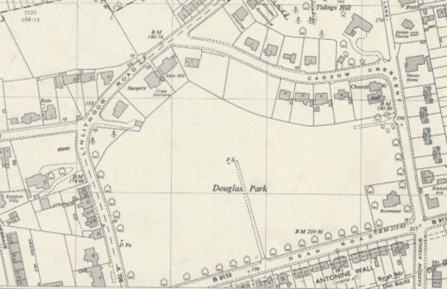
From 1950 the park was gradually restored. The 1960 Ordnance Survey map shows a path leading from the main gateway on the south side to the flagpole in the centre of the ridge. A drinking fountain occurred near the western edge and the boundaries had been planted with trees. Toilets and a pavilion were erected during the 1960s in the south-west corner near the road junction. The park now contains a quantity of fixed equipment in a children’s play area, two recreational grass sports fields with associated car parking and changing room provision for football teams. The remainder of the park is primarily informal grass areas and woodland.
Grid Reference
NS 998 811
 Falkirk Local History Society