
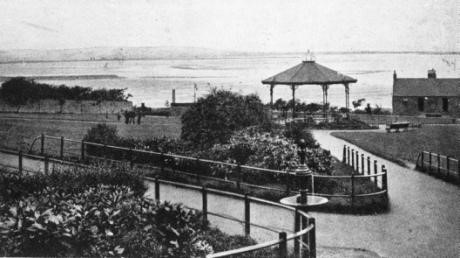
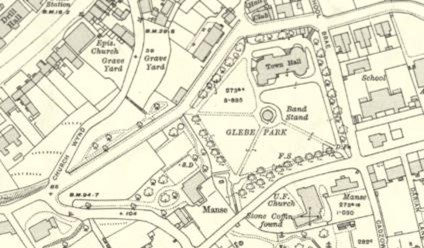
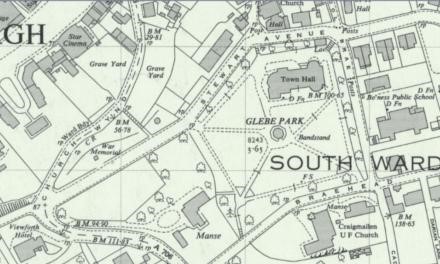
In 1899 Bo’ness Town Council took a feu of the Glebe Park in Bo’ness from the Rev Robert Gardner, the parish minister. The capital costs came from the Harbour Transfer Fund. The glebe was located above the town centre – to the west of School Brae and north of Braehead. Here it enjoyed splendid panoramic views across and along the Forth. That year it was used for agricultural purposes and early in 1900 the process of turning it into a public park began in earnest. Nearly ¾ acre of the Glebe Park Feu was used to improve the School Brae road and to form a new west/east road called Stewart Avenue. The construction of this road meant that there was a detached part of Glebe Park to the north-west of the main park and this was later used for a war memorial. Shrubs and trees were planted in the park. At the south-eastern corner a pillared gateway had been erected. For the convenience of those living in the Bankhead district, a small self-closing gateway with a flight of steps was also placed in the wall at the south-west corner. Both the road and the park were opened with due ceremony during the Bo’ness Fair on 13 August, the latter by Mrs Law, wife the convener of the Parks Committee, with a silver gate key. The key bore the inscription: “Presented to Mrs Law by the Rev, Robert Gardner, minister of Bo’ness, on the occasion of the opening of the Glebe Public Park. 13th July, 1900.” When the gate had been opened, the parks committee’s carriages and the Fair Queen’s carriage drove across the park and re-joined the procession at the north-west corner.
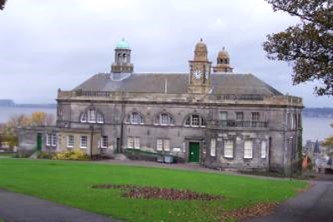
Part of the original intention in buying the Glebe had been to erect municipal buildings there and this was permitted by the feu charter. However, in 1902 the Council decided to use the north-east corner of the plot for a combined town hall and free public library. As this differed from that agreed, the Presbytery had to approve the change in use and did so on the understanding that it was in lieu of the municipal buildings and that no other erection would be made. Work soon began on the magnificent building designed by Washington Brown and it was officially opened on 14 September 1904.
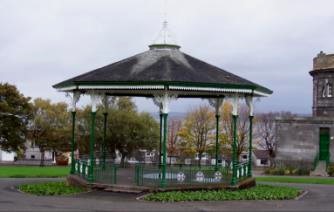
It was decided to erect a bandstand as the central feature of the park with paths radiating from it to the four corners. In March 1901 the contract for the bandstand was awarded to Walter Macfarlane & Co at a cost, including the foundations, fencing and paintwork, of £250. It was in place for the next Fair Day when the coronation of the Queen took place in the park. The playing of bands was popular. Music stands were incorporated into the structure in 1902. A fountain, or rather a drinking well, was soon placed near the main entrance and connected to the mains supply. A gardener was employed and, as a manual lawnmower was used for the grass, most of it was left uncut. Some flower beds were laid out and in 1902 a request was made for a cold frame with a brick base and a three-light top. The costs of the maintenance of the park were largely taken from the Promenade Fund. In 1904 Provost Stewart donated a flagstaff.
Routine maintenance and upgrades continued to a high standard over the years. In 1906 the ash paths were surfaced with tar macadam. Privet, laurel and other shrubs were arranged in hedges along the borders in 1908, and as part of the national coronation celebrations the “King’s Tree” was plated by Provost Stewart (the Queen’s Tree being in Victoria Park). The slope of the park made the southern portion unsuitable for football – but ideal for the rolling of Easter eggs. In any case, most ball games were banned. The by-laws also forbade cycling, though there were quite a few cycling accidents over the years. The greatest trouble that the authorities had was in trying to prevent the public from using the park as a short-cut and wearing unsightly paths across the grass. Heavy kerbstones and cast-iron plaques saying “Keep off the grass” were to no avail. Light wire fences were resorted to but they looked worse than the unofficial paths and were a trip hazard to boot.
From 1924 the area of the grass plots cut by the lawn mower were gradually increased, and two gardeners were employed. It was impossible to take in a larger area by hand mower and so in 1927 a motor mower was purchased. It was 1934, after years of discussion, before seats were provided for those listening to promenade concerts. More flower beds were added.
Then the advent of the Second World War put a stop to such improvements. The park remained the centre of many activities with open-air dances as well as those in the town hall. Parades, competitions, religious and military services as well as political meetings all took place. In 1944 a Bofors gun was put on display with a team of ten men and a sergeant demonstrating how it operated.
A huge static water tank was inserted into the park in 1942 and fenced off to stop youngster from using it as a swimming pool. Needless to say one small boy did make his way in and had to be saved from drowning by a passing seaman who hailed from Manchester. Perversely, in 1946 the Council considered converting it into such an open-air swimming pool but the need for an attendant was a stumbling block. An alternative suggestion of filling it in and using it as a platform to replace the bandstand was laughable. It was the beginning of 1949 before it was finally dismantled.
The 1940s and 1950s were the heyday for the park with colourful floral displays. The park was, and still is, central to the Bo’ness Fair Days, and that alone would make it significant. However, it is the backdrop of the town hall and the Forth which makes the park so beautiful and unique. In 2023 work began on renovating the bandstand to return it to the central feature that it was at the very beginning.
Sites and Monuments Record
| Glebe Park | NS 998 814 | |
| Glebe Park Bandstand | SMR 314 | NS 9982 8143 |
| Bo’ness Town Hall & Carnegie Library | SMR 375 | NS 9984 8147 |
| Bo’ness War Memorial | SMR 588 | NS 9968 8140 |
 Falkirk Local History Society