
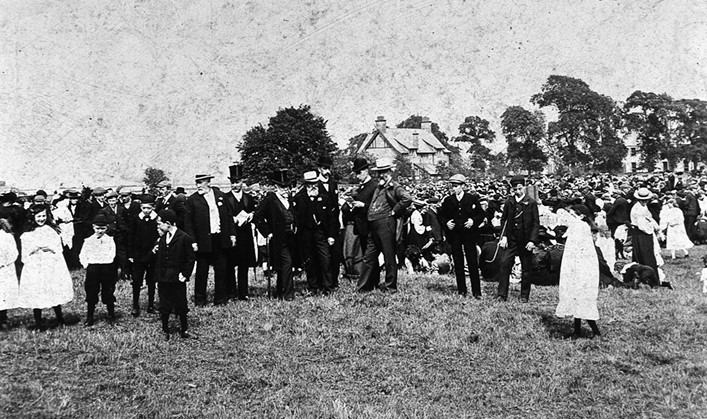
Kinningars Park, to the east of Bo’ness, was part of the estate of Grange. The name refers to the fact that it was used for breeding and keeping rabbits in a warren before the 17th century. By the 19th century the name applied to a wide sweep of land to the south of the coastal road stretching almost all of the way from Harbour Road to Carriden Brae. However, the focus of Kinningars Park was the field studded with mature trees to the east of Grange House. During the first decade of the 20th century it was owned by Henry M Cadell and formed part of the policy. Despite being private, the park was used for numerous public events. In 1895 it became the scene of an annual sports day promoted by the Bo’ness and Carriden Band, which also ran an annual brass band contest there. And in 1897, and for many decades afterwards, it was one of the venues taking part in the Bo’ness Fair Days. The local Rifle Volunteers made use of the park for its exercises. Ever active, the Bo’ness and Carriden Band started up an annual grand choir contest in 1906.
It came as a shock to the local residents when the mature trees, which had provided shelter, were all cut down in March 1911. Two years later a woodyard and sawmill were built in the main part of the park for Kennedy & Co. Henry Cadell had built a new mansion for himself at Bonnytoun and was no longer concerned about the amenity of Grange House. As he later wrote:
“The park had been in grass for over 40 years while we lived at the old house. It had several fine old trees, which were cut down to make way for ugly piles of pit props which however gave a more lucrative harvest than green grass.”
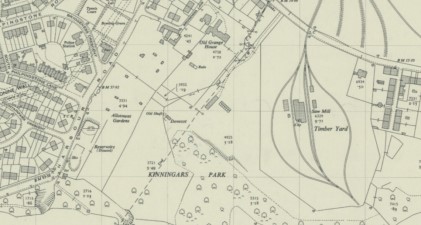
Thankfully this still left a considerable area to the south and west suitable for such events as the Bo’ness Fair. This part of the park was leased to Mr Stewart of Drum Farm for grazing and this kept the grass in trim. The open shaft near the doocot had to be properly fenced off before the crowds were allowed in. In 1930 three acres of the park were granted for use as a playground. At the same time boring took place to see what coal remained in the ground. These found that the seams in the vicinity were uneconomic and so the coal was chased to the north, under the Forth.
The southern part of the park was occupied by allotments and two reservoirs used by the Bridgeness Coal Company. The ponds were fenced off in 1938 due to the construction of the Fountainpark housing estate to the west.
.
With amazing generosity the park was eventually gifted to the local council by the Cadell family. One condition was that the old steam engine house/doocot should remain. The ponds were filled in and the allotments disappeared.
.
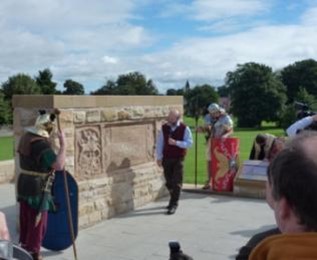
In 2012 a replica of the Roman distance tablet from the Antonine Wall, known as the Bridgeness Tablet, was erected in the park adjacent to harbour road. With the Forth in the background this makes an appropriate start for a walk along the Antonine Wall to Old Kilpatrick on the Clyde.
A Fire Engine House at Kinningars Park
National Grid Reference
NT 013 813
 Falkirk Local History Society