
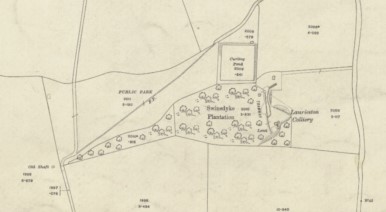
Football was all the rage in the 1880s when the Laurieston Football Club was formed. It came to an arrangement with the Earl of Zetland that it could use the grass park at the foot of the brae north of the village, except for the four summer months when the grass was cropped by a farmer tenant. This was one of the first public parks in the Falkirk district and until around 1900 was known as “Zetland Park,” it then changed its name to the “Laurieston Public Park.” It was here that annual fairs were held with five-a-side football matches, maypole dancing, music, dancing, pitching and quoiting. In the 1930s these were replaced by the galas. Bands often played in the park.
Around 1921 the YMCA erected “The Hut” on Boyd Street adjacent to the public park to provide a meeting hall and this doubled as a sports pavilion. In 1931 Daniel Mellis of Partick, Glasgow, erected two ranges of four swings, 9ft high, at a cost of £48.
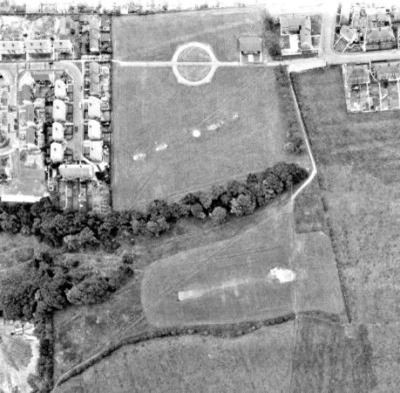
Up until 1932 the park had been on the relatively level ground at the foot of the hill with a curling pond just to its east. The Laurieston Park housing scheme began in the late 1930s and was extended in the 1950s to the Icehouse Brae. Foreseeing an increase in demand, the Village Committee bought 3.8 acres of additional land at the top of the hill for an extension to the park and this was laid out and equipped before being handed over to the Eastern District Council. The new section was separated from the old by the Swinedyke Plantation and was more formally laid out. The west side of the park contained an avenue of trees lining the drive to McKillop’s Buildings at Thornbridge. This was the main artery for those tenements.
House building was held up during the Second World War and in 1942 the 36th Independent Infantry Brigade camped in the Low Park for several months. They were training in house-to-house fighting techniques using the now empty houses at Thornbridge. Local farmers were refused permission to graze their cattle in the Park, but were granted permission to cut the grass and take it away. Six allotments were formed within the Park.
A wooden pavilion was built in the south-west corner of the upper park with a flagstaff and drinking fountain opposite it on the north side of the path. Today the park is little altered, though some of these features have been replaced..
National Grid Reference
NS 911 797
 Falkirk Local History Society