
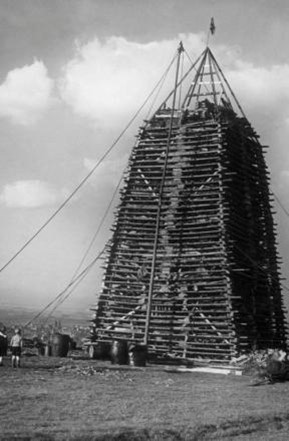
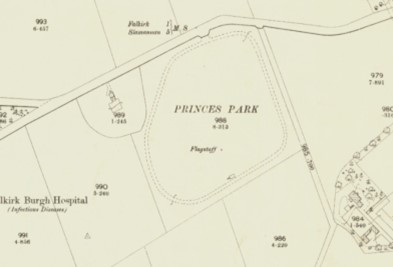
The first permanent public park of the town of Falkirk was Princes Park which was rather inconveniently located up the hill some distance to the south. The Falkirk Herald was scathing of the elevated location and correctly forecast that few of the public would be willing to scale the heights. The site was chosen not for its utility but for its cheapness. As the two fields from which it was formed were already in the ownership of the Town Council the expense of the project was minimal. The land had been acquired by the Feuars as part of the settlement when the common muir was divided. The hedge dividing the two fields was removed and a 14ft wide drive was formed. This continued around the internal perimeter of the park with the intention that it could be used for promenading, cycling or trotting. As the site was rather steep the idea of cycling was rather laughable! The track was made of 90 waggon-loads of ash donated by the North British Railway Company and transported at its expense – it was probably glad to be rid of it! Mr Nimmo, joiner, trimmed a wooden pole free of charge for use as a flagstaff. Carron Iron Co donated six seats, and Grahamston Iron Co two seats. The park was officially opened by Provost Griffiths in July 1893 as part of the celebrations connected with the marriage of Prince Edward and hence it was named “Prince’s Park.” He received a golden key inscribed “Presented by Bailie Gavin N. Hamilton, convenor of the Park Committee, to Provost Griffiths, on behalf of the burgh, on the occasion of the opening of Prince’s park, Falkirk, 6th July, 1893.” On the side was the burgh coat-of-arms. To attract the public a huge bonfire was set alight. This was to be one of many such fires and the hilltop location made it ideal for a beacon. The Town Council soon started to promote the park for its fantastic views to the north – but the children of the town had little interest in those. Playground equipment was installed near to the hedge at the northern boundary of the park – swings and maypoles.
Another bonfire was set ablaze in the park for the jubilee in 1897 and was accompanied by fireworks. Some 50 tons of material had to be carted up the hill for the bonfire.
Water was pumped up the hill to a “well” in the park so that the children did not need to return all the way to their homes. Unfortunately, they had a habit of leaving the tap running and so this service was discontinued. In 1906 a cast iron drinking fountain was installed in its place. The park was little used and so a proposal by some locals to form a golf club and create a nine-hole course using the park and adjacent fields was initially looked upon favourably but never came to fruition. The isolated position favoured the use of the park by the Falkirk Volunteers for their exercises, mock battles and parades. In December 1916 some 2,300 Volunteers assembled to be inspected by Viscount French.
Slamannan Road was widened in 1934 and a new retaining wall for the park was constructed, together with a new entrance gate. Late that year the Town Council approached the Daily Record newspaper for help with the erection of a view indicator in Princes Park. The newspaper had previously helped with such facilities at Ben Lomond and elsewhere in Scotland. The proprietors of the Associated Scottish Newspapers agreed not only to provide the chart, but also to pay for the engraved metal plate. Falkirk Town Council paid for the cost of the rustic stone plinth and it was unveiled the following year, being located at 375ft OD.
1935 also saw yet another bonfire in May for the 25th anniversary of the coronation of George V. It was a massive pile, standing no less than 42ft 6ins high, and being 28ft in girth, containing an estimated 100 tons of material. Its construction was supervised by William Gibson, the burgh engineer. At the base were hundreds of old railway sleepers, on top of which was piled tons of old timber obtained mostly from houses demolished under the slum clearance schemes. The core comprised a heterogeneous collection of material including brushwood, shavings, close on 20 tar barrels, more than a hundred old motor tyres, and other stuff – the whole was soaked with 280 gallons of old engine oil!
Bonfires were again used for royal occasions in 1937 and 1953. And in May 1946 one celebrated VE Day. The view indicator had been taken away during the war so that an invading German army could not use it as a guide – if they had made it to Falkirk they were evidently lost! It was July 1948 before it was returned.
.
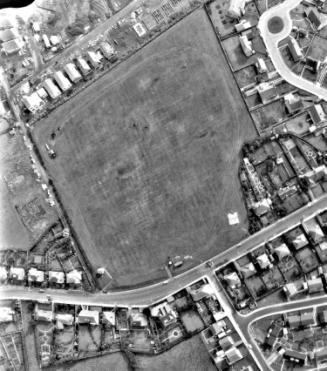
The view indicator is still there but the public conveniences are gone. The playground equipment, now in the north-west corner of the park, periodically has been renewed
National Grid Reference
NS 879 788
 Falkirk Local History Society