
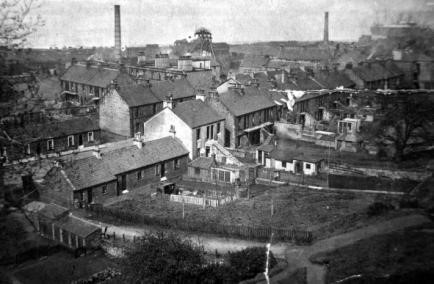
In Bo’ness the 1897 Diamond Jubilee of Queen Victoria was commemorated by a permanent memorial in the shape of the Victoria Public Park, which was formally opened by Mrs Law, the wife of the convenor of public parks, on 22 June. The ground for the Park, formerly called the “Braes,” was a sloping strip of ground on the north side of Philpingstone Road west of Cowdenhill Road. It was in grass and impossible to enclose for grazing and was used more or less as a public playground. The steep area of about 9.5 acres was feued by HM Cadell of Grange to the Town Council for £35. At the same time he created Grange Terrace as a westward extension of Philpingstone Road and feued the land to the south for building. Trees were planted along the north side of the new road by Cadell and he also created the first terrace paths throughout the park. At the opening sixteen young trees were planted by the sixteen burgh commissioners near the western entrance in the shape of a diamond and called the “Diamond clump.” The trees were mostly reared on the Grange estate. The four corners of the diamond represented the four wards of the town.
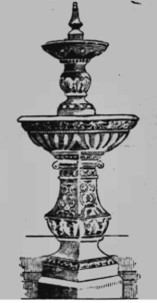
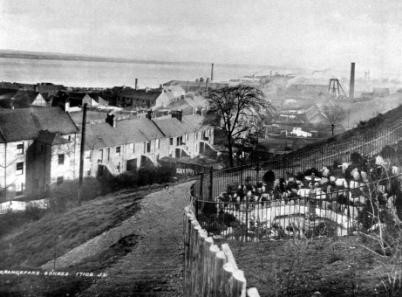
Part of the new park was known as the “Barrel Braes” from a water spring that filled a barrel set into the ground. The local inhabitants used to dip their stoups into the barrel to obtain their water supply. Now they had piped water. The little spring was landscaped at the expense of Provost George Cadell Stewart. Rock work and plants were placed in the hollow and a ceramic fountain was obtained from Doulton & Co in London and unveiled the week after the opening of the park – to be known as the Diamond Fountain. This area was surrounded by iron railings supplied by Alexander Callendar of Bathgate at a cost of 9d per linear yard. A cast iron drinking trough fed from the spring was placed outside the enclosure for the public to use. HM Cadell was an expert at the construction of bonfires and the final celebration of the Diamond Jubilee in the park took the form of a large bonfire.
Other donations were made. Miss I.M Cadell, sister of HM Cadell, donated fourteen cast iron seats made by Ballantine & Duguid. These were taken inside during the winter months. Mrs Ballantine of Roman House gave £5 towards shrubs. A keeper was appointed by the Council to tend to the park and in 1901 a cast iron urinal appeared.
At the time of the creation of the park, the colliery just beyond its northern boundary was closing. The old engine house of No. 9 Pit was purchased for use as a band hall. It was repaired and redecorated. Pits to the south, the Chance and Mingle Pits, provided the blaze for the paths in the park. James Dymock, plumber, provided the use of three horses and carts free of charge to carry the material to the park. Not surprisingly, in 1898 subsidence occurred within the park near to the north side. This was a common occurrence in Bo’ness and the hollow was simply filled in and landscaped. Cutting the grass in the park was put out to tender. Other maintenance was ad hoc. In the spring of 1899 it was found that the top of the Diamond Fountain had been damaged by frost and specialists from Doulton were brought in. This was to be a perennial problem and each winter the water to the fountain was turned off, drained and a padded cover put in place. Colourful flower beds were introduced. In 1902 an oak tree was planted for the coronation of Edward VII and called the Queen’s Tree.
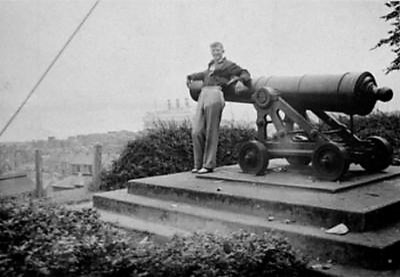
Henry Cadell brought four old Carron guns from Bellary Fort in central India back to Scotland in 1900. The largest, an 18-pounder, with a specially made carriage, was presented to Bo’ness Town Council for King Edward’s coronation and was placed on a concrete plinth next to the flagstaff in Victoria Public Park in 1902. The only condition attached to this gift was that it should be fired occasionally on great occasions such as the coronation. It could be heard for miles around. It was soon nicknamed “Big Harry” and was fired that August in honour of the marriage of the provost’s daughter. A salute of seven rounds was fired by Gunner Currie for the marriage of James Calder in February 1904. Between 1902 and 1915 the gun was used to bring in the New Year with a single blank discharge. The practice was suspended due to the First World War and the other three carronades were scrapped. By 1916 the remaining gun was known as “Old Harry.”
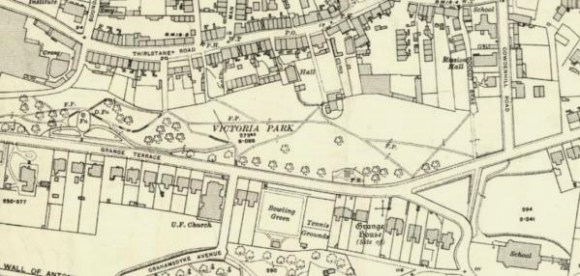
There were several entrances to the park though the main ones were seen as those on the east. Access to the main street at Grangepans was by a small lane which in 1914 was officially named Park Lane. In 1905 HM Cadell gave another access road to the main street at the side of Cairn’s property near the band hall and this became Cairn’s Lane.
The feu charter of 1897 gave the Town Council the right to feu two acres of the land at the east end of the park but much of this had been used up for the formation of the new road. In 1906 it advertised one acre for sale divided into three lots and these were quickly taken up.
Right from the beginning bands had performed in the park using make-shift facilities and there were many proposals to erect a bandstand. Plans for a wooden platform were drawn up early in 1907 and in June the following offers for its construction were received: Peattie and Wilson, £25-17s; Jipps and Sneddon, £27-13s-6d; And. Drysdale, £29-1s-9d; and Baikie and Sellars, £27-4s-3d. As these estimates considerably exceeded the cost which the Council had anticipated, it was resolved not to accept any of them, and the parks manager was requested to devise a wooden platform, costing £5 or so.
In the First World War the park was used for the usual parades, concerts and demonstrations. Allotments were also inserted and these were allowed to remain for several years after the return of peace because there was an economic depression.
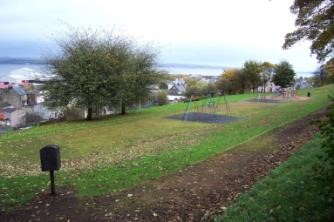
In 1924, despite opposition from some local residents, a children’s playground was formed at the south end of the park opposite to the bowling green. Almost an acre was levelled and paths were put in place. Mrs W.F. Fairlie gifted two giant strides, four sets of swings, and four see-saws. The following year the piece of ground below the cannon was flattened to form a platform for the long-promised wooden bandstand. The wood was obtained from the Forth Shipbreaking yard nearby at a modest cost. 1925 also witnessed the closure of the drinking fountain which it was noted was “broken every other day.”
Wooden shelters with iron roofs had been erected in the park and these came to be used by the elderly who formed their own social club. The shelters required continual maintenance, as did the paths. During heavy rains the blaze on the paths washed into the drains and so in the 1930s a gradual process began of replacing the surfaces with concrete or tar macadam.
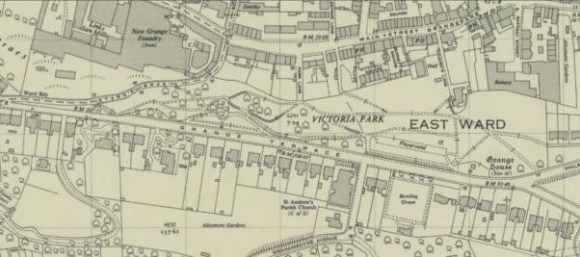
The Second World War saw the return of allotments to Victoria Park, as well as a public air raid shelter and a wooden hut for firewatchers. Old Harry, the cannon, was finally scrapped in 1940 as part of the salvage campaign. It was taken to P & W McLellan’s yard and broken up with a sledge hammer. In 1943 the firewatchers’ hut at the foot of the park was bought by the Town Council for the use of the elderly as a meeting hall.
The end of the war was marked by the re-painting of the flagstaff. Despite having been urged by neighbouring residents to thin some of the trees in the park to provide timber as part of the war effort it was only in February 1947 that the sawmillers and haulage contractors moved in, felling about 100 trees. In 1949 the concrete platform for Old Harry was demolished and replaced by a flower bed. That year the ceramic fountain was also abandoned. After years of repairs and decay it was finally removed.
Sites and Monuments Record
| Victoria Park | SMR 1334 | NT 005 814 |
| Diamond Fountain | SMR 1333 | NT 0053 8143 |
 Falkirk Local History Society