
Wallacestone rests on the summit of a high west/east ridge with magnificent views over the Forth valley and is reputed to be the place from which William Wallace watched the English army approach Falkirk from Linlithgow in July 1298 en route to the Battle of Falkirk.
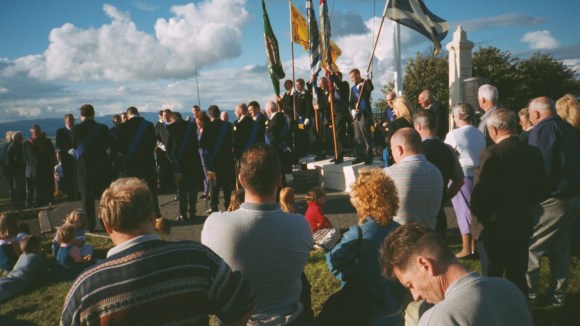
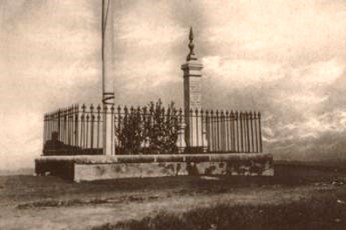
In 1810 an inscribed stone pillar was erected to commemorate the event (Bailey 1994, 17) and this became the locus of an annual fair to commemorate Wallace. The pillar was subsequently enclosed by an iron railing to preserve it and two stones from London Bridge where Wallace’s body was displayed were brought to the site by a Falkirk mason. A flagpole and benches were also provided and slowly the area took on the prospect of a park.
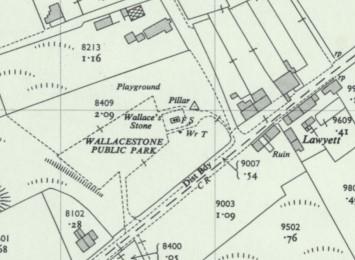
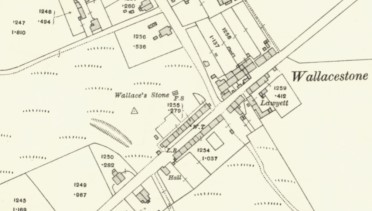
The 1914 Ordnance Survey map shows that it was then still bounded on the south by miners’ rows. Their demolition in the early 1930s allowed the landscaping of the area and opened the park up to view from the road. Much of the manual work was done voluntarily by local men and ashes were spread over the building rubble to create an area of hard standing.
Sites and Monuments Reference
| Wallace’s Stone | SMR 603 | NS 9188 7710 |
| Wallacestone Park | NS 918 7700 |
 Falkirk Local History Society