
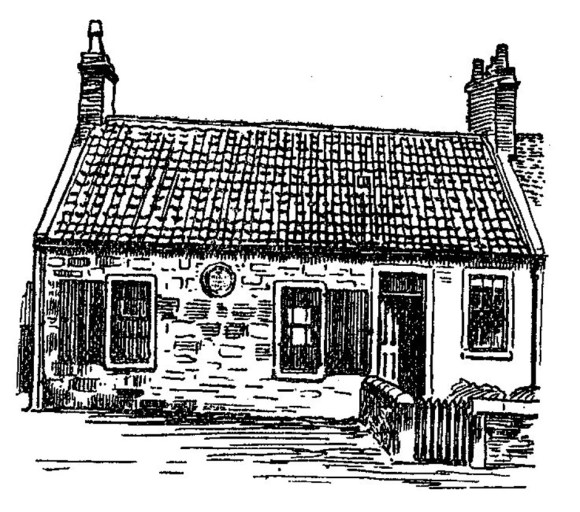
At a public meeting of the inhabitants of Grahamston and Bainsford on 21 November 1809 it was agreed to erect a schoolhouse in the area. Sufficient money was subsequently promised to take the project further and a feu was obtained from James Potter on the east side of Grahams Road with an annual feu duty of £1 8s 4d. A committee consisting of James Russell, George Sherriff, Alex. Liddell, John Melville, and James Potter, was appointed to make out a plan and procure specifications, “and to get the matter done as speedily as possible.” The plan appears to have been drawn by Mr Melville and early in November of 1810 the work was completed at a cost of about £134, apportioned as follows:
| Mason work | James Wyse | £53 | 6 | 4 |
| Joiner work | James Towers | £70 | 5 | 1 |
| Plaster work | John Bryson | £5 | 0 | 0 |
| Slater work | Thomas Stirling | £5 | 10 | 0 |
| £134 | 1 | 5 |
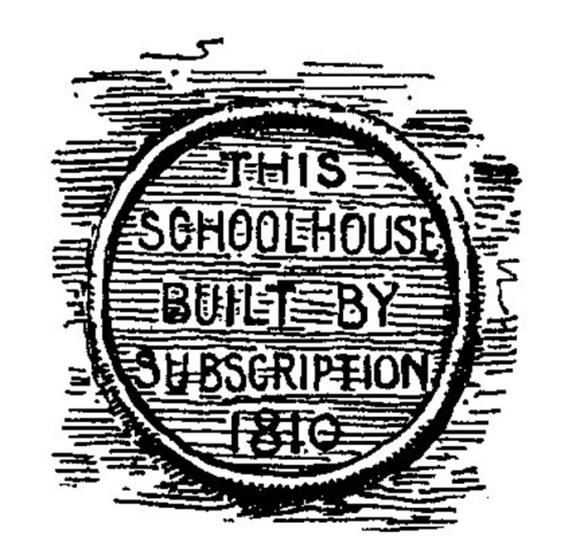
The mason’s account included the following item: “To a stone for an inscription, 10s 6d.” This stone – circular in form – was placed in the front wall of the school and bore the inscription “THIS SCHOOLHOUSE BUILT BY SUBSCRIPTION 1810.” A complete list of subscribers was published by James Love (Love 1898).
Upon the completion of the building the trustees of the school had a debt of around £60 to pay off and found it no easy task to raise the deficit as the majority of the leading inhabitants had already subscribed. A ball was held on 9 November 1810: “doors to be opened at 7, and to begin at ½ past 7 – 200 tickets at 2s 6d each for the purpose of raising money to defray the expense of building the schoolhouse.” The amount made from that function was some six guineas, upwards of 30s being spent for music and candles. In order to meet their liabilities, the school committee had to borrow the necessary amount, the interest on the sum lent, and likewise the feu-duty, being met by the rent received from the schoolmasters from time to time.
In 1812 the subjects taught were reading, writing, arithmetic, and book-keeping. For the payment of £5 yearly the schoolmaster had the use of the schoolhouse and garden. The following year this was reduced by a pound and in 1817 stood at £3 18s 4d. The building was divided into two with the southern portion providing a small residence for the teacher. The schoolroom was almost square with two windows in the front wall and two in the back. The entrance lay at the end of the north gable. The front yard was not bounded by a wall and acted as a play area. The layout is well shown on the 1859 Ordnance Survey map.
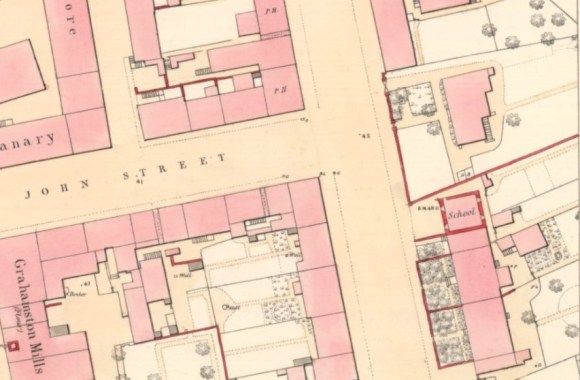
At a cost of £4 the schoolroom was lit with gas in 1834, David Arnot, smith, performing the work. £3 was collected from the public, the teacher, James Horn, contributing the remainder. Upwards of thirty years had gone, and the debt had not been reduced in the slightest. Accordingly in 1844 Rev. Mr Begg, minister of the parish, was petitioned to lay a statement regarding the funds of the school before the Heritors of the parish in the hope that they might contribute towards diminishing the debt but nothing seems to have come from this action.
The best known of the school teachers at the Grahamston Subscription School was James Horn. Mr Horn was reckoned a famous teacher of navigation, and very many successful seamen received their education from him. He kept a morning class for young men in business, a day school, and evening classes for working boys, and there were few holidays in his tenure of office; indeed, he could not afford many holidays. At his best Mr Horn never earned £100 a year. On 19 February 1841, after twenty-four years’ service there, a number of those who had benefited by his tuition gathered and presented him with a purse of sovereigns, a beautiful chart of the world, and several mathematical instruments.
The appeal to the Heritors in 1844 must have resulted in some help with the running costs by the Kirk Session for in 1859 the Ordnance Surveyors describe the school as :
“A subscription school under the domination of the Established Church. The teacher’s salary, amounting to about £70 per annum, is solely derived from the fees of the pupils. The usual rudiments of education are taught. Average number of scholars, males 50, females 50. Total 100.”
The mention of the Established Church undoubtedly came about as a result of its exertion of control over schools as a result of the Disruption. Up till 1865, no rent seems to have been charged for the use of the schoolroom after school hours, but at a conference of the various societies who utilised the room in the evenings, a scale of charges was agreed upon. This gave the committee of management a yearly income of some £10, one half of that sum being set aside to pay the feu duty, and the interest on the debt of £50. The school had by this time fallen into disrepair, and by the efforts of Robert Drysdale and William Gillies, a sum of £13 6s 6d was collected, and the interior of the schoolroom overhauled. George Binnie, the manager of Falkirk Iron Works, presenting pipes, runs, and conductor, without charge, and agreeing to do repairs to the roof of the building from time to time. The names of those who subscribed for the repairs were also published by James Love. In 1874 William Gillies and a new committee were able to raise £50 by subscription to clear the debt of the school (Love 1898).
A good income was derived from the letting of the building in the evenings, and on the Burgh School Board coming into existence this was considerably augmented by the rent received from that body for the use of the building until the Northern School was erected. Consequently, when William Gillies resigned the treasurership of the school committee in 1880, owing to failing health, he was able to hand £74 over to his successor. The affairs of the school were still managed for the inhabitants of Grahamston and Bainsford in 1898 by a committee consisting of the following: William Robertson, chairman; secretary, Mr James Boyne; treasurer, Mr Robert Wilson; Alexander Glegg, John Hastings, William Kirk, Thomas Arthur, David Philip, John Campbell.
Prior to the passing of the Education Act of 1872, the building had ceased to be used as a day school. In August that year the Misses Harley announced that they intended teaching “the various English Branches, including Sewing, &c.” that season. Their tenancy did not last long.
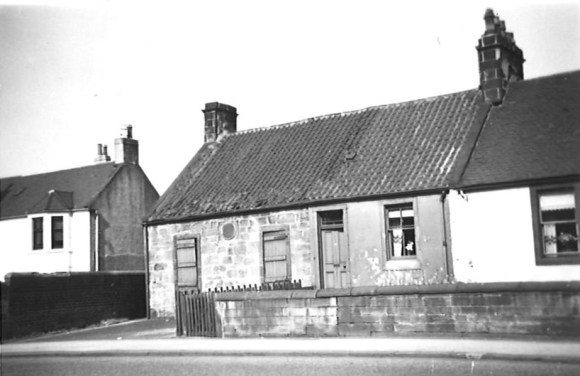
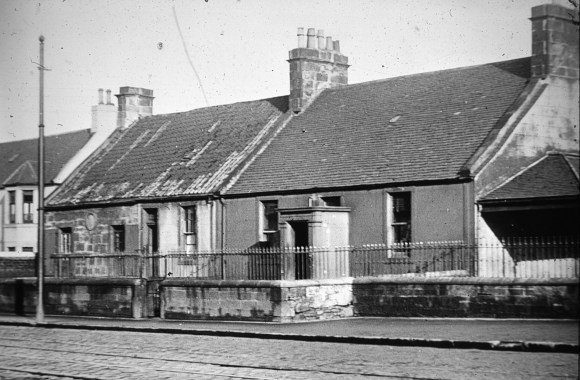
At that time it was proposed to demolish the old school and to erect a public baths. In 1906 plans for this were submitted by James Strang and by A & W Black – the latter were chosen. Estimates were obtained and £2,600 was promised by Robert Dollar. For some reason the work did not proceed and the building remained until it was demolished in the 1960s.
| YEAR ARRIVED | HEADTEACHER | YEAR LEFT | No. PUPILS |
|---|---|---|---|
| 1810 | William Murdoch | 1811 | |
| 1811 | James Turnbull | 1812 | |
| 1812 | John Russell | 1817 | |
| 1817 | James Horn | 1847 | |
| 1847 | John Young | c1856 | |
| 1856 | William Smith | c1862 | |
| 1872 | Misses Harley |
Sites and Monuments Record
| Grahams Road | SMR 1014 | NS 8881 8105 |
 Falkirk Local History Society