
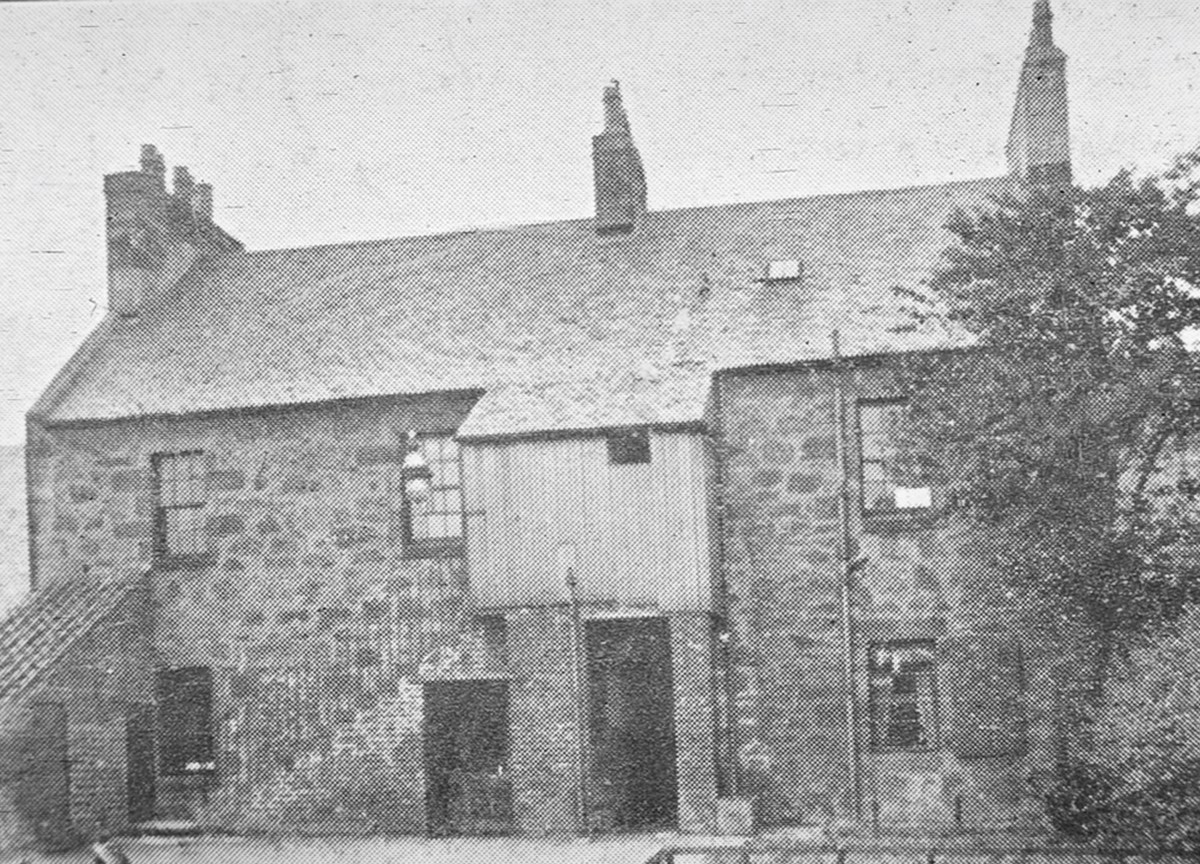
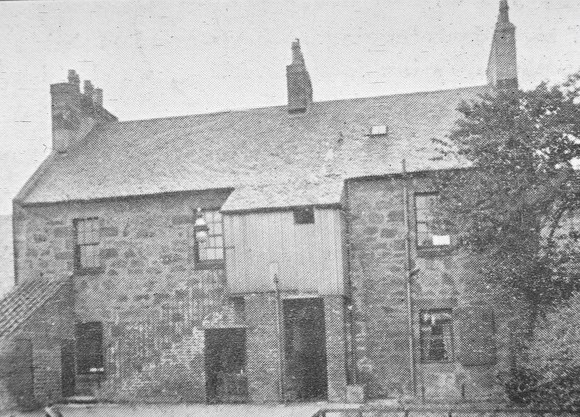
Thomas Grosart was considering entering the church ministry and in 1818 or 1819 he re-opened a school (it had been shut for some time previous) in a small room of a tenement at the corner of Bryson Street, Grahamston. He drowned whilst bathing in the Forth and Clyde Canal on 1 July 1820, and the scholars he had gathered round him were without a master. Some of their parents suggested his younger brother, James Grosart, should take his place. He was persuaded to do so and applied himself with such dedication that before long the number of scholars under his charge exceeded the accommodation of the little schoolroom, and he removed to larger premises in Graham’s Road (later the ground flat of the Conservative Working Men’s Club), still in Grahamston. By 1828 the school had outgrown it too. The landlord agreed to add a storey to the schoolhouse, and on the house adjoining. Here in this upper flat he carried on his work of teaching for more than forty years, having no pecuniary assistance in the shape of salary from any quarter.
A graphic description of the interior of James Grosart’s school was given by an old pupil, Mr Hudson:
“Let them now look in at Grosart’s school. He was sure every old pupil of Mr Grosart would agree with him in saying that he was a remarkable man, and they might ask – What did he not teach? Above the entrance door was a music board, which had always some new song or hymn on it, in staffer sol-fa notation. They saw the walls covered by maps mostly of his own painting. Above the fireplace were illustrations of the principles of mechanics. At the south-west corner, over the slate press, was a working model of a steam-engine in sections, showing the action of the slide valves, &c., all made by his own hands. The centre ornament of the roof was the mariner’s compass, with all the points carefully painted in true position. The remainder of the roof was covered with various constellations of the starry firmament. All of these were at hand for illustration in his teaching, and many others besides. How he managed to keep a crowded school going in full swing, from the infants in one corner to the sailors in the other learning navigation, many of them with mates’ certificates, and studying for the captain’s, with no pupil-teachers, only a monitor appointed now and then, to call out the names of bad boys, who got their reward at his convenience, and with none of the machinery of a modern Board school, and to turn out so many capital scholars, now scattered all over the world, beat his (Mr Hudson’s) comprehension.”
He continued: “Hansel Monday was a great day at the school. They all brought the master his ‘Hansel,’ and got an orange and a little book, and lots of fun at the American post, the white cockade, songs and recitations. Whoever heard Mr Grosart recite ‘Mary, the Maid of the Inn,’ and did not feel every hair standing up and their blood curdling? He seemed to throw his whole soul into it, and photographed the picture on their minds. He believed many of Mr Grosart’s old pupils kept up the custom of sending him his ‘hansel’ long after they had left the school.”
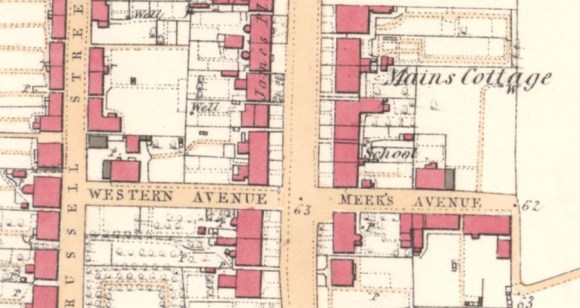
In 1860 the Ordnance Surveyors noted the building as:
“A private adventure school situated on the second storey of a two storey house in Grahamston, and is rented for the purpose. Affords tuition in the elementary branches of an English education. Average attendance about 120.”
The map shows it just to the north of Meek’s Avenue which was to become Wallace Street. A pend in the centre of the two storey building led from Graham’s Road to the back of the property and to an external stair.
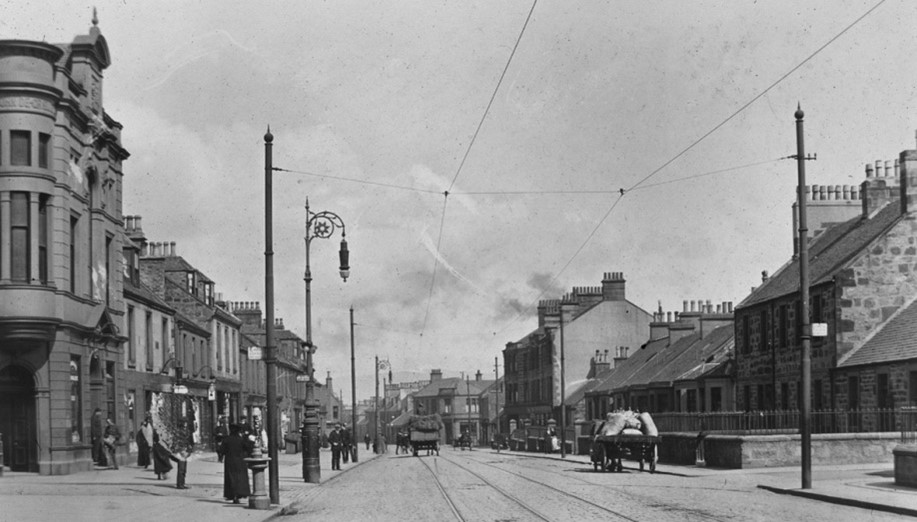
After the Education Act of 1872 Grosart deemed it right to step aside and allow the School Board to take up the work. For a time, however, he conducted evening classes, which were well attended. His retiral from day-school work was the signal for his old pupils and friends to show their appreciation of his long and earnest labours. Accordingly, a large and influential committee was formed, with Mr Borthwick Watson as secretary and treasurer. At a crowded gathering held in Bank Street Church on the evening of Monday 12 January 1874, and presided over by John Russel of Mayfield, Provost of Falkirk, Mr Grosart was presented with a handsome gold watch and a purse containing the sum of £203. Mr Grosart died at his residence, 75 Graham’s Road, on 19 November 1891, in his 90th year.
National Grid Reference
| Grahams Rd | NS 8885 8070 |
 Falkirk Local History Society