
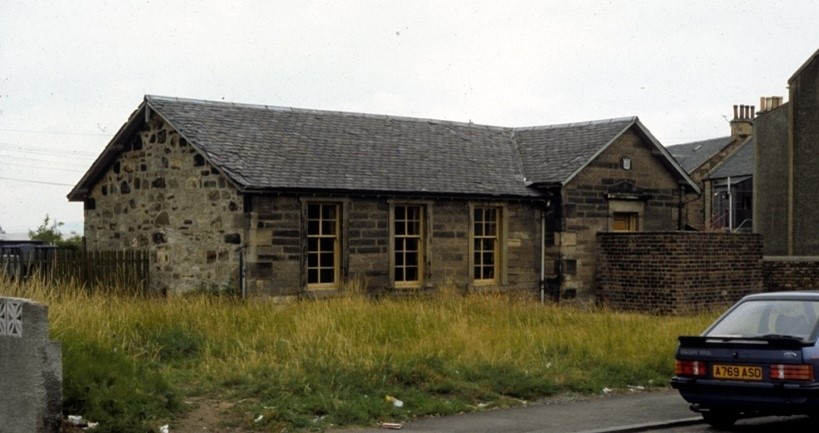
Rev Eneas Rate came to the Falkirk area shortly after the Disruption of 1843 and worked alongside Rev Lewis Hay Irving as a missionary for the Free Church in Falkirk and Camelon. In the late 1860s he fell heir to a considerable inheritance and having private means started independent work as a missionary in Bainsford. In 1871 he had a small hall constructed at his own cost in Mungalhead Road near to the junction with Bainsford Main Street. This was used as a school and was usually referred to as “Rate’s School” and a part of the classes as “Bainsford Free Church Female School.” A Sabbath school also met here and the building was used to promote the Free Church. Public sermons were still well attended.
The day-school work was very successfully carried on by a staff of three or four teachers for a long number of years, even after the setting up of the Falkirk Burgh School Board. In 1873 that Board reported on Rate’s School, noting that it had 165 pupils on the roll, with an actual attendance averaging 137. The measurement of the school was 769 square feet, so allowing 8 square feet as required by the Education Department for each child, there was only nominal accommodation for 96 scholars. At that time there were two female teachers, and the average fee was 3d per week and the building was good. Mr Rate’s School lay just beyond the 1873 burgh limits, but it drew most of its pupils from within it and was thus of interest to the Board. One of the teachers there was Miss Isabella Pollock, but she left around 1876 due to a disagreement with Rate. Fortunately for her, this was just the time when Bainsford Public School was being established and 150 inhabitants of Bainsford successfully petitioned to have her appointed to it as headmistress of the infant department.
Through an application made by the Falkirk Burgh School Board, Rate’s School was able to obtain grants, and was inspected by a Government Inspector. Rev Rate did much good work in Bainsford and was instrumental in setting up the Bainsford Savings Bank which met at the school. It was also used for temperance and political meetings, as well as concerts and parties.
The re-opening of Bainsford Subscription School as Bainsford Public School in 1878 took away much of the requirement for an independent school and in 1888 Rate’s School closed. In that year it was noted that Bainsford Public School had a roll of 450 and accommodation for only 300. An extension to it was badly needed, but so too was a temporary solution to tide the school over. The answer was for the Falkirk Burgh School Board to lease Rate’s old school building. The Education department approved of the action and so in September that year Mr Gilfillan, the headmaster, removed the infant department to Rate’s School. This department had 189 pupils on the roll. The infant department of Bainsford Public School remained at “Rate’s School” until the opening of an extension at the Public School in 1892. Rev Eneas Rate died in September 1893 having helped with the construction of Bainsford Parish Church which took over his religious role.
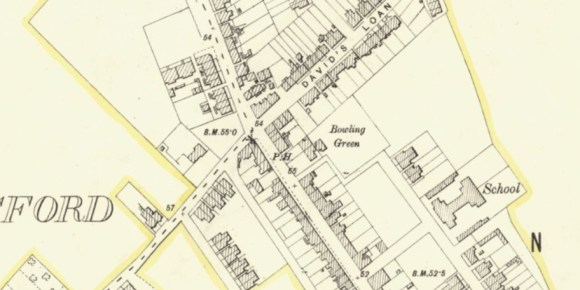
The North End Hall is the easternmost building on the north side of Mungalhead Road (next to “B.S. 55.0”). The “School” marked on the map was the Bainsford Public School.
Soon after that, Rev Rate’s trustees renamed the hall the “North End Hall” and it was made available for all sorts of social functions from weddings to political rallies. It became the base for several organisations, including a Boy Scout troop, the Rechabites and the East Stirlingshire Football Club Supporters Group. In 1921 the trustees of Rev Rate gifted the building to Bainsford Free Church and it remained in use as a public meeting hall well into the 1970s. It then stood empty for a number of years and around 1990 was sold and subsequently demolished to make way for two houses.
| YEAR ARRIVED | HEADTEACHER | YEAR LEFT | No. PUPILS |
|---|---|---|---|
| Miss Isabella Pollock | 1876 | ||
| Miss Janet Gillespie | 1887 |
National Grid Reference
| Mungalhead Rd | NS 8849 8153 |
 Falkirk Local History Society