
& Victoria Primary School
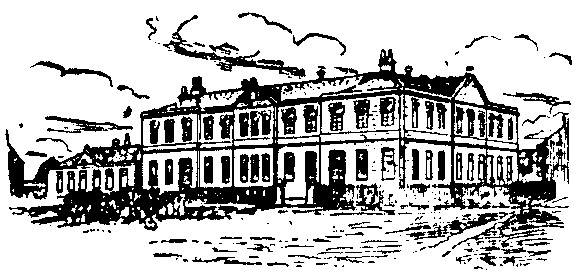
The construction of new housing to the east of Falkirk in the last decades of the 19th century led to a decision by the Falkirk Burgh School Board to build a new school to serve that area. The site chosen was on the corner of Queen Street and Victoria Road and the initial working names for it were either Salton Park School or Firs School. In November 1899 “Victoria School” was chosen. Plans were prepared by A & W Black for a school to accommodate 1,339 pupils and arrangements were made to take out a loan of £14,000 to pay for it. The plans were passed by the Dean of Guild in January 1900 and building work began shortly thereafter. It officially opened on 13 August 1901.
The buildings consisted of two blocks in a plain Classical style (Italian Renaissance). The principal block fronts Victoria Road and Queen Street and is two storeys in height – it provided accommodation for the senior department; while the other block is of one storey and faces Queen Street– it was utilised as the infant department. These were connected with a covered passage. The senior department was planned on the central hall principle – the hall, into which the several classrooms opened, being lit from the roof. In this department there were 17 classrooms, besides the practical cookery room and the cookery demonstration room, with boys’ and girls’ cloakrooms and lavatories, as well as headmaster’s and head mistress’s and male and female teachers’ rooms – the rooms for the staff all having suitable lavatory accommodation.
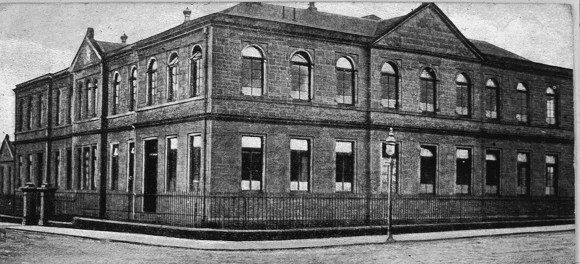
The infant department contained six classrooms, with the necessary teachers’ rooms, cloakrooms and lavatories. The departments accommodated 892 and 450 respectively. The contractors for the work were: mason work – John Gardner, Falkirk; joiner work – J & A Main, Falkirk; plumber work – Wallace & Connell, Falkirk; plaster work – James Miller, Falkirk; slater work – Drummond & Crowe, Laurieston; heating apparatus – John Spence & Sons, Airdrie; glazier work – D O’May, Falkirk; painter work – James Marshall, Falkirk; tile work – the Staffordshire Tileries Co, Glasgow.
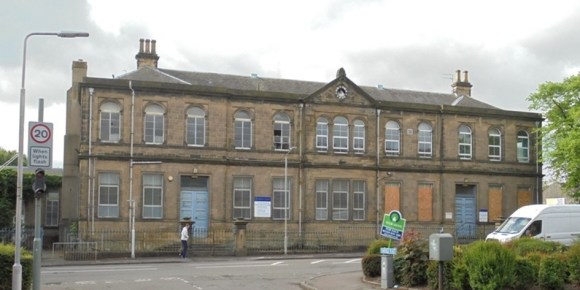
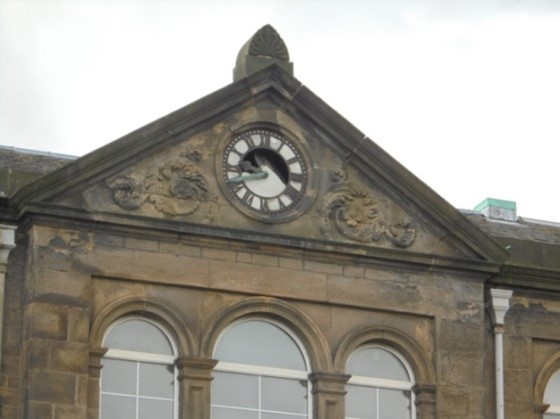
The numerous windows of the main block are square-headed on the ground floor and round-headed on the first. A prominent string course separates the two floors and a large, moulded cornice provides the wallhead. The symmetrical two-storey north façade is in polished ashlar and has five bays with the end and central ones only slightly advanced. The centre bay has a rectangular three-light window on the ground floor with a more ornate round-headed version on the first floor in antis. The arches are moulded and the mullions take the form of panelled pilasters. The triangular pediment above contains a clock set between floriated scrolls and is topped by an acroterion-palmette finial. The end bays have two ground-floor windows and a door, with three windows on the first floor in antis.
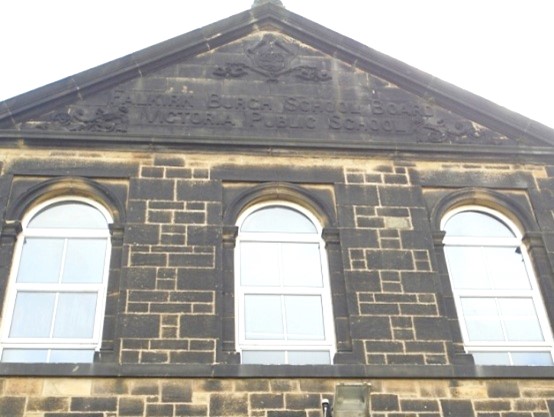
The masonry of the west façade is of snecked rubble and here the central bay of three windows is slightly advanced. Its pediment has the same finial as found on the north front, but the tympanum contains the foliate bracketed inscription “FALKIRK SCHOOL BOARD/ VICTORIA PUBLIC SCHOOL” below a cartouche with “1900” in monogram form. The south front is extremely plain and is made impressive by sporting 12 sets of windows.
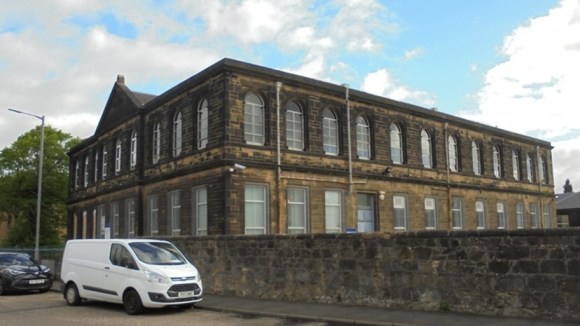
The main buildings changed little during its life as a school. It survived a minor fire and a major gas leak in 1912. No extensions were made to it. It remained in use as a school throughout the First World War, providing shelter in the afternoons for the pupils of Comely Park School who had been made homeless by its military occupation. It also took in pupils from the Central School, which it retained after the war ended.
The county architect estimated in November 1930 that it would cost £280 to install electric lighting into the building and this was considered too expensive. Instead, the Property Sub-Committee recommended that the gas fittings should be overhauled by the Gas Department of the Burgh of Falkirk! This caused an uprising as it was not the burgh’s responsibility and the gas did not give a good light but did produce an overwhelming smell. Gas masks were distributed to the population from Victoria School in September 1938 during the Munich crisis, and again a year later when war with Germany did break out again. Once again the pupils from Comely Park School were temporarily housed at Victoria School, which also served as a Rest Centre. In 1941 the Department of Health complained that the large roof-light on the hall would be unsafe in the event of an enemy raid but the Ministry of Supply refused a permit to purchase the netting required to protect it.
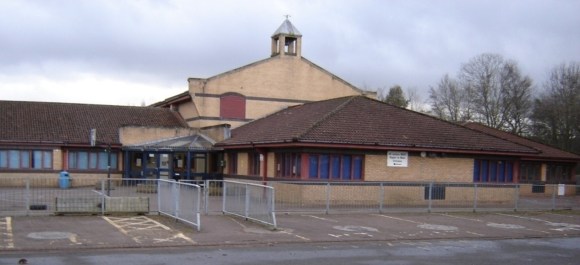
By 1993 the school was considered to be outmoded and Central Regional Council acquired a new site to the north of Falkirk College, closer to the later housing. The new school opened in April 1995. Its appearance is dominated by the buff-coloured brick and red tiled roof. A birdcage belfry was constructed over the two-storey central section to house a bell which had been given to the school in 1974 by St James Church.
The old building was taken over by Falkirk Council’s Library Support Services and the name was changed to “Victoria Buildings.” The central hall had a floor inserted. Around 2015 the boiler failed, the building was abandoned and is currently (2023) up for sale.
| YEAR ARRIVED | HEADTEACHER | YEAR LEFT | No. PUPILS |
|---|---|---|---|
| 1901 | Andrew M Craig | 1905 | 750, 820, 1050 |
| 1905 | James Hunter | 1924 | 1050, 990 |
| 1924 | William Erskine | 1929 | |
| 1929 | John Taylor | 1935 | |
| 1935 | Robert Jenkins | 1940 | |
| 1940 | John Matheson | 1943 | |
| 1943 | William Robert Gardiner | 1946 | |
| 1946 | Robert Fyfe | ||
| 1990s | Angeline Bellingham | ||
| Ms Karin Stuart | Present |
Sites and Monuments Record
| Queen Street | SMR 1015 | NS 8940 8038 |
| Middlefield Road | SMR 2299 | NS 8973 8074 |
 Falkirk Local History Society