
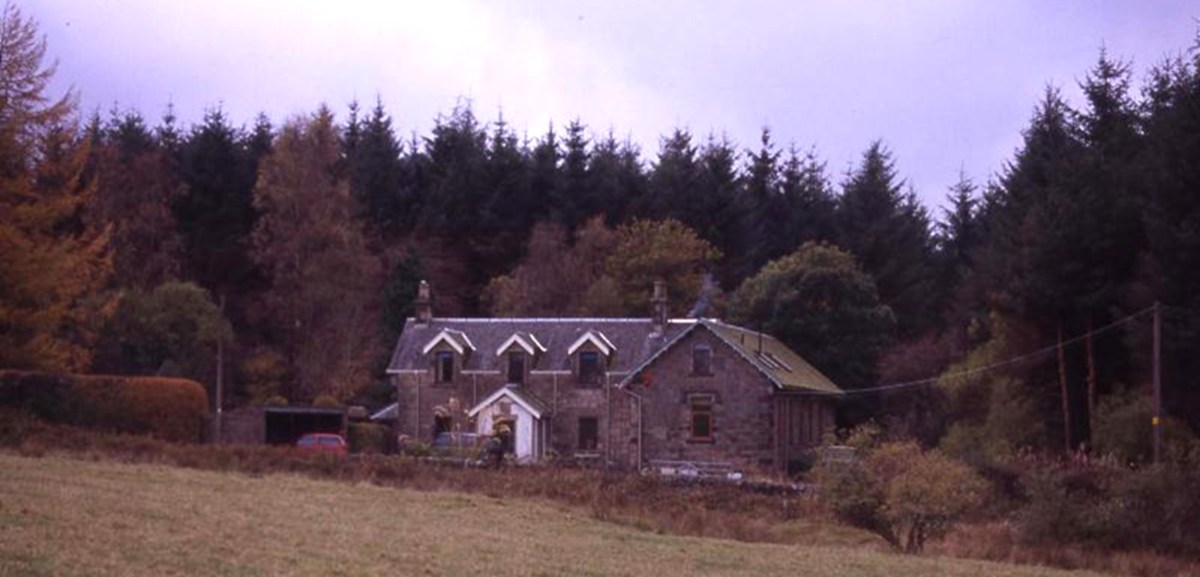
The school at Auchengean was erected by William Forbes of Callendar in 1849 for the benefit of his tenantry living in the south of the Parish of Falkirk. It opened on 14 December with Mr Colquhoun as the teacher. It is probable that the school replaced the one at Craigburn mentioned in the New Statistical Account of 1841. As well as a schoolroom there was a house for the master. The site stood on the Lands of Auchengean and fronted the main road to Slamannan. It proved to be convenient for the colliers living in the area of the Glen Village which boosted the numbers attending.
Nearby, private schools were set up for the colliers at Glen Village and Gartcows, but both soon closed. The teacher at Gartcows, Mr Penman, moved to Auchengean. He was a successful teacher and the tenant of Craigieburn Farm held occasional concerts to supplement his salary.
When the Falkirk Parish School Board was formed in 1873 it wrote to the owners of the various private schools in the area to ascertain how they stood with regard to future operations. Camelon School was handed over gratis to the Board, Zetland School in Laurieston was leased with no money actually changing hands, and negotiations were opened with William Forbes. In June that year the law agents of Forbes sent a draft lease for 19 years at a nominal rental of £2 per annum. Nineteen years was the normal term of let for an agricultural holding. The Board hoped to augment the facilities available at the school and naturally asked for a 99 year lease. The clerk for the Board interviewed William Forbes and found that Forbes was averse to do anything that would place the school beyond the control of his successors. The clerk therefore suggested that Forbes might make the necessary outlay on the extension of the school himself with the Board paying a proportion of it back as its terms of occupancy. As an alternative, the Board could make the additions and at the end of the 19 years lease get compensation for the constructions if the lease was not renewed. Forbes agreed to the latter suggestion. He also agreed to drop his condition that the present teacher be retained ad vitam aut culpam. The members of the Board then visited the school and inspected the buildings. In July 1874 the lease was signed and a female teacher was assigned to Auchengean School to work alongside the schoolmaster.
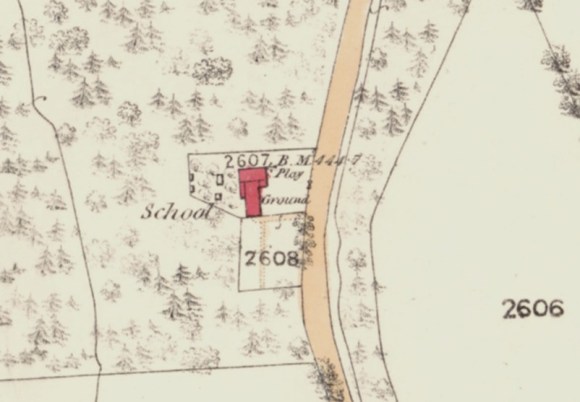
Routine repairs and painting were carried out at intervals and in 1884 a shed and new office were added by Mr Black, architect, at a cost of £60. That year James Love gave music lessons at the school – he is better known today as a historian. The attendance increased and by 1888 it was noted that teaching was taking place in the school lobby and in the shed. Ever since it had taken out the lease the School Board had made plans for an extension. It was seen as a relatively simple operation to extend westward as that merely required the knocking out of a large doorway and the construction of two wing walls and a gable. The stumbling block was that they did not actually own the building and so the Department of Education would not provide a low interest loan. Nor was it willing to allow the Board to arrange for a private loan which had to be paid back on the rates.
George Deas Page, architect, Falkirk, drew up plans for the extension, adding another classroom to the existing, in 1889 and estimated the cost as £500. They were approved by the Department of Education in April 1890. A snag then occurred when William Forbes objected to the nature of the stone boundary wall. It was to be 6ft tall but he knew that this presented little challenge to the young boys who “would get over it like cats.” He asked that a parapet wall topped with iron railings be substituted. The Board agreed to put iron spikes on top of the wall! Contracts were awarded that June to: mason work – MacAlley, Polmont; joiner work – J & A Main, Falkirk; plaster work – David McNair, Falkirk; slater work – J Walker, Falkirk; plumber work – D Draper, Falkirk; glazier work – D O’May, Falkirk; painter work – Mr Allan, Grangemouth; blacksmith work – Mr Kidd, Camelon. Work started late in the year. However, changes made by the Board delayed the programme and some of the contractors refused to complete the work. Page, who was supervising the construction, had to issue new contracts and assess the payments due for what had been done. As a consequence it was December 1892 before the extension was ready. Relations between Page and some of the School Board members had deteriorated and the architect took the Board to the small debts court to get full payment.
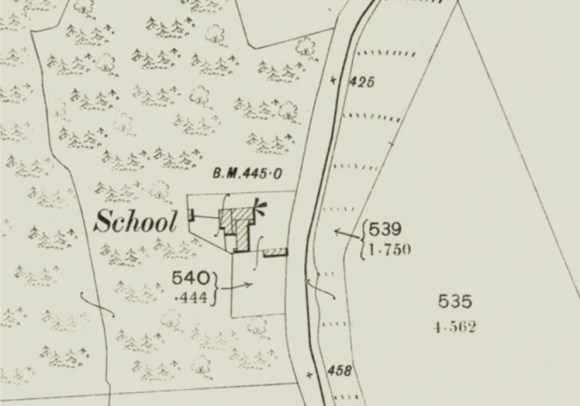
Thankfully Forbes agreed to another 19 years on the lease in 1893. Eight years later he was approached with a request from the Board to purchase the school as a further extension was proposed. After several months of negotiation an independent valuator put a price of £650 on the property (presumably not including the 1892 extension), but it was 1903 before the Board took possession for £640. The modest extension to the west opened in September 1902.
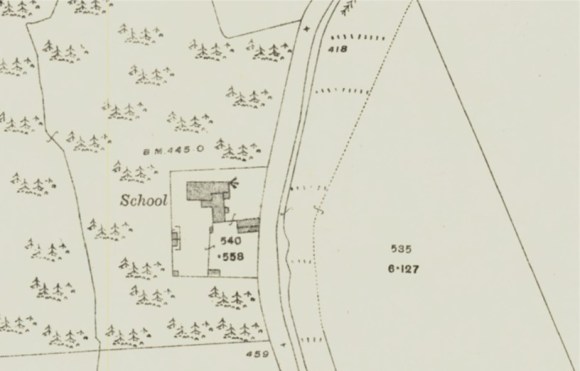
It was not long, however, before discussions began about finding a more central and convenient location. These rumblings provided a backdrop to the next four decades! Meanwhile, in 1907, the school was the recipient of a gift of 200 books from James Coutts of Paisley – part of a much wider scheme to improve reading. Coutts even provided a bookcase.
Pupils were attracted to the larger schools, such as Comely Park School which was only two miles away. A decision to close the school in 1922 was reversed after a vigorous campaign by the local people which left the Education Committee with a flea in its ear. Pupil numbers continued to fall and in 1924 there were only seven attending. Not surprisingly the headmaster was withdrawn and future staffing was by female teachers. Up until now water had been obtained from rainwater and in 1930 it was found that the cost of joining the school to the water main would be £306. Closure was again considered. As fortune would have it, a few years later the British Broadcasting Corporation built its transmitter nearby and the county architect was able to piggyback on to that project to get water to the school. In 1933 water closets, wash-hand basins and a drinking fountain were provided at the school, and a bathroom for the schoolhouse. However, the smallest school in the county had become the butt of local jokes and during the Second World War the school was quietly phased out.
| Year Arrived | Headteacher | Year Left | No. Pupils |
|---|---|---|---|
| 1849 | Mr Colquhoun | 67 | |
| c 1850 | Peter Penman | c1866 | |
| 1860s | William Fairlie | ||
| 1875 | Mr Kelly | 1884 | |
| 1884 | Allan Carswell | 1901 | 63-81 |
| 1901 | John Davidson | 1902 | 95 |
| 1905 | Thomas Bartlie | 1920 | |
| 1930s | Miss Annie Paul | 1938 | 4 |
| 1938 | Miss Betsy McKechnie | 1943 |
In 1942 the school building was used as sleeping accommodation for the numerous Home Guard units undertaking training at Craigieburn. Weekend courses were intense and supplies were stored in the school. The building still belonged to the County and the house was leased to head teachers from other schools who had trouble finding accommodation. John S Abercrombie of Airth School had it for several years. The school was used for storage. Colonel Forbes asked if he could buy the premises for his estate workers to live in but his offer was turned down. It was the early 1960s before electricity was installed. Finally the school and schoolhouse were sold by Central Regional Council in the 1980s. It is now a dwellinghouse.
Sites and Monuments Record
| Auchengean School Slamannan Road | SMR 2279 | NS 8635 7746 |
 Falkirk Local History Society