
Towards the end of the 17th century Walter Scott from Water of Bonny (i.e, Bonnybridge before the bridge was built) moved to Edinburgh where he traded as a glazier and made a fair amount of money. So, when he came to write his will in 1707 he made out a bequest of £1,000 Scots to pay for the employment of a schoolmaster at Water of Bonny, the bequest to be administered by the Kirk Session of Falkirk. The will stated that the person appointed should be
“ane godly honest poor man that had fallen from his means and had not spent the same in debauched or riotous living, and is of the age betwixt 40 and 50 or thereby.”
These were rather confined parameters but Scott clearly knew what he wanted. Scott died in 1715 and the Kirk Session got in touch with Walter Scott’s son, also named Walter Scott, to see if he had any recommendations for the post of schoolmaster. He recommended William Scott in Skipperton of Seabegs, one of his relatives, who was a qualified teacher. The Kirk Session recognised that William Scott did not fulfil the conditions of the Will and sought the advice of the Presbytery, which came to the same conclusion. Walter Scott junior then offered to give money towards the building of a schoolhouse should his relative become the teacher and as a result both Presbytery and Kirk Session acquiesced to the appointment. William Scott became the first teacher of the school in November 1715.
It was several years before a school was actually built and presumably the handful of pupils and the schoolmaster met in rented accommodation until then. The income from the bequest only provided a modest salary for the teacher and he evidently did little beyond the bare essentials. The school did not meet over the long summers or at harvest times and even in the winter months the hours seem to have been 11am to 2pm. At the end of March many of the pupils had to help on the family farms and the number of pupils dropped to seven or eight. In 1740 the Kirk Session took William Scott to task for his slackness and neglect of duty. It laid down new rules for the school – it was only to close for a maximum of six weeks during harvest time, the hours of opening were to be 10am until 3pm with an hour for lunch. It was also agreed that William Scott would move to live closer to the school, though Skipperton was only one and a half miles away. When the Kirk Session checked in 1744 the school hours were only 10am-2pm and the teacher was still living at a distance, which is why he said he could not open longer; whereupon the Kirk Session found him a house nearer the school. Perhaps realising that the game was up, William Scott resigned.
Strangely, William Scott’s son, Walter Scott then got appointed to the post. No explanation is given as to why it was allowed to be kept in the family. Unfortunately, this Walter Scott proved to be no more diligent than his father. When members of the Kirk Session paid another visit to the school, on 16 April 1762, the only two boys present were the nephews of the schoolmaster! Walter Scott the still younger was given another chance but things had not improved by April 1764 and he was informed that the Kirk Session would cease paying him unless there was an immediate improvement. This produced a modest improvement.
The school struggled on under the same strains for decades – poor attendance, poor teaching and long long summers. When John Grindlay of Bonnyside House was sent to the school around 1819 he was one of only three pupils. The numbers failed to increase and in the mid 1820s the school closed for many years and the building went to ruins. It was rebuilt and “a cripple” was appointed as the teacher (this may have been William Geddes who had lost the use of a hand; he later went to Laurieston School).
The school was almost certainly on the north side of Main Street opposite Barleyhill where it remained for the rest of its existence as a public school. Buildings are shown here on Roy’s map of 1755 and on Grassom’s map of 1817. In 1830 Peter Roberts was appointed as the schoolmaster and this issued in a new era in which the masters received fees from the pupils to supplement the meagre salary. Things improved slowly thereafter. In 1850 it was with delight that the examiners from the Presbytery noted that five pupils there were studying Latin, surely a sign of high standards. When the post became vacant in 1855 it was advertised with a salary of £4 and a free dwellinghouse. Walter Gardner was appointed by Rev William Begg. Gardner seems to have been a strong advocate for the establishment of a church in Bonnybridge – of whatever denomination would do so. In his attempts to introduce formal services he obtained the assistance of ministers of various denominations and set up a well-attended Sunday School. This cannot have gone down well with the Kirk Session who paid him and he seems to have been at loggerheads with part of the local population. The result was that a non-denominational School was established at Glenside in 1858.
At a meeting in 1859 Gardner felt it necessary to say that
“So long as I am the schoolmaster of Bonnybridge School, I shall never condescend to acknowledge the usurped and self-elected right of any illiterate and vain individual to interfere in the management of the school, but that upright and straightforward rev. gentlemen [William Begg] and his kirk session.”
Six months later he left. With his departure the minister of Dennyloanhead Church wrote to William Begg saying that he would willingly agree to have one school instead of two and that he was sorry about the trouble that had taken place. Begg and the Falkirk Kirk Session agreed to set up a Committee of Management composed of members of the Falkirk Kirk Session and three of the Subscribers to the teacher’s salary. At a public meeting in Bonnybridge the three representatives were selected and a petition was put forward asking that John Cuthell, who had only been appointed to the Gateside School a few weeks before, should be allowed to fill the vacancy at Bonnybridge School. The Kirk Session acquiesced.
It was at this point that the Ordnance Surveyors wrote that it was:
“A small school in the east end of the village of Bonnybridge. The average number of scholars is about forty males and 43 females. The teacher’s salary, exclusive of school fees, is £4 per annum – being the interest of £100 bequested for that purpose. He has also a free house and garden. The school is under the management of the kirk session of the parish, who appoint the teacher.”
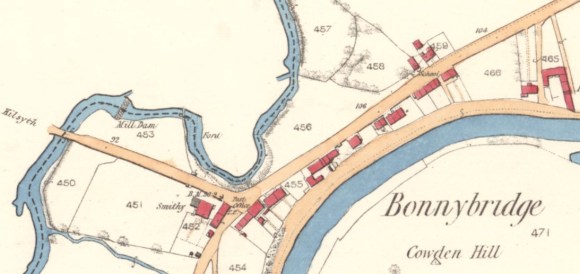
The contemporary map shows the small building with its southern gable against the road. Cuthell had 60 pupils each paying 2d to 3½d per week.
Late in 1862 the then teacher gave warning that he was about to leave. George Ure, after consulting his business partner, James Smith, called a meeting at his house at which it was agreed that an effort should be made to raise money to enlarge the schoolroom so as to get the Government grant, and also for the teacher’s salary. This ad hoc committee made up of Messrs Turnbull, Mitchell, Grant, Wellstood, and Ure, met with Rev Begg and the Kirk Session in Falkirk to discuss the matter and it was decided that the group should be formalised as a management committee for the school. They advertised for a teacher and were fortunate in selecting William Gillespie who was to remain there for forty years. The committee, with the assistance of Rev Begg and the Falkirk Session, collected money sufficient for the purpose. The old schoolroom was raised in the roof and the floor, and a wing added. The school now had seating for 180 pupils and officially opened on 22 September 1863. Year by year new forms, new tables, new maps, and such like were added. Now a Government Inspector examined the school alongside the representatives of the Presbytery.
Being publicly minded, the management committee held open meetings and published its accounts in the Falkirk Herald.
Income
| 1867 | 1869 | |||
| James Ross, chemical works | £1.0.0 | |||
| Proprietors in Columbian Stove Works | £10.0.0 | Proprietors in Columbian Stove Works | £20.0.0 | |
| Workmen in Columbian Stove Works | £3.11.6 | Workmen in Columbian Stove Works | £5.16.6 | |
| George Turnbull, Bonnybridge | £2.0.0 | George Turnbull | £2.0.0 | |
| David Gillies, Bonnybridge | £1.0.0 | David Gillies | £1.0.0 | |
| Peter Grant, Bonnybridge | £1.0.0 | Peter Grant | £1.-.- | |
| William Wilson, Banknock | £1.0.0 | James Wilson | 10s | |
| James Russel, Bonnyfield | 10s | James Russel | £1.0.0 | |
| George Paterson | £2.0.0 | |||
| J & D Paul | £1.0.0 | |||
| Teetotal Society | £1.0.0 | |||
| Collections at sermons in schoolhouse | £6.14.0 | |||
| Scott mortification | £4.0.0 | Scott mortification | £4.0.0 | |
| Second subscription | £2.10.6 | Collections | £7.2.5 | |
| Balance due Treasurer | £11.13.2 | |||
| Total | £34.6.0 | Total | £57.2.2 |
Expenditure:
| 1867 | 1869 | |||
| Teacher’s salary | £25.0.0 | Teacher’s salary | £25.0.0 | |
| Cleaning and painting school | £4.12.0 | Cleaning & c. | £5.19.8 | |
| Carriage hire & c | 14s | |||
| Six new tables | £4.00 | |||
| Total | £34.6.0 | Total | £57.2.2 |
Not mentioned in these accounts is any payment for the female assistant who taught sewing, needlework and knitting – known as “industrial work.” Early in 1866 a department was introduced into the school for girls under a Miss Scott – who became Mrs Gillespie, the wife of the head teacher.
As the numbers of pupils increased the accommodation had to be enlarged. In May 1866 £120 was spent on this. Although managed by a board of trustees, it was still a parochial school and so in 1873 it was passed over to the Falkirk Parish School Board. At the handover George Ure pointed out that the existing school had served the inhabitants of the two parishes of Falkirk and Denny almost equally – he and most of his workforce living on the Denny side of the River Carron. He hoped that this would continue to be the case and that there would be no point of discord between the Denny and the Falkirk Parish School Boards – his hopes were soon dashed.
| Date Arrived | Headteacher | Date Left | No. Pupils |
|---|---|---|---|
| 1715 | William Scott | 1744 | |
| 1744 | Walter Scott | 1766+ | |
| c1815 | Closed | c1825 | |
| William Geddes?? | |||
| 1830 | Peter Roberts | 1834 | |
| 1834 | John Henderson | 1837 | |
| 1837 | Mr Harkness | 1838 | |
| 1838 | Mr Roberts | 1846 | |
| 1846 | James Hunter | 1848 | |
| 1848 | Andrew Philip | 1849 | |
| 1849 | George Kirkwood | 1854 | |
| 1854 | Joseph Lyall | 1855 | |
| 1855 | Walter Gardner | 1859 | |
| 1860 | John Forrester? | 83 | |
| 1860 | John Cuthell | 1862 | 60 |
| 1862 | William Callendar | 1863 | 36 |
| 1863 | William Gillespie | 170 |
Sites and Monuments Record
| Bonnybridge Parochial School, Main Street | NS 8259 8040 |
 Falkirk Local History Society