

When the Falkirk Parish School Board was set up in 1873 it was offered the old parochial school in Bonnybridge by the Kirk Session and the trustees. Difficulties arose, however, over the lack of proper title deeds. It was September before the Department of Education sanctioned the transfer of the property, by which time the School Board had already condemned the accommodation there. The Board had already determined to construct a new school in the village. Mrs Strachan agreed to feu 1,600 square yards of land to the west of the old school and this was had on valuation. T B McFadzen was commissioned to produce plans and in December attended a Board meeting to discuss them. In the meantime negotiations were opened with the Denny School Board to form a combination school as just under half of the pupils attending the school at Bonnybridge came from that parish. It was agreed that Denny would pay one third of the cost of construction so that that proportion of pupils could attend from north of the River Bonny (no time limit was put on this and when further extensions were added Denny insisted that they were entitled to one third of the increased capacity). Falkirk Parish School Board undertook the construction work and future management of the school.
The Falkirk Kirk Session handed over responsibility for the Scott Bequest which helped to pay for the schoolmaster. In the meantime additions were placed on the old school to serve until the new one was ready. The extra schoolroom for 40 children was completed and ready for the new term in August 1874. The cost of £101 16s 2d was much higher than anticipated and George Ure donated £11 16s 2d to keep them down.
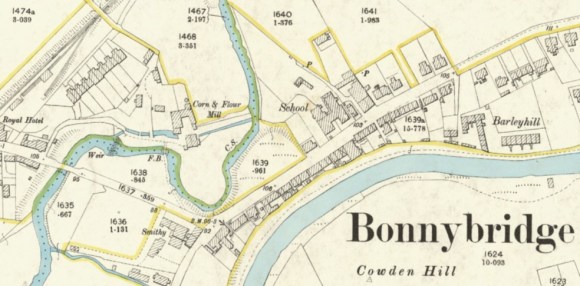
The site of the new school sloped away to the north towards the river and so the main road was at a higher level than the buildings, consequently the school was set a little back to allow light into the schoolrooms. The single-storey school was planned on the narrow-roomed principle to accommodate 300 pupils, and consisted of a large schoolroom, infant schoolroom, and two small classrooms. There were raked or gallery floors in each of the classrooms except that for the infants. The building had two principal entrances on the south side – one for girls and infants, and the other for boys – so arranged that admission could be gained into any of the rooms without disturbing the teaching in any of the other apartments. Ventilation was by openings in the ceiling of each room, with horizontal shafts in the roofs, all led into a belfry and thence to the open air. The bell summoned the pupils to classes. The heating was by open fireplaces in each room. The total cost of the school was £1,951 7s 11d (after the deduction of a £380 grant from the Department of Education), on top of which there was £847 19s 10d for the teacher’s house. It was officially opened on 4 March 1876 and a month later the Denny School Board paid £300 as its contribution – which was nowhere near a third! The “Auld Schule” was sold by public roup on 11 May, fetching a mere £300. The following month James Smith of Benvue, Dowanhill, Glasgow, donated £500 to the landward School Board of Falkirk, the interest of which was to be applied for prizes to meritorious pupils attending Bonnybridge School. Smith was one of the founders of Smith & Wellstood. The incentive not only enhanced the performance of the pupils but also increased their numbers. The following year Smith increased the size of his donation so that it would produce interest of around £20 a year.
The school was a victim of its own success and just five years after it had opened it needed to be enlarged. For the last four of those years Bonnybridge had been growing at a rate of 37 pupils annually. Correspondence with the Denny Board soon revealed it intransigence when it came to further financial input. A visit to the school in 1880 showed that the passages were taken up with forms and it was with great difficulty that anyone could get past the scholars. Talk of temporary additional accommodation was soon dismissed, what was needed was a substantial addition. The public demanded action and a bill (poster) was circulated stating:
“To the inhabitants of Bonnybridge, A public meeting will be held in the School House on Monday evening, 17th inst., at 7.30, to take into consideration the overcrowded state of the school, and to adopt measures to get an addition thereto. Working men of Bonnybridge! Will you allow your children to be steamed and stewed alive? There are fifty more children attending school just now than the school is fitted to hold, and the polluted atmosphere is ruining the health of your children. Let every man be present. You pay your rates. Demand your rights. By order.” (Falkirk Herald 22 May 1880, 4).
The quickest fix was to make internal alterations and to put on a small extension to accommodate a further 90 pupils and in 1881 quarter of an acre of land was acquired to extend the playground.
As is often the case, the quick fix was little more than a patch and in 1888 the Falkirk Parish School Board decided to provide a further 154 places at a probable cost of £1,350. George Deas Page was instructed to draw up plans to broaden the school so that each row of desks could hold more pupils, and to add an upper storey. Seven times his plans were submitted to the Department of Education and each time they were rejected. The Department saw the scheme as too expensive and failed to see the need to make the classrooms wider. In truth the reason for this had been to fit more pupils into each class with a single teacher. Page was accused of professional ineptitude and it was only upon investigation that it was realised that he had been constrained by the Board itself. It was May 1890 before the final plans were approved and immediately tenders were invited:
“To Contractors. Contractors desirous of Tendering for the Digger, Mason, brick, Carpenter, Joiner, Glazier, Slater, Plumber, Plaster, Smith, Iron, and Painter Works of proposed Alterations and Additions to Bonnybridge Public School, for the Falkirk Parish School Board, may inspect the Drawings and Specifications, and apply for Schedules of Measurement at the Office of the Architect.
Offers to be lodged with the Clerk, B. Watson, Esq., Bank Street, Sealed and Endorsed, “Tender for Additions to Bonnybridge School,” not later than Monday the 30th curt. The lowest or any Offer may not be accepted. G. DEAS PAGE, Architect. Old Glebe Chambers, Newmarket Street.” (Falkirk Herald FH 21 June 1890, 1).
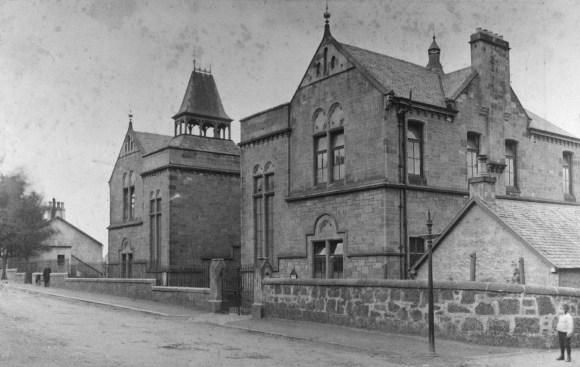
The work was difficult and progress was slow. Accommodation was provided for the students in the Parish Church hall whilst this was going on and over the summer of 1891 the headmaster had to move out of his house. On the understanding that the school would not reopen until his house was fit for him to return, he rented a house in Potobello and moved there with his family. For this disturbance he was given an allowance of £10 a month, but when the new term started the schoolhouse was not ready and he had to leave his family behind. It was spring 1892 before the entire works were completed. The Denny Board refused point blank to contribute. Eventually they were brought to the negotiating table by threats from the Department of Education and in May 1896 reached an agreement whereby Denny would pay £1 per scholar above 150 in attendance at Bonnybridge School.
It was shortly after that another long-lasting dispute between the two school boards was settled. Denny was one of the first Boards to introduce free books and believed that its young parishioners attending Bonnybridge School should be given the books by the Falkirk Parish School Board which did not introduce that policy for another twenty or so years. This demand is all the more incredible when it is realised that the school rates for the Denny children went to the Denny Board.
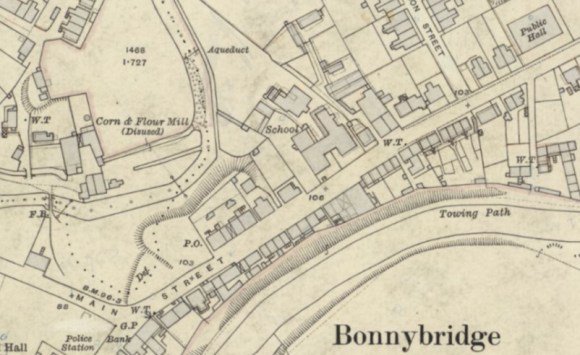
Unsurprisingly the Denny School Board sent more than its share of pupils to Bonnybridge and the school was unable to cope. Tired of the manoeuvrings of Denny, it was decided to turn away the surplus – 69 scholars. This led to the construction of a school in the Dennyloanhead area. Even so, it was necessary to extend Bonnybridge School yet again but the intended work had to be delayed due to the First World War. After the war, in 1923, it was decided that an intermediate department would be introduced at Bonnybridge requiring more accommodation. To a certain extent the problem was alleviated by the removal of Roman Catholic pupils to St Joseph’s the following year.
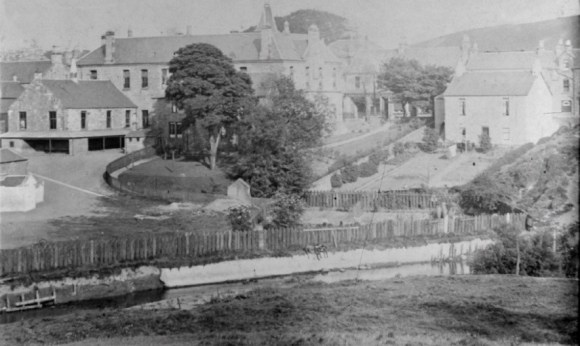
A county library was opened in Bonnybridge School in 1935 and continued successfully until 1950 when it was moved into a room in the Public Hall formerly used by the Ministry of Labour. Bonnybridge School moved from being a Secondary School to a Primary School in 1959.
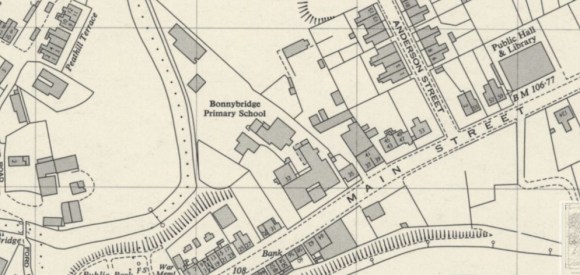
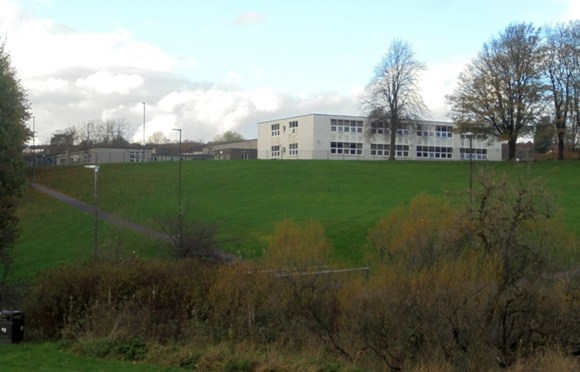
In 1960 Stirling County Council returned to the need for a modern replacement for the school and in June of that year bought that part of the old Kilsyth and Bonnybridge Railway track from Peathill Bridge to Highland Dykes Crescent. Construction began the following month and Bonnybridge Primary School opened on 20 February 1962. The official opening was on 26 April. The school had accommodation for 450 pupils in sixteen classrooms and cost £105,000. The bell from the old school, dated 1874, is on display but no longer in use.
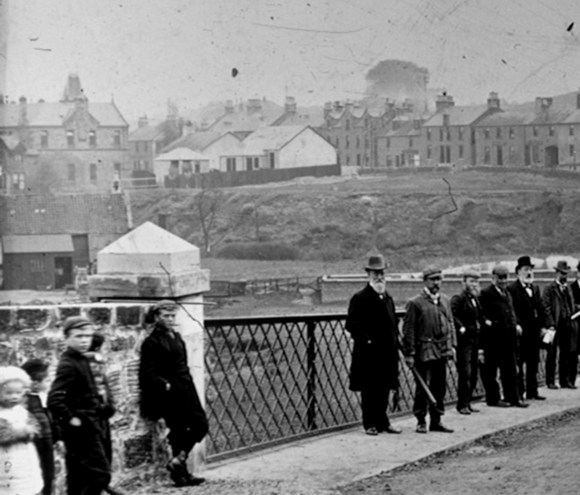
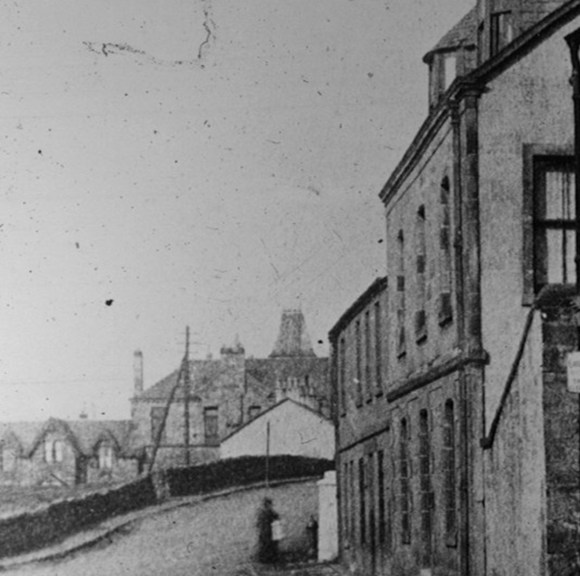
The old school on Main Street was then demolished and the Bonnybridge Social Club built on its site. This, in turn was demolished in 2015 and in 2022 a block of flats was opened.
| Date Arrived | Headteacher | Date Left | No. Pupils |
|---|---|---|---|
| 1863 | William Gillespie | 1904 | 415 (1887), 461 (1890) |
| 1904 | David Spence | 1930 | 345, 576 |
| 1931 | Robert Jenkins | 1935 | |
| 1935 | Gilbert Gray | 1946 | |
| 1946 | Hugh G Stark | 1959 | |
| 1959 | WilliamTait | 1967 | |
| 1967 | Clive Sidall |
Sites and Monuments Record
| Bonnybridge Public School Main Street | SMR 1240 | NS 8256 8039 |
 Falkirk Local History Society