
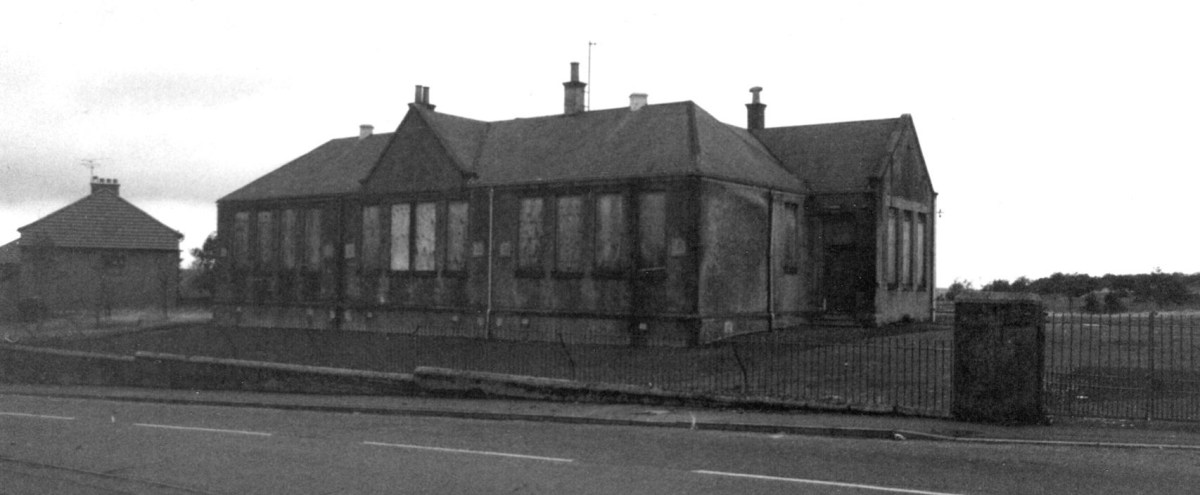
In 1903 John G Stein, brick manufacturer, asked the Landward Education Board to consider the provision of a new school for his workforce at High Bonnybridge which was dramatically increasing and for which he was building housing. There was much discussion but nothing happened. The question of a school at High Bonnybridge was raised many times and finally, in late 1911, the School Board proposed to build the Broomhill School for children up to the first standard.
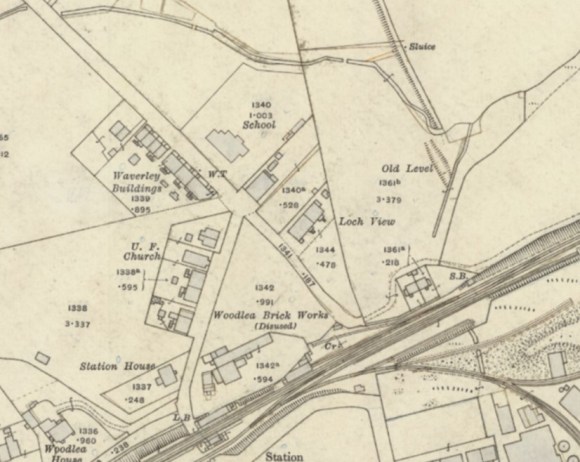
The school was built at the junction of Broomhill Road and Church Street adjacent to the Co-operative shop and opened 11 August 1913 with 72 pupils. Miss Mary Knowles was transferred from Greenhill School to be the first head teacher and with her went Isabella Crawford. The school stood back from the road at a high level, presenting a more imposing feature than its relatively small size might suggest. It was built in a simple manner for economy combined with efficiency, and provided accommodation for 150 scholars. This consisted of three classrooms, a teachers’ room, a cloakroom and a hall. It was designed by P and C Hamilton, Falkirk, architects, in such a manner that it could be extended without any internal alterations being necessary. Heating was by anthracite stoves and radiators supplied, naturally enough, by Smith and Wellstood Ltd of Bonnybridge. The contractors were: mason work – John Gardner, Falkirk; joiner work – James Gray, Bonnybridge; plumber work – Thomas Spreat, Glasgow; plaster work – Thomas McGregor & Sons, Laurieston; slater work – David Thomson, Redding; painter work – John MCallum, Bo’ness; glazier work – Daniel O’May, Falkirk; iron work – Bryden & Middleton, Glasgow.
The year after Broomhill School opened it was reported that people were entering the playground shed there in the evening and gambling. A suggestion that a house be built adjacent to the school was rejected. The age range of pupils taught at Broomhill seesawed as the School Board made numerous arrangements only to change them again and again. For the first 12 years it catered for all congregations, but when St Joseph’s RC School opened in 1925 some 34 pupils transferred to it.
When it was first built there was no artificial lighting in the school. Oil lamps were introduced around 1920 and electric light was installed in 1935. This meant that black-out precautions had to be introduced in 1939 with the outbreak of war. That autumn the school was late in returning as the air raid shelter was only completed in May 1940. The following year saw the introduction of school meals cooked at the Community Feeding Kitchen (Science & Arts School) in Park Street, Falkirk.
Following a reorganisation of Educational provision in 1947 all of the children in Broomhill and High Bonnybridge over the age of seven years were sent to Greenhill School. The Primary 1 and 2 pupils stayed on at Broomhill, which then became known as the “Wee School.” This decision was reversed in 1954!
A radical shakeup was proposed in 1972 which would have resulted in the closure of Boomhill, St Joseph’s, Greenhill and Castlecary Schools and the construction of a single replacement at High Bonnybridge. This was rejected by many of the parents loyal to their own schools and by the Catholics in particular. In 1988 the Antonine School was opened and both Broomhill and Greenhill closed. Broomhill was demolished c1999 and the houses of Lochinvar Place were built on the site.
| Year Arrived | Headteacher | Year Left | No. Pupils |
|---|---|---|---|
| 1913 | Miss Mary Knowles | 1920 | 95 |
| 1921 | Miss Anne Brand | 1938 | 40 |
| 1938 | Mrs Smith (temp) | 1939 | |
| 1939 | Miss Janet B Nicol | 1965 | |
| 1965 | Ralph Watson | 1968 | |
| 1968 | John Kinghorn | 1971 | |
| 1971 | Margaret Thornburn |
Sites and Monuments Record
| Broomhill School | SMR 2184 | NS 8306 79454 |
 Falkirk Local History Society