
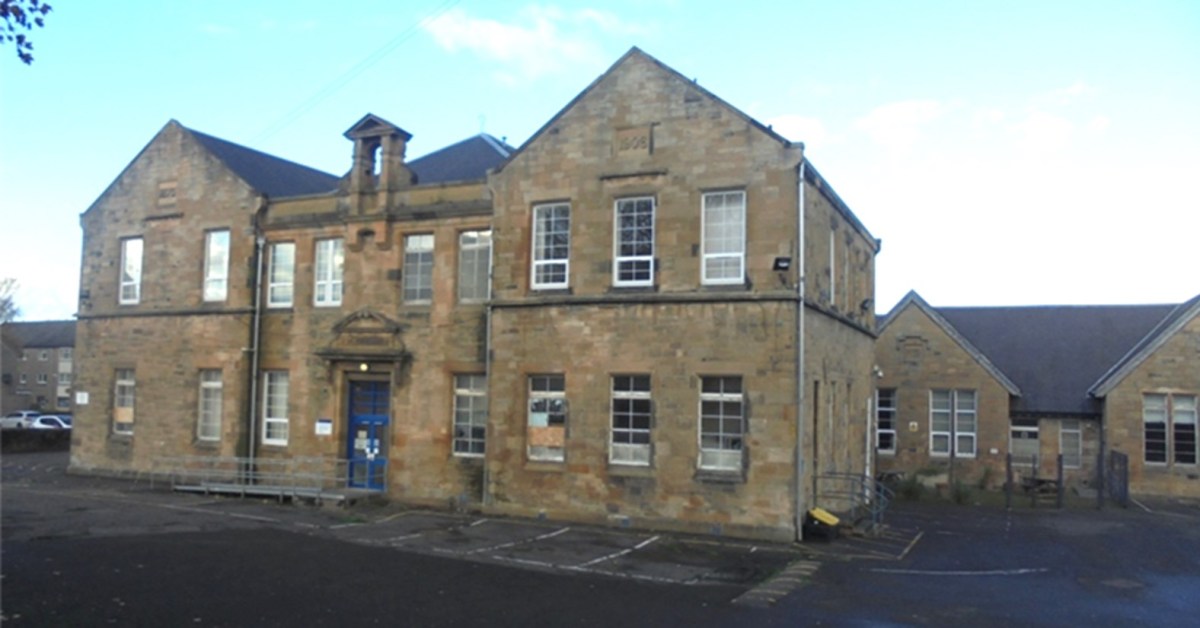
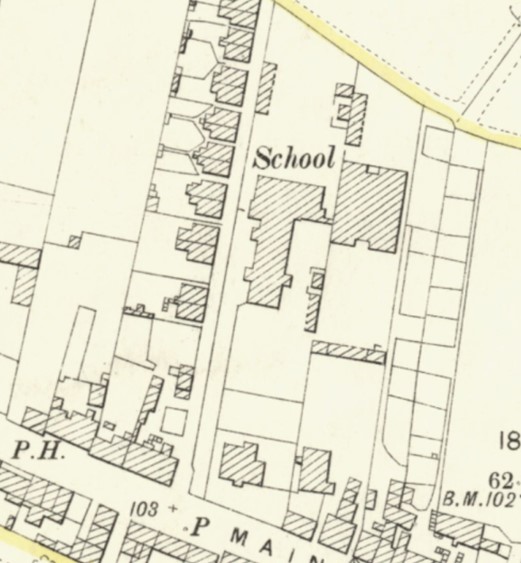
It was opened on 12 March 1876 when the pupils marched to it from the old school. The cost was put as:
| Estimates, Architect’s fees, &c for school | £2125.8.0 | |
| Teacher’s house | £857. 11.1 | |
| Price of House | £250.0.0 | |
| TOTAL | £3232.19.1 | |
| Deduct building grant by Government | £428.8.0 | |
| Leaving payable by ratepayers | £2804.11.1 |
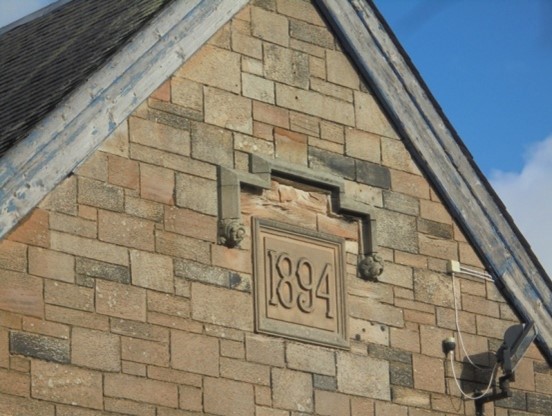
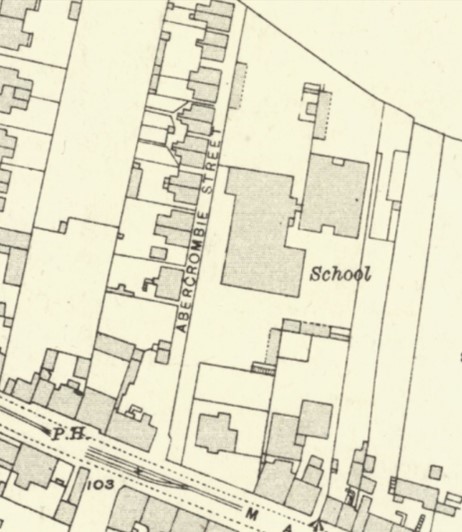
Immediately after its formation the Falkirk Parish School Board started to look for a green-field site at Camelon for the construction of a large school to accommodate around 350 pupils. In 1874 agreement was made with a Mrs Galbraith for a site to the north of the Main Street and T B MacFadzen, architect, was asked to draw up plans. The building was of two storeys on the narrow-roomed principle and was aligned north/south on the east side of a new lane known as Abercrombie Street. Two porches on the west front contained entrances for the girls and the boys. It contained a large classroom, an infant classroom, and two small classrooms. The prominent south gable with its tall chimney and date stones is still recognisable.
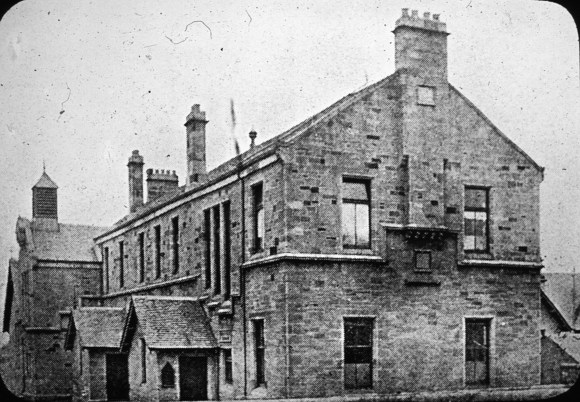
Considering that the old school had held only 87 children it is amazing that by 1883 the new one was overcrowded. Competitive plans were submitted for an extension which was completed early in 1884. The extension was probably that at the north end of the building and increased the accommodation to 500. Even that was not enough and in September 1886 the number of pupils that attended was 537, though there were 643 on the roll.
“To Contractors. Contractors desirous of tendering for the MASON, JOINER, SLATER, PLUMBER, PLASTER, and PAINTER WORKS of proposed ALTERATIONS and ADDITIONS to CAMELON PUBLIC SCHOOL for the Falkirk Parish School Board, may inspect the Drawings and apply for Schedules of Measurement not later than the 14th inst., at the Office of the Architect, G. Deas Page, Old Glebe Chambers, New Market Street…” (Falkirk Herald 7 May 1887, 1).
The infant department which had occupied the 1884 addition was shifted to the Camelon Public Hall during the buildings works. This was absolutely necessary because the work that was completed in 1887 placed a second storey onto that wing. The total school accommodation was then 711. The work cost £1,533 exclusive of the architect’s fees and so a loan of £1,600 was procured from the Public Works Loan Commissioners.
The 1887 addition did not resolve the problem that the school had experienced with regard to its water supply. It was noted that too many of the scholars rushed to the village pump for water during breaks, and were in danger of being hurt by vehicles on the public road. It was therefore decided that two small cisterns could be fitted up inside the school, one for boys and one for girls, and filled daily with drinking water for them. In December 1877 the cisterns were supplied by Mr Borland, ironmonger, at £10 14s 6d, that being the cheapest tender. Water from the mains finally arrived late in 1892.
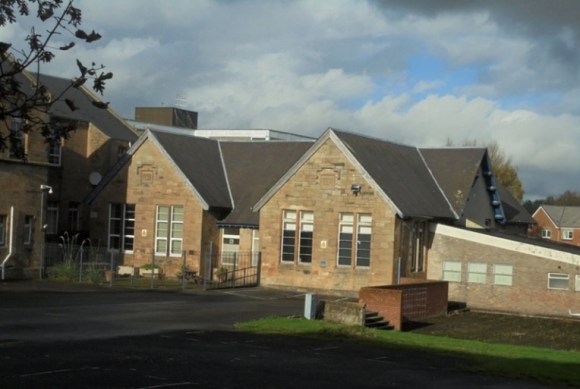
Those last years of the century saw the establishment of iron foundries and chemical works in and around Camelon and the village experienced another growth spurt. In November 1893 the Falkirk Parish School Board obtained the permission of the Department of Education to enlarge the school yet further and to obtain a loan of £3,400, spread over a period of 30 years, for the purpose. The addition came in the form of a separate block to the east requiring an intake of further ground. It was designed by A & W Black and was ready for painting in November 1894. It had accommodation for a further 416 pupils bringing the total for the school to 1,127. As it was a single storey it cost only £700. There was no formal opening.
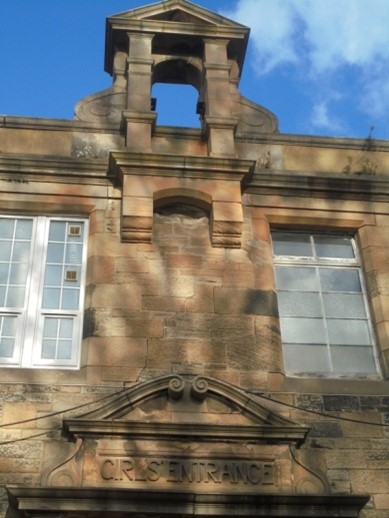
In October 1897 the wooden belfry was found to have shaken the adjoining masonry and so estimates were obtained to have it rebuilt. Not everything was that straight forward. The school now needed more staff and the School Board soon found itself at odds with the staff and the public. The people of Camelon still reckoned that they should have a say in the main posts and in June 1900 around 600 of them attended an open air meeting to discuss the appointment of an assistant head – truly amazing! At the same time the School Board was looking at yet another extension to the school. Between 13 August and the beginning of September 1900 some 177 children were added to the school roll. To alleviate the overcrowding a new school was to be built at Carmuirs. In the meantime the gymnasium in Union Road was leased, and an iron building with three classrooms was erected in the playground.
Shortly after five o’clock on the morning of 22 December 1905, a policeman on his beat observed flames issuing from Camelon Public School. Falkirk Fire brigade was summoned, and on reaching the scene it was found that the flames had got a firm hold of the original part of the school buildings and it was gutted. The brigade succeeded in saving the two north wings from destruction. The damage was in the region of £2,000 and was covered by insurance. It was thought that the fire originated in the teachers’ room, in which a fire had been left burning the previous evening. The earliest school records were destroyed by the fire. The School Board decided to take the opportunity to enlarge that part of the school and A & W Black produced plans with a central hall.
The fire-damaged part was rebuilt and considerably extended; and was opened by Rev Ross Taylor on 20 May 1907. He was presented with a key inscribed “Presented by the architect and contractors to the Rev. A. Ross Taylor on the occasion of the opening of Camelon School, 20th May 1907.” The two-storey extension enclosed a large hall, 52ft long by 30ft wide, with separate entrances and cloakrooms for boys and girls. Off this hall, on the ground floor, there were five classrooms, a head master’s room and a male teachers’ room. A spacious gallery ran round the upper part of the hall, and from it entrance was got to five classrooms, a cooker room, an infant mistress’s room, and a female staff room, and also to cloakrooms for boys and girls. It accommodated 580 scholars, and the total cost of the extension and reconstruction amounted to about £5,000. The contractors were: mason work – John Gardner, Falkirk; joiners – J & A Man, Falkirk; slater and plaster work – James Millar, Falkirk; plumber work – A & G Robertson, Falkirk; tile work – Field & Allan, Edinburgh; painter work –O’Brien & Meek, Falkirk; glazier work – Daniel O’May; heating works – James Cormack & Sons, Glasgow.
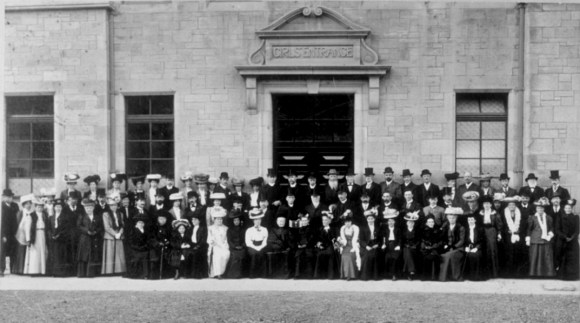
Present at the opening ceremony were Mr J C Gilchrist, convenor of Camelon School Committee; Rev A Ross Taylor, chairman of Falkirk Burgh School Board; Mrs Taylor; Rev Alex Loudon; Mr A C Rennie; Rev W W Miskimmin; Mr A C Mackay; George McLay; James Hunter, George Nelson, William Erskine, W A Gray. James Cochrane; Rev & Mrs Muirhead; Rev & Mrs J Scott; Dr Mitchell; Mr & Mrs David Davidson; Mr & Mrs Thomas Packman; Thomas Stark Brown; George Hastie, John Smith, Mr Biggar and Mr Frame.
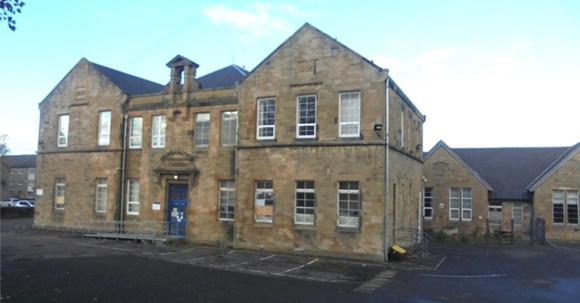
Like most of the schools in Falkirk, Camelon School was taken over at the beginning of the First World War to house part of the Territorial Force. By agreement with the Falkirk Burgh School Board the military removed from the school in September 1914 but remained at Carmuirs School. Camelon School was then used by its own pupils for four hours in the morning and by those of Carmuirs for four hours in the afternoon until 1917.
By the 1930s pupils of secondary age were attending the Advanced Division of the school. The population size had more or less stabilised and the construction of the new school at Merchiston relieved Camelon of its surplus. Although the building was used as a Rest Centre in the Second World War, school life continued with little interruption.
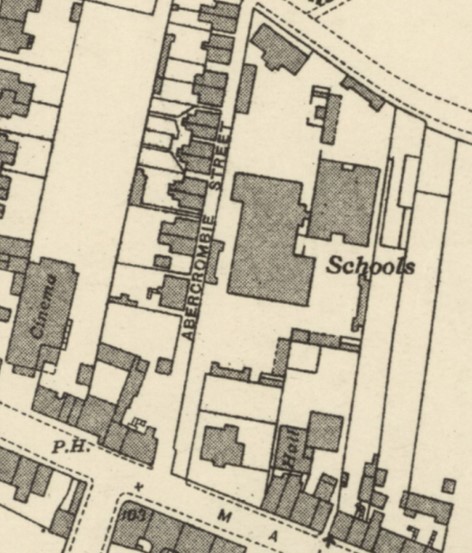
After the war the nature of the provision changed and in 1947 it was proposed to erect a woodwork room, two classrooms and a dining hut to the east of the playground. Arrangements were made with the Falkirk and District Co-operative Society to acquire the land and construction work began in November that year. A slight problem arose when it was found that the Co-op did not own the land and a Compulsory Purchase Order had to be resorted to.
In 1957-59 the school was reconstructed by Alison & Hutchison & Partners placing a large steel-framed curtain-walled two-storey wing added to the north with lower buildings to the east. This included a large dining hall and kitchen. The school was re-named Camelon Junior Secondary School. Some primary pupils were transferred to Bantaskine School in 1958 and the rest to Carmuirs Primary or Easter Carmuirs Primary in June 1960.
| YEAR ARRIVED | HEADTEACHER | YEAR LEFT | No. PUPILS |
|---|---|---|---|
| 1875 | John Ferguson | 1878 | 320 |
| 1878 | David Davidson | 1912 | 633, 750 |
| 1912 | Alexander Allison | 1932 | 778 |
| 1932 | Mr A G Abbie | 1938 | |
| 1938 | Hugh D Ferguson | 1945 | |
| 1945 | John J Moffat | ||
| Wallace Anderson |
Sites & Monuments Record
| Camelon Public School Abercrombie Street | SMR 1882 | NS 8708 8049 |
 Falkirk Local History Society