
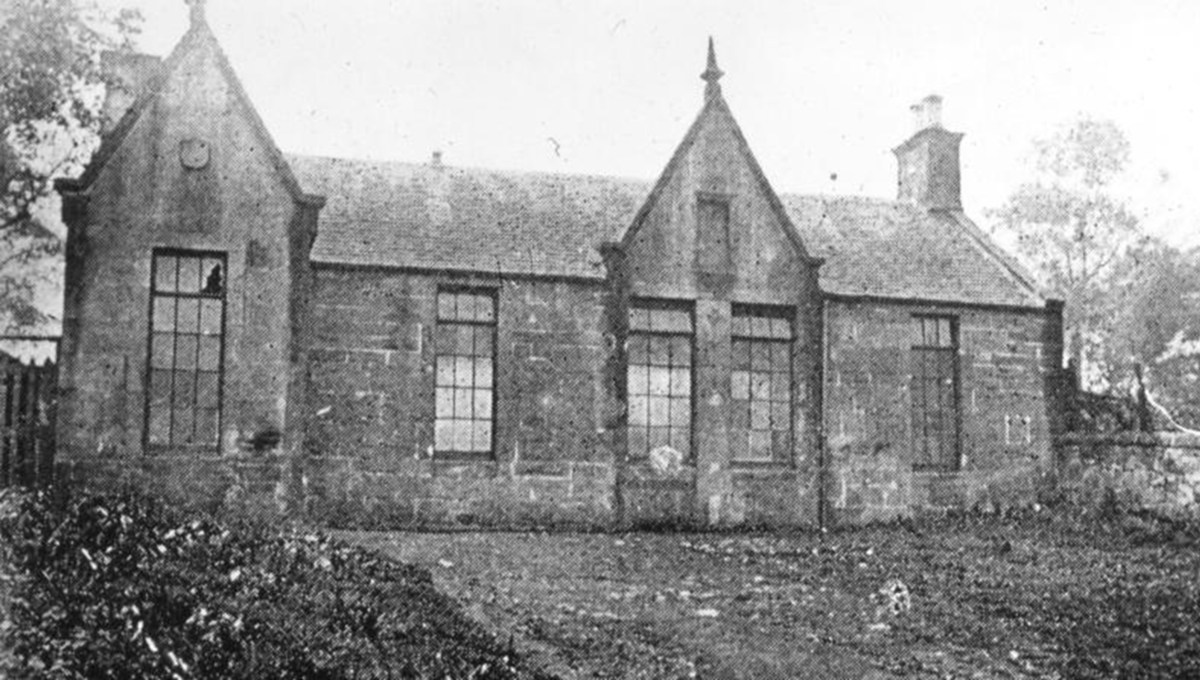
The village of Camelon was created in the period 1740-1760 when a large number of feus were sold off. It was some time before the formal trappings of an organised settlement developed though the feuars were given certain rights to water and the like. From time to time meetings of the feuars were set up to deal with certain issues and amongst these was the need to provide education for the children. The earliest mention of a school is on a now lost subscription sheet dated 21 April 1786
“for the purpose of paying the rent of a dwelling-room for a schoolmaster for the town of Camelon, and fitting it up with tables, forms, etc.”
The hired room was inadequate and the people of Camelon desired to have a building to be used solely as an education establishment. A committee of feuars was appointed in 1791 to improve matters and it approached Mr Forbes of Callendar to ask for a feu which he granted at what was then the extreme west end of the village on the main road. The following is an extract from the charter:
“A disposition, dated the 18th day of August, 1791 year, made and granted by William Forbes, Esq of Callendar, whereby for the causes therein mentioned, he sold, and in feu farm disponed to, and in favour of the said James Stark, John Robertson, Robert Robertson, Thomas Aitken, Alexander Drummond, Francis Buckie and John Kerr, as trustees, and for behoof of alenarly of the feuars and tenants in Camelon and his own tenants adjacent thereto, and to the survivors or survivor of them, the said trustees, and to the persons that may be afterwards approven of by a majority of the said feuars, and at their desire be adopted into the trust as disponees of the aforesaid trustees, or survivors or survivor of them , always for behoof aforesaid.”
From its commencement the school was managed by a committee annually chosen by the inhabitants of the village. The thatched building appears to have been erected in 1794. It has been referred to as a but-and-ben with one room being the school and the other the schoolhouse. On occasions the teacher’s wife used the schoolhouse as a shop to add to the family income. Schoolmasters were appointed by the public without regard to their religion, though the School Committee passed a resolution
“that none had a liberty to vote in chusing a teacher but such as had subscribed five shillings to build the School.”
Among the regulations issued to the teacher was that he teach for six hours each day, except Saturday; the children were to be taught the catechism (then standard); the scholars were not to be asked to do any manual work other than the carrying of coals; and the master was not permitted to keep doves as they were found to injure the thatch. It was also decided to host a Sabbath Evening School – not so much for religious education as
“to keep idle, disorderly, and vagrant children in or about the place from strolling about on that day, breaking into enclosures and destroying the policy of gentlemen and others about or in the neighbourhood of Camelon.”
After five years it was decided to amalgamate the School Committee with that for the public well and the “School and Well Committee” was formed. In 1799 Camelon was first subjected to a regular system of local taxation. For this purpose stent masters were appointed whose duty was to determine the assessment of each inhabitant by judging their ability to pay. Notice was then pronounced by the village bellman and the stent master called to collect it, though not always successfully. The income was spent on periodically re-thatching the school or repairing the well and introducing hand pumps. Voting for the teacher was extended to everyone.
In 1841 the rates chargeable by the teacher were
“½d a week for providing pens and ink; reading 2½d; writing, 3d; arithmetic, 3½d. The other branches by private agreement.”
That was the year that the Statistical Account of Falkirk Parish was written and it was stated that Camelon had two schools,
“one of which was built by subscription, and a Sabbath school supported by a society.”
These would correspond with the names of John Knox and Miss Aitken provided for us in 1837 in Pigot’s Directory. In 1859 the Ordnance Surveyors described it as
“A small school situate at the east end of the village of Camelon, built by public subscription. The teacher is wholly paid by the school fees. Average attendance, male 30, females 30. Education elementary.”
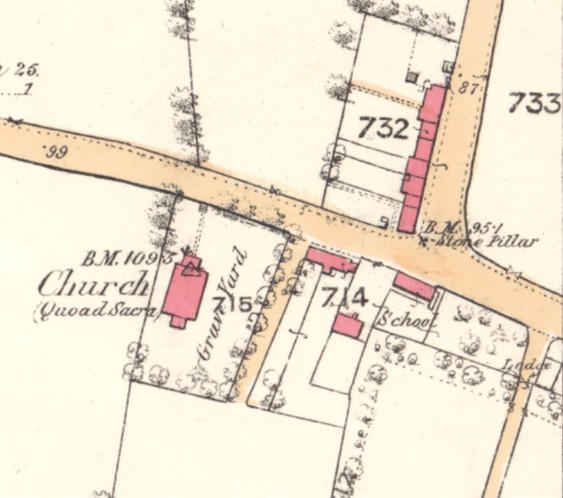
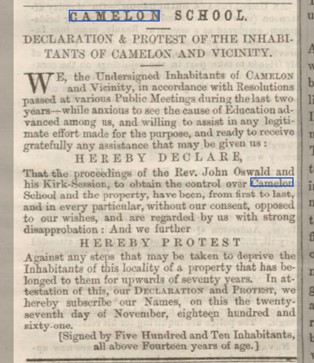
It is unfortunate that the Ordnance Survey men did not give more of a description of the building or an impression of its condition, as they normally did. The omission may have been deliberate as the condition had led to a bitter dispute. Thatched buildings require periodic replacement of the reeds and this was evidently the case in 1857 when a Government Inspector condemned the building. Unfortunately, the School and Well Committee with its limited resources had to spend a substantial sum on the public well at that moment and the school project had to be left for a future date. John Oswald had been minister at the nearby Camelon Parish Church since 1849 and decided to take the school in hand. He ascertained that the original school trustees were all dead and although two replacement trustees had been chosen to succeed them the property had never been transferred to them. Indeed, the wording of the charter would seem to have made such a legal transfer unnecessary. In any case, Oswald approached William Forbes with the information that the charter was now defective and persuaded him as superior to grant a charter of novo damus transferring the property to the Kirk Session of Falkirk. Notification of the transfer was then posted on the kirk door. Few in Camelon believed that the note was authentic because they had not been consulted and the result was that it was recorded in the Register of Sasines on 12 February 1861.
Rather late in the day, the general populous of Camelon became aware of the transaction and at a well-attended meeting at the School they accused the minister and a small party of fanatical supporters of usurping the public rights to Camelon School and calling themselves a school committee,
“depriving the public of their right in the property of the school, and converting it into a sectarian institution.”
They elected a committee of managers to preserve their possession of the school with Robert Tweeddale, the schoolmaster, as its secretary. In all probability the parish minister had been keen to get rid of the teacher as he did not belong to the Established Church!
Things got heated and inflammatory language was used on both sides – with the church coming of the worse in the minds of the public for these exchanges. The School and Well Committee, finding that a new charter had been granted to Mr Oswald and the kirk session, agreed to acquiesce if a fair representation of the feuars and householders was granted in the managing committee; the same to be embodied in the titles. Rev Oswald refused such an embodiment, averring that he held the titles, and would rebuild the school. The School and Well Committee had possession of the building and refused to hand it over, resolving to take legal steps in their own defence should any attempt be made to dispossess them of it.
Tempers frayed and things came to a head in late April in a typically Camelon fashion. The minister was caught walking down the main street and was pelted with stones by a large crowd. He was forced to take refuge in a private house for his own safety and was eventually rescued by the police and escorted out of the village. The mob sensed victory and a drummer shadowed the retreating party playing the tune of the “rogue’s march.” The liberal press at the Falkirk Herald and the Stirling Observer supported the local people and their affirmative action and published this statement:
“The School and Well Committee are thoroughly determined stoutly to resist any active interference with the school on the part of the kirk session and their party, and steps are being taken to put the school in a more efficient state of repair. Besides the setting agoing of public subscriptions, the committee have decided on a series of Sunday evening sermons in aid of the school, the first of which was delivered last Sabbath evening, by the Rev James Cowie of Denny, and which was peculiarly adapted to the circumstances of the people. The services, in consequence of the largeness of the attendance, had to be conducted in the open air. The weather, fortunately, was very favourable.” (Falkirk Herald 25 April 1861, 3).
This action was just as significant as the stoning. The church in Camelon had only been re-opened in 1848 after the Disruption had caused a five year closure. The services at the school by secessionist ministers not only put up a finger in the face of the established Church, it also hit at the Church’s potential audience and in this they were eminently successful. The preachers were charismatic speakers and mostly well-known figures.
| April 1861 | Rev James Cowie, Denny | 1 |
| May 1861 | Rev Lewis H Irving, Falkirk | 2 |
| May 1861 | Rev Mr Wade, Falkirk | 3 |
| June 1861 | Rev Mr McPherson, Stenhousemuir | 5 |
| June 1861 | Rev Lewis H Irving, Falkirk | 6 |
| July 1861 | Rev Mr Stevenson, Dennyloanhead | 8 |
| July 1861 | Rev Mr Corbett, Newcastle | 9 |
| July 1861 | Rev Mr Miller, EUP Church, Falkirk | 10 |
| August 1861 | Rev Mr Baird, Cumbernauld | 11 |
| September 1861 | Rev Mr Muir, South UP Church | |
| September 1861 | Rev Mr Dobbie, UP Church, Linlithgow | |
| October 1861 | Rev Mr Wade | |
| October 1861 | Rev Lewis H Irving, Falkirk |
The old building was replaced by one on the same footprint with a dressed sandstone frontage having a central gablet with a finial, and a symmetrically placed widow to either side. The roof was now of slate. Shortly thereafter it was extended by a single bay to the east. The new bay was slightly advanced and had a gablet similar to the existing one. It was 1869 before the extended school was opened.
Copies of the Falkirk Advertiser were burnt in front of the Camelon Public Well because they were seen as spreading falsehoods and future sales in the village were halted. Concerts were held in the school to raise the funds necessary to effect the improvements to the building. The performers gave freely of their talents and time. The grand concert of vocal and instrumental music held in October 1861 was to assist in defraying the expenses incurred by the introduction of gas pipes into the school. They were used that evening for the first time to illuminate the “venerable” building
At the end of that bitter year the two sides made contact and a compromise was imposed which sat uncomfortably with both – the school would remain the property of the Kirk Session but it would be managed by the School and Well Committee. Finally, they could start fundraising to make the necessary improvements. In the eyes of many mariners the Established Church had lost its moral authority and the Camelon Working-men’s Christian Association worked not with it, but with the School and Well Committee.
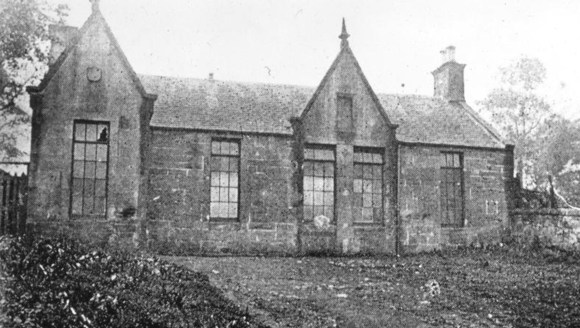
The new school was described in the Falkirk Herald of 5 June 1869:
“The new building consists of one large room capable of accommodating 200 scholars, and containing from 300 to 400 people at a public meeting, being 42 by 20 feet. It is well lighted, having no less than nine large windows. The interior of the school is plain, but neatly got up; the writing desks are close to the wall and are fixtures; while the seats for the bulk of the scholars are situated in the centre of the room. The large apartment is well ventilated from the ceiling; several of the windows are made to open for the admission of a fresh breeze on excessively hot days. Two fire places have been provided as a means of circulating heat in the cold months of winter. The commodiousness of the school internally, in on the whole all that could be desired in a district like Camelon. The exterior of the building has no great display, being plain and simple in design, but truly indicative of the “place of discipline and instruction.” In front of the edifice a large square has been set apart as a playground for the boys, while a similar portion of ground in the back of the school has been laid out, and is intended to be used for like purpose by the girls.”
Ralph Stark, who had played a prominent role in the defence of the property, was also to the fore in the rebuilding. He was also working on gas lighting for the streets of the village and on a sanitary drainage scheme. As he later pointed out, this meant that there was no money to spare as the population of the village was overwhelmingly of the lower working classes. He took out a personal loan of £200 to pay for the school, the burden of which was in due course to fall on the payers of the stent. However, over the next decade only the interest was paid.
Rev. Oswald left Camelon in 1867 and the following decade was much quieter. The passing of the Education Act in 1872 brought about a chance to bury the troubled past. Strictly speaking Camelon School was not a parochial school and so was not automatically transferred to the Falkirk Parish School Board. In this way it was similar to the school at Bonnybridge. Both schools were offered to the Board in 1873 and in both cases the kirk session and the managing committees agreed that this would be free of charge, but that they would like the community to be allowed to use them for evening meetings. At Camelon the two parties met separately and each reaffirmed their sole rights to the property. A general meeting of the feuars of Camelon agreed to the handover.
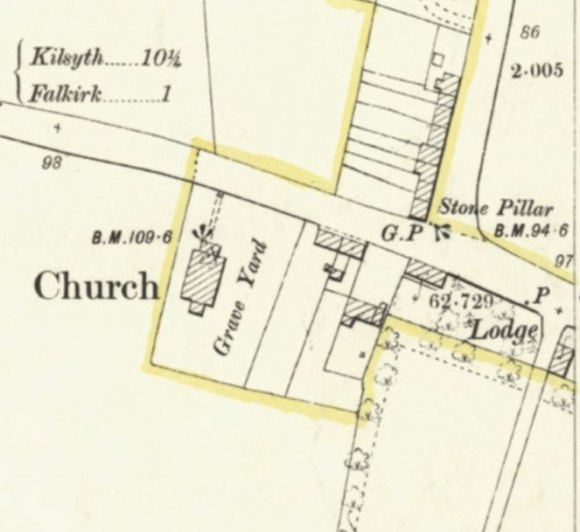
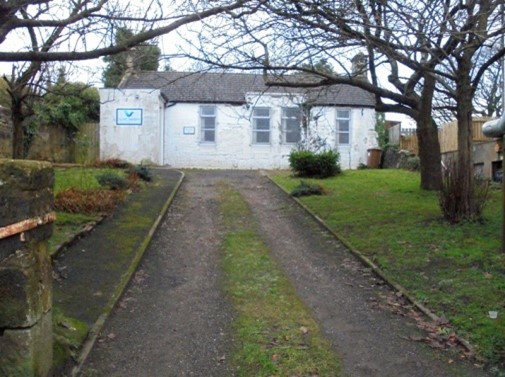
Bonnybridge School, despite problems with the title deeds, was taken on by the Board, but the nature of the debt at Camelon meant that it could not be. In a sense this made little difference to the Board which needed to build a better and much bigger school on a new site in Camelon.
For a short spell in 1886/7 Camelon Public Hall was used to house the overspill from the infant department of the Camelon Public School until the extension there was completed. Ralph Stark had been president of the School and Well Committee for 35 years and was succeeded by Robert Stark until 1902, when Mr Forbes granted a new charter. which was needed because the building and ground had ceased to be used for a school.
| Year Arrived | Headteacher | Year Left | No. Pupils |
|---|---|---|---|
| Mr Seggie | c1796 | ||
| 1796 | Mr Barclay | 1802 | |
| 1805 | John Knox | 1841 | |
| 1841 | Mr Glass | 1844 | |
| 1844 | Mr Slater | 1846 | |
| 1846 | Robert Tweeddale | 1861 | 80 |
| 1861 | Mr Ure | 1869 | |
| 1869 | Mr Walker | 1874 | 87 |
| 1874 | John Ferguson | 1878 | 320 |
Sites and Monuments Record
| Camelon Subscription School Glasgow Road | SMR 2050 | NS 8681 8048 |
 Falkirk Local History Society