
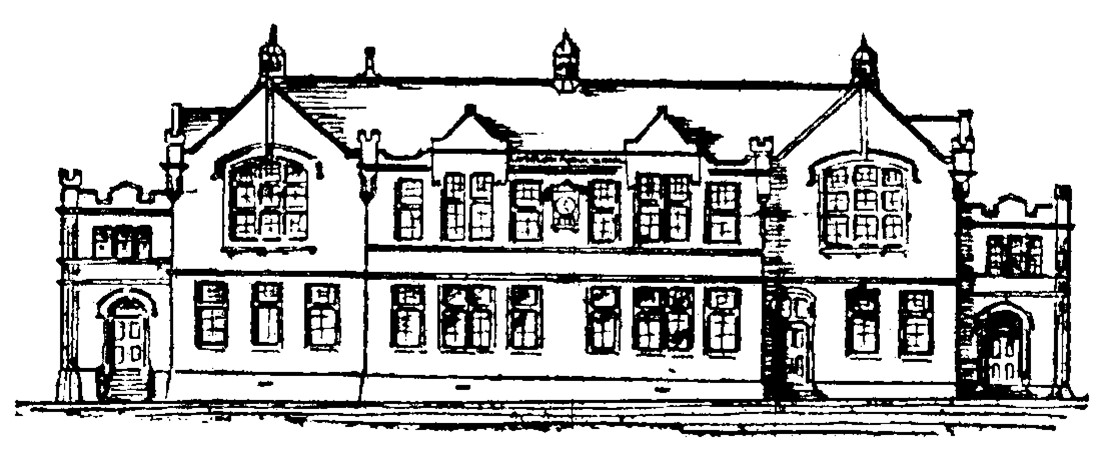
By the end of the nineteenth century Camelon was growing at an astonishing rate and it became apparent to the Falkirk Parish School Board that rather than extending their existing school there it might be preferable to construct another on a brand new site to the south. Accordingly, land was acquired behind the main street in an undeveloped area. It lay to the west of Union Street and it was anticipated that the settlement would expand in that direction – as indeed it did. The design of the new school was put out to competition and Mr Wilson of Edinburgh, the School Board Architect selected the plans of James Strang of Falkirk for a school to accommodate a further 800 pupils. The plans were passed by the Department of Education in 1900. In March 1901 a loan was arranged with the Glasgow Savings Bank in order to fund the project.
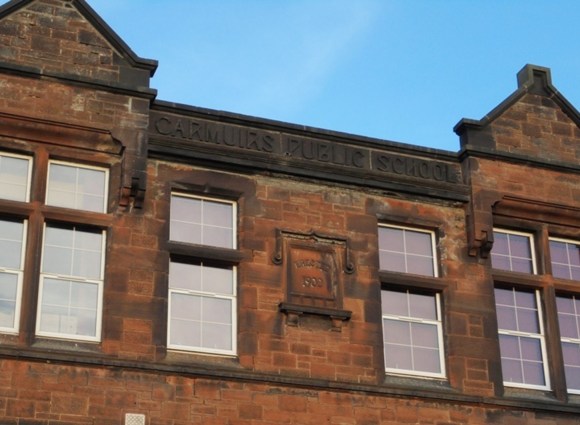
Building work began in 1901 – but the inscription on the face reads “ERECTED/ 1900”. This was not an accident. Camelon had just been incorporated into the Burgh of Falkirk and so, late in 1901 the Department of Education made the School Board area co-terminus with the new burgh area, thereby including Camelon and part of Carron in the remit of the Falkirk Burgh School Board. The Department stated that the new school at Carmuirs was to be transferred to the new Board on 15 May 1902 “in so far as it is erected” on that date. By putting the date at which the design had been drawn up the Falkirk Parish School Board was taking credit for it.
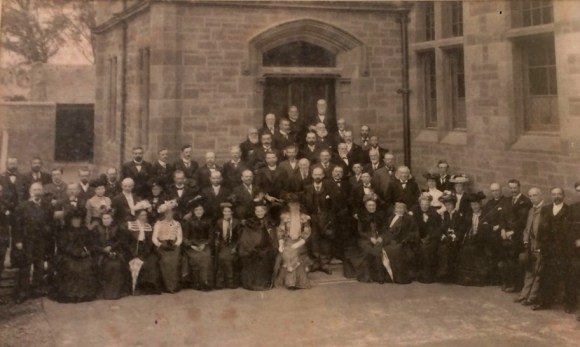
The two school boards cooperated fully and on the date of the changeover a memorial stone was laid in the north porch by Robert Kirkwood. Strang presented Kirkwood with a silver trowel and after they had been photographed by J C Brown, photographer, outside the door, the party proceeded inside. In the central hall they inspected a brass plate inscribed with the name and date of erection of the school, the names of the chairman, members, and the clerk of the Falkirk Parish Board. The plate also noted that the memorial stone had been laid. Two months later the building was formally opened on 5 May 1902 by Robert Hunter of Glenfuir and he was presented with an inscribed key. Once again J C Brown was there to record the event.
A new brass plate was added to the central hall :
“Carmuirs Primary School – Opened on the 5th August 1902, by Robert Hunter, Esq, J.P., C.C., chairman of the Eastern District of Stirlingshire Technical Education Committee. Members of the School Board – Rev Jas. Aitchison, chairman; Archibald Christie, J.P.; Fergus David Ferguson; Edward Flannigan; John McColl; Archibald Cochrane Rennie, J.P.; Wm. Strang; Rev. Andrew Ross Taylor, M.A,; Robt. Whyte; Thomas Gibson, clerk; Borthwick Watson, D.L., J.P., treasurer; John Smith, headmaster; James Strang, architect.”
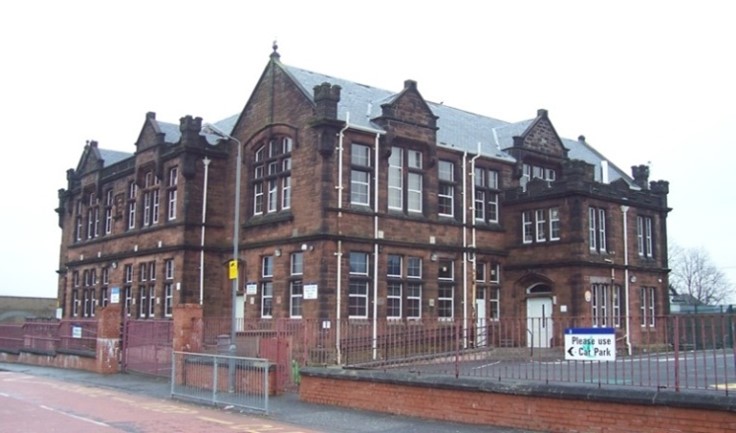
The most noticeable feature of the building is that it was built of red sandstone from Closeburn Quarry, Dumfriesshire. A martial aspect is given by the use of small battlemented bartizans and gablets set on mock machicolations. The large number of mullioned and transomed windows provide an overall Elizabethan style. The design of the school was on the central hall principle with the rooms all opening onto the large hall. The hall measured 50ft by 29ft and had a wood block floor making it ideal for drill. It was lighted by a cupola in the centre, measuring 24ft by 12ft. There were three principal entrances – one in a porch at each end for the boys and girls, and one in the north bay of the main west front for the infants. There were seven classrooms on the ground floor. The teachers’ rooms adjoined the entrances, an apartment each being provided for the headmaster and headmistress, one for the female assistants and another for the male assistants. Each of these rooms was fitted with the necessary lavatory accommodation. The staircase adjoined the central hall and led to a balcony, at the end of which there was an electric gong. The first floor also had seven classrooms and a cookery room capable of holding 40 pupils, giving accommodation for a total of 800 children. All of the classrooms were connected with the headmaster’s room by telephone. The interior arrangement was designed to be flexible. The infant classrooms were temporary, and could be easily converted into classrooms for the higher standards, while the infant cloak-rooms could also be converted into another classroom for scholars. The heating was on the low pressure system, and the central hall and balcony were heated by radiators.
The following were the contractors: mason – George Sanderson, Falkirk; joiner – William Walker, Polmont; slaters – Drummond & Crowe, Laurieston; plumber & gasfitter – Wallace & Connell, Falkirk; plaster and cement work – James Miller, Falkirk; tile work – Wilson & Wood, Glasgow; glazier work – Daniel O’May, Falkirk; heating – James Combe & Sons, Glasgow; smith work – John Kidd, Camelon; painter – Thomas Mckenzie, Falkirk; electric bells – Laurie & Co, Falkirk. The school bell was supplied by John Wilson & Co, Glasgow. The school cost a little over budget, being just over £10,000.
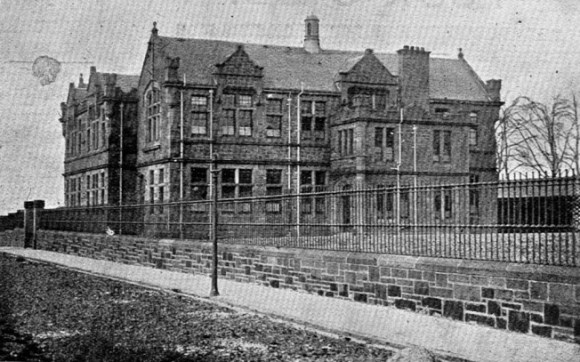
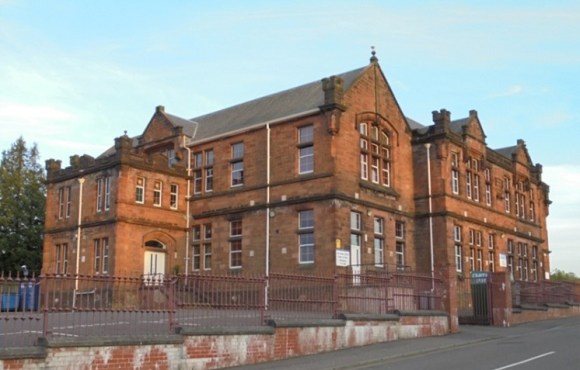
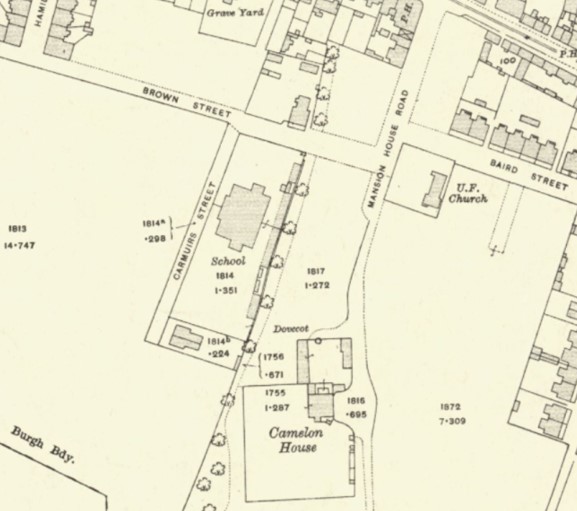
At the beginning of September 1914 Carmuirs School was occupied by the Royal Army Medical Corps and the pupils attended Camelon School for half-day schooling in the afternoons. The building was returned to the School Board in time for the August term in 1917 and the interior was given a refreshing coat of paint.
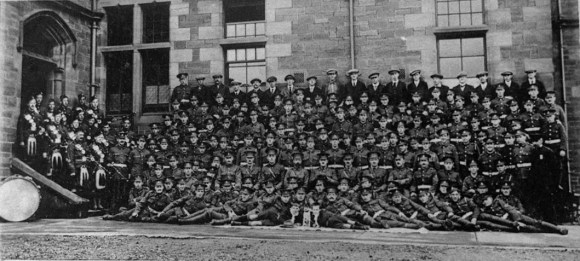
In 1923 it was decided that Carmuirs School would become the intermediate centre for Camelon and Carmuirs pupils. This, together with the huge expansion of council houses to the west, inevitably led to a shortage of classrooms, and so in 1930 temporary wooden classrooms were built in the playground. The joiner work was done done by JJ & P McLachlan of Larbert, the electric lighting by John McInnes of Larbert, and the heating by Graham & Morton of Stirling. The two classrooms were known as “the Annexe.” Even this was not enough and in 1938 it was proposed to build a sectional hut of three classrooms. Within months, costs rose from £750 to £850 due to shortage of material caused by the international situation. They were probably not built because of the Second World War. It was 1947 before the problem was revisited and plans approved for the erection by Stirling County Council of standard Ministry of Works’ hutments at the south end of the playground to be used as a cookery and laundry room. The two large air raid shelters against the south wall were demolished to make way for it. The cost of erection was estimated at £2,210.
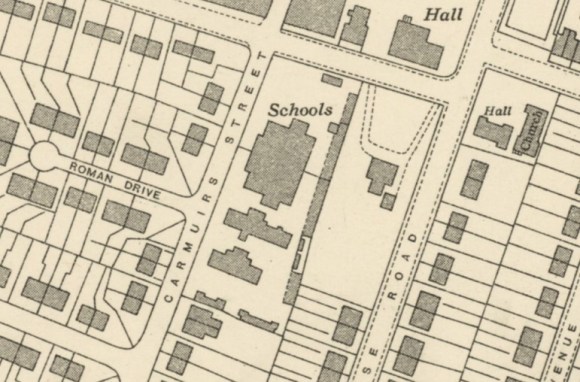
Teaching practices changed and, despite a drop in pupil numbers, the accommodation proved insufficient. Numbers increased again with the resumption of council house building at East Carmuirs. In 1954 the Welfare Hall in Falkirk was utilised as an annexe to Carmuirs School and in 1955 Falkirk Town Council was asked to reserve seven acres of ground in the Easter Carmuirs Housing Scheme for the erection of a primary school.
| YEAR ARRIVED | HEADTEACHER | YEAR LEFT | No. PUPILS |
|---|---|---|---|
| 1902 | John Smith | 1926 | 384, 479, 695 |
| 1926 | James C Johnston | 1935 | 912 |
| 1935 | L A B Rae | 1941 | |
| 1941 | George Lindsay | 1949 | |
| 1949 | James Scott | 580 | |
| Sharon Wilson (Acting) | Present |
Sites and Monuments Record
| Carmuirs Public School Carmuirs Street | SMR 1873 | NS 8676 8036 |
 Falkirk Local History Society