
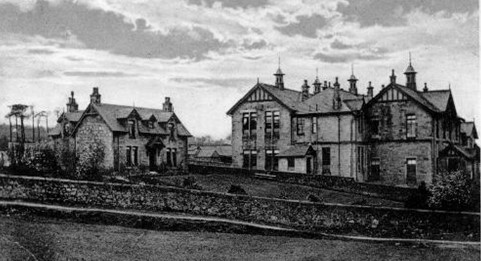
In the 1870s and 1880s the area south of the Forth and Clyde Canal became industrialised with the arrival of a railway yard, distillery/paperworks, a large iron foundry and several brickworks. James Smith, of the iron foundry, Smith and Wellstood, suggested that he might establish a venture school at Greenhill but delayed. Letters were written to the Falkirk Herald in 1880 asking for a school to serve the area but the Falkirk Parish School Board did not consider it appropriate as Bonnybridge School was not far away. A petition from the residents and ratepayers of Greenhill in 1883 asking the Board to reconsider their decision met with a more favourable response, but still a refusal. However, the petitioners were able to get the School Inspector, Mr Jolly, to produce a report in their favour and this was sufficient to convince the objectors on the Board of the justice of their case. It was agreed that a school to take children up to standard 3 would be established. In August the Board commissioned George Deas Page to draw up a plan for feuing a plot of ground belonging to the North British Railway Company to the south of their railway near an under-bridge. Presumably this was the cheapest land in the area and so the disturbance of passing trains was ignored.
The single storey school was Gothic in style with a double porch in front, built in white Plean stone. Over the porch rose a stone belfry. The rectangular building contained two classrooms to accommodate 102 pupils. The interior measured 39ft by 25ft which could be divided into the two rooms using a sliding partition, the upper part of which was glass. One of the rooms was fitted with a gallery (ie sloping floor) for the infants. The playground was large. A stream, dry in the summer, ran to the east of the school and the public footpath alongside it was a favourite haunt for the children. The total cost of the school was about £1,150 and it formally opened on 1 September 1884 with Miss Jessie Syme as head teacher.
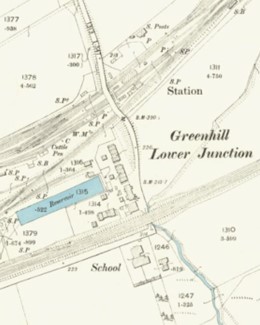
At the time of the opening there were 86 pupils on the roll but by 1888 this had risen to 122. Part of the reason for the increase was that it had been decided, late in 1884, that the children would be taught to the fourth standard and so a pupil teacher was immediately appointed. In 1887 teaching above Standard IV was approved by the Department of Education.
The result of this, and more industry, was a further increase in pupil numbers, and so in 1890 A & W Black, Architects, Falkirk, were asked by the Chairman of the School Board to draw up a plan for an extension of two additional classrooms with extra accommodation for 107, making a total of 211. He estimated the cost as £550. The other Board members insisted that Deas Page should also be allowed to submit proposals for the extension, which now was to be for 150 pupils. Black’s plan was preferred, though his charges were not. A & W Black charged a fee of 5% of the building price (plus a measuring cost of 1.5% which were obtained from the contractors who, of course, added it to their tender prices). Despite this the Board stuck with the firm. Page was awarded the extension at Auchengean.
“To Contractors. Estimates wanted for the Mason, Joiner, Slater, Plumber, and Plaster Works, of Additions to Greenhill School. Plans to be seen with, and Schedules of Quantities obtained from, the Subscribers. Sealed offer, marked “Tender for Greenhill School,” to be lodged with Borthwick Watson, Esq., Clerk, Falkirk Parish School Board, Falkirk, by Monday, 2d February. A & W Black, Architects.” (Falkirk Herald FH 21 January 1891, 1).
The extension was to the south of the earlier block, separated from it by a 10ft wide corridor. As well as the two classrooms it held a head teacher’s room. It was officially opened on 25 September 1891 and cost about £850. The year before the school had re-opened after the summer break as a full primary school taking pupils up to Standard 6. Consequently Alexander Stein was appointed as the new head teacher. It was to be several years before a schoolhouse was built for him to the east of the school. Offers for its construction came in during November 1893: mason work – Stewart & Son, Bonnybridge (305 10s); joiner work – James Menzies, Bonnybridge (£170); slater work – Drummond & Co, Laurieston (£31); plumber work – Mr Draper, Falkirk (£39 10s); plaster work – Mr McNair, Falkirk (£36) – total £582. Together with the architect’s fees, ground preparation, and so on, the total cost was close to £700.
The supply of water to the school proved to be problematic. In 1894 an agreement was reached with the Caledonian Railway Company to tap into the water supply for the nearby houses. This, however, often ran dry. In 1897 a tank was provided at a cost of £8 10s to collect rainwater from the roof. Just two years later the head teacher was complaining that they had to carry water from the burn. In 1901 Miss Muller of Glenyards gave permission for the school to receive water from a small reservoir on Greenhill Moor which supplied her property and the necessary work cost £27. This was not the end of the story. In October 1903 the parents complained that the water contained “iron substances.” Fortunately, the water mains were extended into the district nine months later.
The school was part of the community which supported it. Mr Stein, brick manufacturer, paid for 36 of the senior pupils of Greenhill School to visit the Glasgow Exhibition in June 1901. A concert held that year enabled books and a bookcase to be bought for the school and in 1902 the Headmaster handed them over to the School Board.
The numbers of pupils attending had continued to grow and the Headteacher’s office had to be pressed into service as a classroom. The education authority decided to enlarge and upgrade the school. It was to be a full school and the new plans included provision for cookery and laundry classes. James Strang was now the Architect and a whole new storey was to be added to the building. This meant that the pupils could not remain there once the old roof had been removed and so temporary accommodation was provided at the hall in the brickworks of James Dougall & Son at High Bonnybridge.
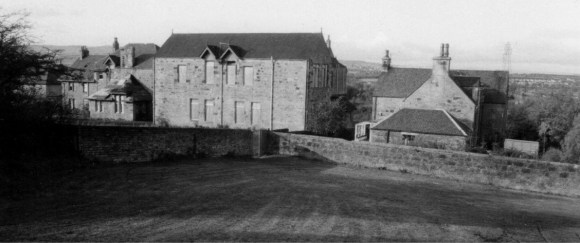
The hall at Griffith’s brickworks was also offered, but the Board considered its setting by the railway to be too dangerous and so plumped for the Bonnybridge Public Hall instead. The work was extensive and it was 1 April 1904 before the school re-opened with accommodation for 500 pupils. The interior had been gutted and a central hall inserted. All of the ground-floor classrooms could be accessed from the hall and staircases led up to a balcony opening onto the upper rooms. The first floor included the cookery room which seated 24 children. Cloakrooms were erected at each entrance. The cost was £3,862.
Construction began on a separate block to the west of the school in 1908 to house the Technical Department in which the pupils of the Supplementary Class would receive instruction in practical subjects. It cost £2,020 and was opened in April 1909.
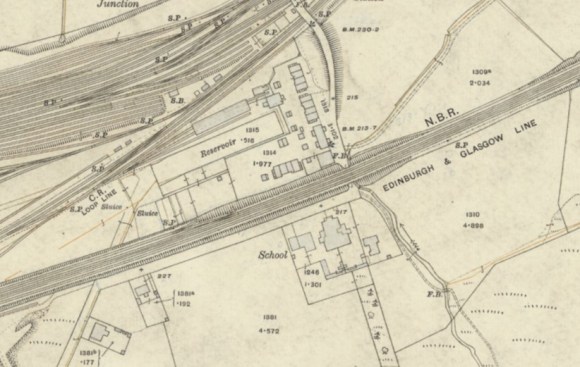
Shortly afterwards an infant school opened at Broomhill, relieving Greenhill of some of its starter pupils. In 1934 it was noted that the mix of primary pupils in Greenhill was made up from those who had begun their life at Greenhill, those who had completed their first three years at Broomhill, and those who completed their first four years at Castlecary.
The school remained open throughout the Second World War. The wife of the head teacher was the branch convener for the Red Cross penny-a-week scheme and the janitor ran the local WVS project to collect clothes for use in emergencies. The garments were stored at the school until needed. After the war the community spirit was continued when a branch library was opened to the public in 1946, run by volunteers and supported by the County
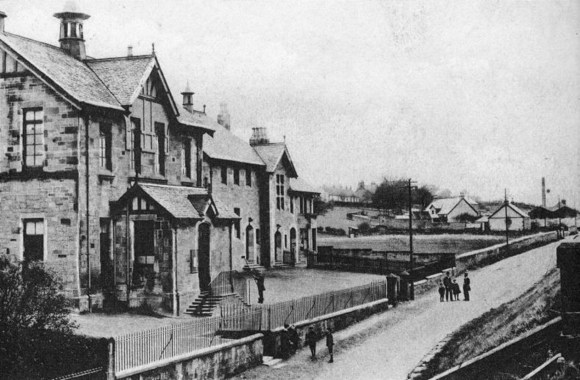
The school had reached its peak and with the movement of a large part of the population to Bonnybridge it slowly declined. In 1947 it was decided that Greenhill would be used solely as a primary school. Under the new scheme Broomhill would remain an infant school for those between the ages of 5 and 7 years after which they would be transferred to Greenhill. All children living south of the Forth and Clyde Canal would attend Greenhill School, which, however, was to be purely a primary school.
This meant that after 11 years of age, pupils attending Greenhill would be transferred either to Bonnybridge, which would become the only primary and junior secondary school in the district, or to a senior secondary school at Denny or Falkirk. A dining room and scullery were created at Greenhill School to cater for school meals. Even the public library was moved – in 1950 a new branch was opened in the Public Hall in Bonnybridge.
In 1978 plans emerged for the construction of a new primary school at High Bonnybridge to replace Greenhill and Broomhill. The Antonine Primary School opened in 1988. Greenhill School was demolished in 1999.
| YEAR ARRIVED | HEADTEACHER | YEAR LEFT | No. PUPILS |
|---|---|---|---|
| 1884 | Miss Jessie Syme | 1890 | |
| 1890 | Alexander Stein | 1895 | 214 |
| 1895 | Hugh Mather | 1902 | 232 |
| 1902 | John Davidson | 1920 | 365 |
| 1920 | L A B Rae | 1930 | 321 |
| 1930 | Francis McKay | 1931 | |
| 1931 | Henry Ireland | 1935 | |
| 1935 | Richard H Stewart | 1938 | |
| 1938 | Frederick J Deans | 1944 | |
| 1944 | John S McGregor | 1959 | |
| 1959 | James Binnie | 1971 | |
| 1971 | John Kinghorn | 1978 | |
| 1978 | George Hill | c1984 |
Sites and Monuments Record
| Greenhill School Glenyards Road, Bonnybridge | SMR 1619 | NS 82181 7879 |
 Falkirk Local History Society