

A desire on the part of some of the Kirk-Session in the mid-seventeenth century to erect a schoolhouse and house and “yeard” for the master led to the minister and Bailie Bowie laying the matter before My Lord Callendar in 1689, but they reported
“yt it was his Lordship’s mind, and because of ye troubles of the times, a school house could not be conveniently built.”
The troubles referred to were those surrounding the abolition of Episcopacy. Instructions were given to hire a suitable schoolhouse, and the teacher was to secure a dwelling-house for himself, the rent of which the Session agreed to pay.
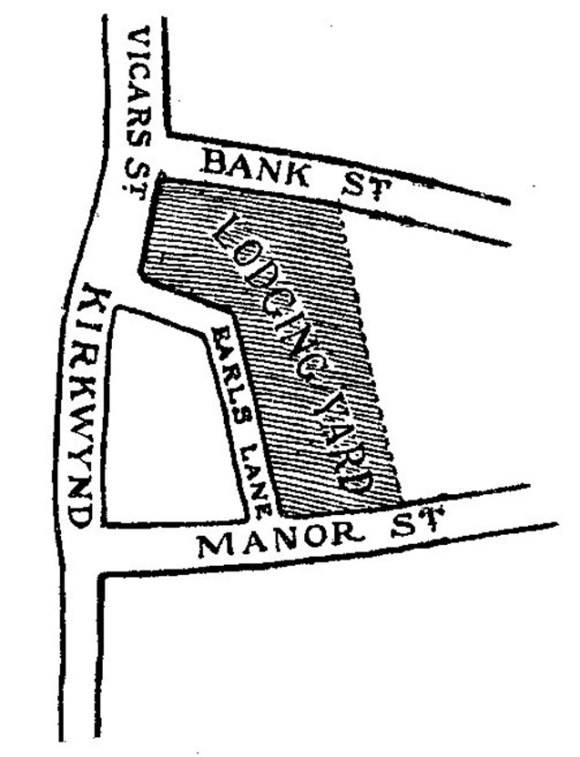
From 1695 to 1703 there were numerous complaints from the schoolmasters to the Session regarding the state of the school buildings, and the want of proper school accommodation for the scholars. Moves from one building to another had to be made as was found most suitable. James Love believed that in 1695 the school met in a house situated in Kerse Lane, but it is not till 1703 that the location can definitely be fixed. Finding in that year My Lord Callendar’s Lodging in town was to be let, and that it would be very suitable as a schoolhouse, the Session for the “incouradgmt” of the schoolmaster, allowed 36 lb. Scots for accommodating him and “ye scholars in ye sd lodging ys year.” The rent charged was very much in excess of what was formerly paid and so it is clear that this represented an increase in the space available.
How long the school was held in “My Lord Callendar’s Lodging” is not recorded, and it is probable no change was made till 1745, when the Session recommended on 21st January of that year for Thomas Heugh and John Burn to agree for a schoolhouse and a dwelling-house for the schoolmaster. A suitable building seems to have been secured, as among the accounts passed by the Session on 24 July of the same year was one amounting to £4 15s 6d “for striking out, windows and mending the tables and seats in schoolhouse.”
At a Session meeting held in February, 1746, the schoolmaster, Mr Adam, represented that the writing-table which had been provided for the use of the school “was carried off and destroyed by the rebels or military when in this place.” The schoolmaster was instructed “to agree with a wright to make a new one.”
In 1761 the number of scholars attending the parish school had so increased that the Heritors were compelled to consider what could be done in order to provide sufficient accommodation. The church and manse had already fallen into states of disrepair, and the idea of building a school was clearly not probable at this time. A great portion of the church – some 25ft in length – of the “Isle” in the Parish Church “be west the steeple,” had not been used for many years, and a wooden partition had been erected to separate the unused part from that which accommodated the worshippers. The Heritors had intended to remove the unused part and build a stone gable in place of the wooden partition. However, they now realised that they could solve the problem of the school by utilising it, and the west aisle was entirely renovated and two schoolrooms formed. For the carrying out of these alterations and “reparations,” the Kirk-Session laid out £20 sterling. They attached two conditions to the agreement with the Heritors which were that they should be allowed to deduct one pound sterling per annum from the three pounds they paid yearly to the Latin schoolmaster in name of house and schoolhouse rent; and that they would take care of and uphold the schoolhouse in time coming, provided the Heritors would refund them from time to time the sums laid out in keeping it in repair.
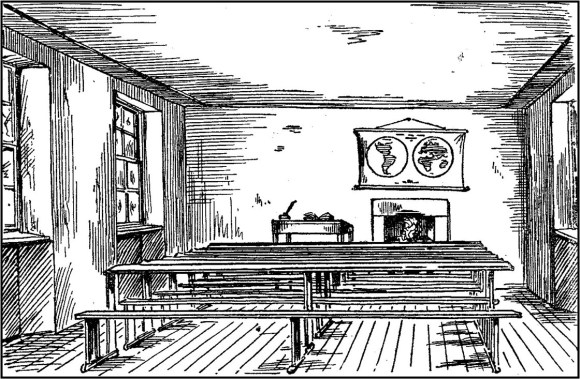
In 1775 an agreement was entered into between the Heritors and the Kirk-Session whereby it was provided that by the latter paying to the Heritors the sum of sixty pounds sterling as a portion of the expense of building a school and schoolmasters’ houses, they (the Session) would be relieved of the annual payment of three pounds. The new schoolhouse was situated on the north side of Manor Street (later the property of Mr James Forgie who used it as a joiner’s shop). In 1898 James Thomson, assistant art master, Falkirk, produced a sketch of the interior of the English schoolroom at Manor Street from descriptions given to him by those who attended it latterly. The size of this room was 29ft by 18ft, while the grammar room was only 12ft by 18ft. Originally it had an earth floor.
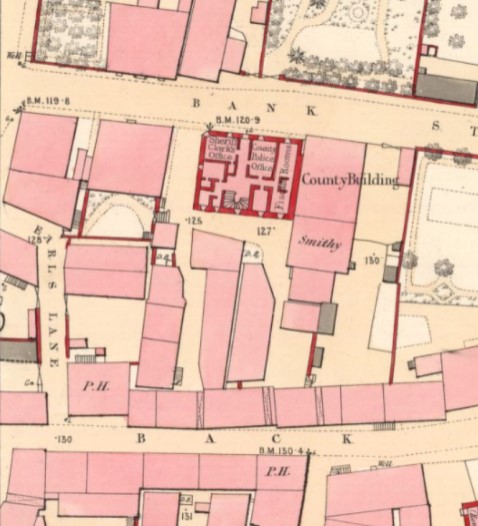
The schoolmaster in 1788 was expected to know the Greek, Latin, and French languages which were taught during the day, and mathematics and church music in the evening. For Latin and Greek the fees were not to exceed three shillings and sixpence per quarter for each scholar. The master appointed an assistant or doctor for the teaching of English. From 1788 he was known as the English master. Besides teaching English and writing during the day, he also taught arithmetic, book-keeping, and geography in the evening. For “compleating” a scholar in geography the fee was a guinea, for navigation a guinea, and for mensuration ten shillings and sixpence.
From time to time repairs were carried out to the 1775 building. It had two classrooms – one for the Latin teacher (the rector) and one for the English teacher – and so the term “schools” in plural is found. In 1803 repairs had again to be made on the schools and in 1813 a petition was presented from the masters setting forth that both schools and dwelling-houses were in great need of repair. A report by Henry Taylor, mason, and William Black, wright, as to what was necessary to be done was submitted, and their recommendations were carried out.
Alexander Callendar of Lady’s Mill, had bequeathed the sum of £1,000 to the poor of the parish of Falkirk, and in 1817 an attempt was made to secure £250-£300 of it for the purpose of building a school and schoolhouse, the remainder of the sum to be invested in good heritable security, and the interest arising from it to be applied in purchasing books for such children as could not obtain them “other ways,” and in aiding the payment of the schoolmasters. But the opinion of legal counsel being taken, it was found that to do so was entirely opposed to the wishes of the deceased.
The Heritors of Falkirk were continually trying to save money and in 1829 gave the two teachers notice to quit the schoolhouse and garden which they occupied so that it might be sold. The action back-fired and, after legal proceedings were threatened, ended up with not only the two masters retaining the dwelling but also to increases in their salaries.
In the 1840s the English master, Thomas Downie, ran an evening school which was extremely popular and became known as “Downie’s College.” His success at the parochial school was equally good and it soon became overcrowded. He complained to the Heritors who appointed a committee to look into the enlargement of the school. This committee recommended the purchasing of the Masons’ Lodge in Silver Row which could be had for about the same expense as would have been involved in making additions to the schoolroom. All this took a long time and Downie, exasperated by their tardy procedure, took the matter into his own hands and removed the English class to a building double the size. The building which he rented was the south-most block on the east side of the Pleasance, which had been used as a private school by Patrick Thornton. The Heritors, while agreeing to pay the rent of these premises, which amounted to £8, reserved to themselves the power to discontinue payment on giving Downie six months’ notice, but the schoolmaster pointed out that they were bound to give him sufficient accommodation, and that if they withdrew the rent of the schoolroom, he would be entitled to apply to the Justices of the Peace, under the 1803 Act. Such proceedings, however, did not require to be taken, as Mr Downie died on 2 September 1841, in the 39th year of his age. Meanwhile, the grammar teacher had taken over the whole of the 1775 school building. In the late 18th century the English master was paid more than the Latin schoolmaster.
His successor, James Burns, was forced to pick up the gauntlet. With over 100 pupils the room in the Pleasance was far too small and he too wrote to the Heritors who acted at their usual sloth-like speed. In 1844 they produced an interesting and detailed report of the situation:
“The Committee have inspected the Parochial English and Latin schoolrooms. They are in a miserable state – damp, low-roofed, and small in size, and in a very bad situation. The area of the English schoolroom is only 348 feet, while the pupils attending this school amount to 202. In consequence of such a number of pupils the parish school-room could not contain them by two-thirds, and the inadequacy of the accommodation being so apparent, the Heritors agreed to rent a large room, whose area was 780 feet, and the roof and ceiling much higher than in the parish school-room. This accommodation was found not to be sufficient, and the teacher has rented a small room adjoining, containing 118 feet seven inches. This accommodation, however, is not nearly sufficient, and there is no play-ground or other conveniences attached to it. The following statement from Mr Burns, the schoolmaster, which can be depended upon, proves the deplorable state of the accommodation afforded by the Heritors to support the education of the children belonging to the parish. He says the number of pupils enrolled since the vacation is 202. Of these 133 write in the following order:- 54 write on tables, 24 write on forms, kneeling on the floor; 45 stand, who have neither tables nor forms, but I endeavour to give them fifteen or twenty minutes by making them change places with some of those sitting at table or lying at forms. I have sufficient forms for 130 only, and there are 72 who have no seats. Any parochial schoolmaster having it in his power to make such a statement is entitled to have at the hands of the Heritors every consideration, and the committee are satisfied that the meeting will at once order a plan for a new English school, and conveniences preparatory to erecting the same. The English School cannot be allowed to remain in its present state and the committee would recommend that certain of the Heritors be appointed to take for the English School more commodious premises until the new school is erected. With regard to the Latin School room, it also is damp and low in the ceiling, but it and the parish school being thrown together might suit.”
Despite their evident duty and the actions of Heritors in other parishes, the Heritors of Falkirk declined to be responsible for the erection of a new building. As they paid the maximum salary to the master they did not consider themselves bound to provide a schoolroom or rooms or a dwelling-house, and therefore they resolved to let the matter drop. Instead, a committee was set up consisting of Rev. William Begg (convener), Mr Henry Salmon, banker; Mr Borthwick, factor to Lord Zetland ; Mr Marshall of Newhouse; Mr Russel, writer; and Mr Aitken, Gartcows. In March 1844, a meeting was held to consider the propriety of disposing of the old school and masters’ houses, and acquiring a site for new buildings, or repairing and enlarging the old schoolhouse or otherwise. It was resolved to proceed with the building of a new school, the different Heritors to subscribe according to their valued rent or otherwise, and the public generally being invited to subscribe. In January 1845 plans were ordered to be prepared by John Tait of Edinburgh, and then possible sites were investigated. The site chosen lay north of the Independent Chapel in Bank Street and the proprietor, Mr Brooks, agreed to open up a road on the east of the ground (now Park Street). One half of an imperial acre of land was purchased at the price of £120 and in consideration of Mr Brooks opening up what is now Weir Street to the Grahamston Road, an additional sum of £10 was to be paid. The contractors were then appointed being Mr Thorburn, Polmont for the mason work, and Mr McLaren of Grangemouth undertaking the wood and other work.
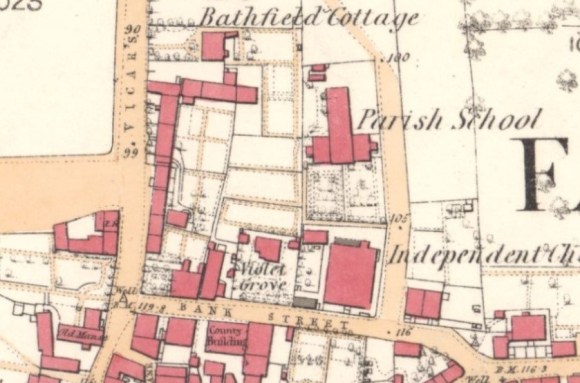
The new school building in Park Street was opened on 18 May 1846 at a cost of £1,500. Of the total cost, £800 was contributed by the Heritors – William Forbes of Callendar and the Earl of Zetland giving handsome donations, the remaining £700 being the voluntary contributions of the parishioners of all denominations. The only obstacle to good teaching remained the elderly Classics teacher, Thomas Gibson. He died that October and a younger more energetic man was appointed so that the Grammar School also thrived.
Although strictly speaking it was still the Parish School, the school of this period is often referred to in publications as Falkirk Grammar School and this period of its history will be found under that title.
The Ordnance Surveyors described the school in 1858:
“A neat and substantial building with playground and garden attached. Situated off Bank Street. Was erected at the expense of the Heritors of the parish. It comprises two distinct parish schools, viz a Grammar School and an English School. The teacher of the former receives the usual parochial schoolmaster’s allowance, and a house and garden, which are attached to the school, rent free. The remainder of his salary is derived from school fees, it is not endowed. The branches taught are classics, German and mathematics. Average attendance about 40. The teacher of the English School also receives the parochial schoolmaster’s allowance from the Heritors as well as a dwelling house and garden. The remainder of his salary is derived from school fees. Affords tuition in the various branches of an English and commercial education. Average attendance about 105.”
In 1860 these fees were set as:- English, 3s 6d per quarter; English, with writing, 4s per quarter ; English, with grammar and geography, 4s 6d per quarter; English, with grammar and arithmetic, 5s per quarter; any single branch, such as arithmetic, writing, or book-keeping, 2s 6d; two branches, 4s; three branches, 5s.
In 1897 the English schoolmaster at Falkirk, George Liddle, celebrated his 50th anniversary as a schoolmaster and was presented with various presents by his former pupils as well as a sum of money. He generously set aside £100 to provide an educational endowment for the benefit of the children attending the elementary schools of the burgh. This sum was invested so as to bring an annual income of £11 10s for ten years, to be expended yearly in the purchase of one gold medal and four bronze medals and book prizes to be competed for by children who passed Standard V. Several examples of these medals are now in Falkirk Museum.
The rector of the Grammar School resigned in 1873 in order to study for the church. The school building had just been taken into the care of the Falkirk School Board and the grammar school was closed and the “English School” expanded
| YEAR ARRIVED | HEADTEACHER | YEAR LEFT | No. PUPILS |
|---|---|---|---|
| (1594) | Thomas Ambrose | ||
| (1632) | John Dishington | 1641 | |
| 1641 | James Wright | 1642 | |
| 1642 | James Livingston | c1665 | |
| 1666 | John Forrest | 1689 | |
| 1689 | James Nicol | 1695 | |
| 1695 | William Drummond | c1697 | |
| 1697 | Patrick Rennie | 1732 | |
| 1732 | Andrew Rennie | 1736 | |
| 1737 | John Adam | 1767 | |
| 1770 | John Gray | 1771 | |
| 1771 | Peter Innes | 1774 | |
| 1774 | James Meek | 1788 | |
| 1788 | Alexander Buchanan | 1788 | |
| 1788 | John Johnston | 1799 | |
| 1799 | William Brown | 1806 | |
| 1806 | Thomas Gibson | 1846 | |
| 1832 | Andrew Morton (assistant) | 1836 | |
| 1842 | David Middleton | 1852 | |
| 1852 | William Strathhenry Kemp | 1859 | |
| 1859 | William Middleton | 1869 | |
| 1869 | Thomas Pearson | 1873 |
| YEAR ARRIVED | DOCTORS | YEAR LEFT | No. PUPILS |
|---|---|---|---|
| 1642 | Robert Wingate | ||
| 1646 | Patrick Anderson | ||
| 1662 | Patrick Higgins | 1666 | |
| 1666 | Robert Young | 1680 | |
| 1680 | James Muschet | 1681 | |
| 1681 | James Park | 1719 | |
| 1720 | Thomas Hogg | 1745 | |
| 1745 | James McDonald | 1748 | |
| 1748 | William Weir | 1753 | |
| 1753 | Thomas Young | 1788 | |
| 1788 | James Young (English master) | 1832 | |
| 1832 | John Andrew | 1835 | |
| 1836 | Thomas Downie | 1841 | 202 |
| 1841 | James Burns | 1855 | |
| 1856 | James Murdoch Pollock | 1860 | |
| 1860 | George Liddle |
Sites and Monuments Record
| Park Street | SMR 1344 | NS 8889 8008 |
 Falkirk Local History Society