
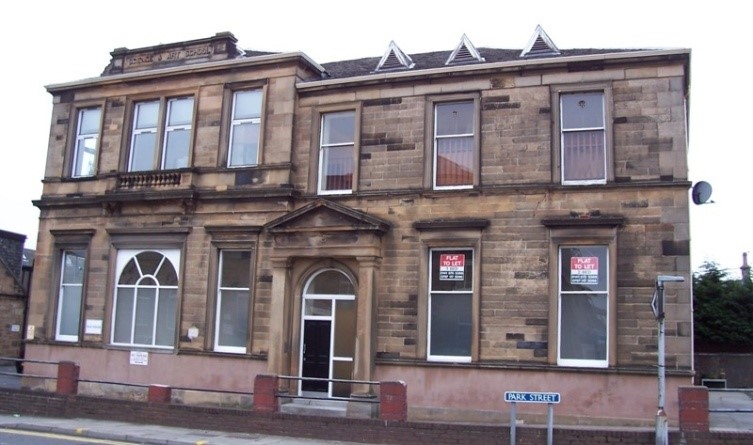
(Technical Institute)
In 1863 Peter Wright was given the use of one of the rooms in Falkirk Grammar School to teach art in a private capacity. For the first two or three years these classes were sparsely attended but the number gradually grew and in 1866, when some 18 pupils were in attendance, a connection was established with the Science and Art Department in London. This connection allowed Wright to obtain grants and prizes each year in accordance with the results of the examinations of his students. From then to 1870 the numbers steadily increased and outgrew the accommodation. Unusually, the Heritors acted promptly and erected an extension costing £600 to the school, and a room was set aside for the Art Night Class. By 1875 pupils were being turned away for want of room. Her Majesty’s Inspector reported that the progress of the numerous pupils attending the classes was seriously impeded by the very defective accommodation provided. He also reported unfavourably regarding the ventilation, light, &c. and stated that the desks and forms were narrow, rickety, and too low. Major Nimmo, who had all along taken an interest in the welfare of the art classes, succeeded in getting together a committee in October 1876 to erect a separate school just for art. The committee consisted of Major Nimmo (convenor), Provost Russel, Bailie Cockburn, John E Gibson ironfounder, James A Henderson banker, Capt Melville, JC Rennie of Gowanbank, Rev George Wade, and Andrew Allan, solicitor (secretary). The site opposite the Grammar School in Park Street was obtained from the trustees of the late Dr Espie. Plans and specifications were obtained from James Boucher, architect, Glasgow, and these, after having been carefully considered and adjusted by the Science and Art Department in London, were entrusted to Mr Boucher to be carried out. Meanwhile, the committee successfully secured subscriptions from a few of the leading men in the district amounting to close on £1,500 and in getting the promise from the Science and Art Department of a grant towards the erection of the building of £640. So successful had the fundraising gone that in the summer of 1877 it was decided to provide additional accommodation for science teaching, including a proper laboratory and a mechanical room (as urged by the South Kensington Dept). The additional cost was put at nearly £600, of which sum the Government has promised to contribute a sixth. A series of lectures was held in the Corn Exchange to collect more money and finally an appeal was made to the general public.
Contractors were advertised for, and the work was given to: mason work – Alexander Dick, Polmont; joiner work – J & A Main, Falkirk; slater work – John Lamb, Falkirk; plasterer work – Mr Miller, Falkirk; and plumber work – David Draper. Building operations commenced at the beginning of October 1877, and the work proceeded rapidly until a severe frost caused a fortnight’s delay. The stones for the walls came from the Dunmore Quarries. The total length of the two storey building was 60ft, and its breadth 45ft. The ground floor contained an elementary room, 24ft by 41ft; a science teaching room, 21ft by 19ft; and a mechanical room, 19ft by 15ft, with janitor’s accommodation behind. On the second floor was the figure room, 25ft by 25ft; a painting room, 25ft by 15ft; a laboratory, 26ft by 20ft; a classroom, 19ft by 15ft; a modelling room, 18ft by 13ft, a master’s room, cloakroom, WC, and general accommodation. The chemical laboratory was suitable for at least sixteen students working at one time.
The school was entered from Park Street by a large pedimented arched doorway, supported by two columns. The large and numerous windows were after the Italian order, and those of the ground floor were corniced. The north bay is slightly advanced and a panel in the parapet contains the words “SCIENCE AND ART SCHOOL” in bold letters. The school was supplied with mechanical appliances, so that those working in foundries and other works in the district had an opportunity of gaining a practical knowledge of their trades. The building cost £2,700.
Falkirk Science and Art School was opened by the Earl of Rosebery on 21 September 1878 with great pomp. The Earl had been one of the commissioners of the Crystal Palace Exhibition in 1851 and the Science and Art Department in Kensington was a direct upshot from it. It promoted science and art related to industry throughout Great Britain and set standards by setting examinations. It is not surprising that the new school was supported by the local industries. Robert McAlley was appointed as the teacher for theoretical and practical chemistry and Charles Dewberry of Blair Lodge Academy taught mathematics and mechanics. The school was for advanced pupils and most of the lessons were held in the evening providing training for professionals. A course in agricultural chemistry shows the practical nature of the offer. Robert McAlley also held the post of public analyst for the Burghs of Falkirk and Stirling and used the facilities in the School to analyse the water samples from public wells. The art department was able to charge more for those attending day classes and so ran them as well as the evening ones.
Writing the year after the opening, Robert Gillespie noted that :
“Upwards of 130 pupils are now being taught the various branches of drawing, by the talented master [Peter Wright], of whom a large proportion are ladies belonging to the town and neighbourhood, who find accommodation in one of the upper rooms, which is freely furnished with a variety of those classical figures common in our Art Schools.”
(Gillespie 1879, 49-50).
The appeal to the general public brought forth limited funds, but a bazaar in the Town Hall in April 1881 produced £1,168 and an associated concert some £78 – sufficient to clear the debt of £850 on the building. The reserve fund was needed because although the art classes were very well attended those offered by the science department were initially not. The Gaff Trust provided much-needed bursaries which helped the school as well as the students. The fees charged at the time were from 6s to 10s a session. One third of the pupils come from outside of the burgh. Amongst other subjects now taught were the skills of patternmakers, joiners and masons – it had essentially become a trades’ school. The art department extended its range by teaching technical, architectural, mechanical, geometrical, and perspective drawing as well as painting in oils and water colours, elementary drawing and shading.
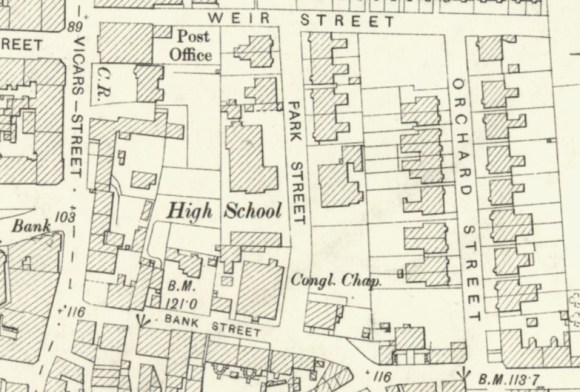
The education environment was, however, shifting around the school. The Technical Schools (Scotland) Act, 1887, encouraged school boards to establish their own science and arts classes. At first Falkirk Burgh was loath to set up such a class in competition to the Science and Art School. Other boards were not so considerate and classes were established at Carron, Grangemouth and Bonnybridge. Day pupil numbers in the art classes at the Science and Art School declined as the younger people found alternative courses free at the High School on the other side of the road. So, early in 1889 the suggestion was put forward that Falkirk Science and Art School could be amalgamated with Falkirk High School. The private school had been running at a slight loss for several years and many of its original managers were no longer active. The proposal was welcomed, though the nature of the trust meant that it was several years before the building could be handed over. Peter Wright was appointed as its headmaster and it thrived. Overcrowding in the clay modelling class was such that around 1894 two more rooms were added to the south-east corner of the building at a cost of £750. Even this was not enough and rooms in the old High School were taken over.
The Falkirk Burgh School Board struggled to think of the Science and Art School as a technical school as it was now merely part of Falkirk High School and in 1899 it approached Larbert School Board and Falkirk Parish School Board with a proposal to establish a new combined technical school in Falkirk. This was rejected by the other boards. Falkirk still hoped to gain the higher grants available for technical schools and corresponded with the Education Department in order to find the best way to proceed. In the subsequent discussion it turned out that it already had such a school – it was just a matter of the name – the Falkirk Science and Art School. This still had close connections to local industry and in 1899 Colonel Nimmo’s son funded an annual prize of £7 for the best original design for any article manufactured in the ironfounding industry in the district. The subjects covered at the school varied to meet contemporary demands. Navigation was introduced and other courses given in patternmaking, mining engineering, mining firemen, electrical engineering, baking and confectionary, ironfounding, metal working, blacksmithing, grate-fitting, architecture, carpentry, joinery, painting and decorating, moulding, building, plumbing, bread baking, and upholstery.
A fillip was received in 1903 when the Falkirk Industrial School closed down and transferred £200 from its assets to the Gaff Trust specifically for the use of the evening classes of the Science and Art School. That year a major exhibition of the art students’ work was staged in the town hall to celebrate the school’s semi jubilee. It included pastels by Mary Wade Wilson of Bantaskine showing garden scenes at her home. She was well known and some of her illustrations were published. Miss Sherriff of Carronvale, only in her early teens, was seen as an up and coming artist. Her drawings of local houses in the Larbert area are familiar to local historians. The exhibition was a success and became an annual event. In 1904 two of the students at the school won the competition to design the South African War Memorial which now stands in Newmarket Street. Ex-pupils were doing well in the work place and testimonials flowed in. An art club was set up so that they remained in contact. Those from the science department took up prominent positions across the globe. Locally these included the burgh engineer, and the architect James G Callander. Not surprisingly, in 1906 the Science and Art School was one of the first to have a gas generator to produce its own electricity.
At the beginning of the First World War the Science and Art School building was temporarily occupied by the military. Despite the briefness of their stay they managed to do a fair amount of damage. The work of the school soon resumed – it was training the engineers so much in demand. After the war the school continued as before with more students from outside of the burgh thanks to travel grants provided by the Stirlingshire Education Authority. That body struggled with the demands placed upon it and had to juggle with the properties in its care. In the late 1920s it found that it had to create new schools for the Catholic population and proposed moving the Science and Art School into the old High School on the west side of Park Street and using the vacated building for Roman Catholic pupils entering the first three years of the secondary course, and for those in the year I and year II advanced division courses.
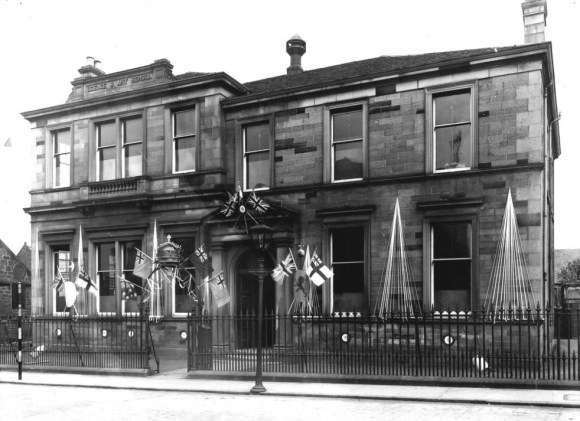
This did not come to pass, but the older pupils from the Falkirk High School Primary Department did occupy the Science and Art School and the dental and eye clinic was also transferred from the Old High School building to it. Despite these upheavals it was in the mid-1930s that the first art exhibitions took place within the building itself. They were a runaway success and led to talk of creating a permanent public art gallery.
During the Second World War the Science and Art School building was converted into a communal feeding centre. Work commenced in March 1941 and was completed in 14 weeks at a cost of £4,220. The steam-heated cooking apparatus was in the hands of the Falkirk Iron Company and consisted of six steam-jacketed boiling pans each of 80 gallons capacity, four pans each of 40 gallons, one potato steamer of two compartments, and one pudding steamer. Each 80-gallon boiling pan was capable of producing in the region of 1440 helpings of soup or 1600 helpings of stew, and the 40-gallon pans in proportion. Food preparation equipment included electronically-driven potato-peeling machines, vegetable-preparing machines, bread-cutting machines, and mixing machines, together with vermin-proof storage bins and a large number of insulated food containers. The latter could be filled and transported to any area in the district damaged by enemy action. Some hand-driven machines were reserved for emergency use. On the ground floor of the reconstructed building was a large kitchen with a loading platform for the distribution of food containers to districts around Falkirk; a food preparation room and washing up room; a large food store; a cash and carry department (take-away) and the boiler house. Upstairs there were the office quarters and dining room accommodation for about 200. The plans had been prepared by county architect who supervised the work. The contractors were: builder work – Ramsay Brothers, Laurieston; joiner work – Thomas Lindsay, Falkirk; plaster & concrete works – JK Millar Ltd, Falkirk; electrical work – Thomas Laurie & Co, Falkirk; painter work – M Sinclair, Falkirk; engineering plant – Donald Smith & Co, Glasgow (£1,500); cooking apparatus – Falkirk iron Co Falkirk (£900); food preparation equipment – J Kelly & Son, Edinburgh (£700).The feeding centre provided all of the school children in the burgh with a hot meal. In addition, arrangements were made to have prepared food transported to schools throughout the area. The dining room became the local British Restaurant and the public could buy prepared meals and take them away at modest prices.
The future of the Science and Art School looked bleak. However, after the war cooking facilities were provided at the individual schools around the area and in 1948 the first Adult Education Centre to be set up in Scotland under the Education Act of 1945 opened in the Science and Art School. With the co-operation of the Stirlingshire Education authority, the Falkirk branch of the Workers’ Educational Association started classes that winter in psychology, appreciation of music (second and third years), English literature, world problems, and public speaking. The centre had three lecture rooms, plus kitchen and cloakroom facilities. It had been re-decorated and furnished and was electrically heated. The East Stirlingshire District Committee of the Scottish Community Drama Association held a drama school in the building in 1954.
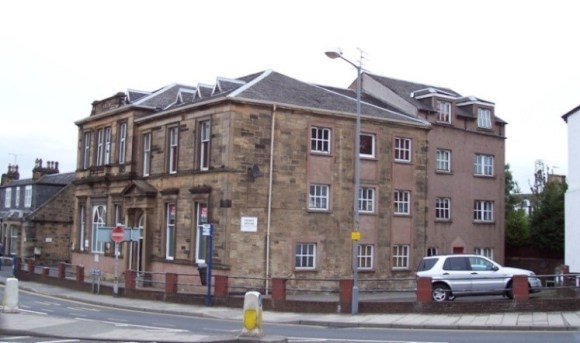
In the early 1970s the building was converted into workshops and classrooms and in the 1990s all the Falkirk technical college’s art classes were relocated there. However, it was not long before the building was sold off and converted into flats and renamed “Silk House”.
Sites and Monuments Record
| Park Street | SMR 939 | NS 8889 8009 |
 Falkirk Local History Society