
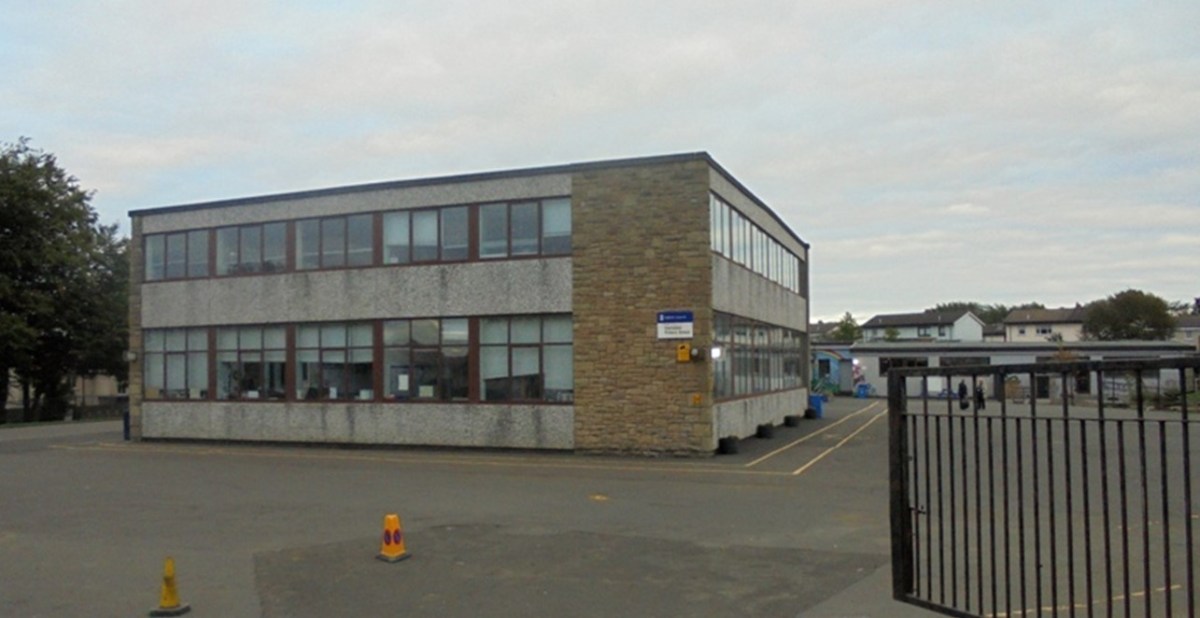
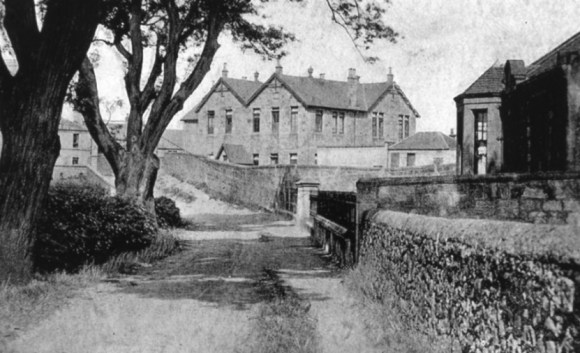
The newly formed Falkirk Parish School Board decided in 1873 that it would construct a new school in Laurieston to replace the Zetland School School. The Earl of Zetland offered to hand over the old school at a yearly rent which he would give back as a donation. Meantime the Board sought a site to the north of the village from the Earl of Zetland but, not finding suitable terms, it feued a site to the south of the village belonging to a Mr Walker. Plans for the school and schoolmaster’s house were drawn up by the Falkirk architect, McFadzen, and the new building opened on 7 February 1876 with Mr Davidson as headmaster. It had cost £3,024 5s 4d. At first the old Zetland School tried to continue as a private school, but within a couple of years it was forced to close.
In 1884 rainwater for washing was collected in barrels from the roof of the school and the cleaner carried drinking water from the public well!
As the population increased the school had to be constantly expanded. In 1889 two class-rooms by Deas Page, architect, were added at a cost of £650, increasing the accommodation to 380 pupils. During the construction work some of the classes had to be held in the Free Church hall and at the old Zetland School. The additional two classrooms and smaller apartments were placed on the south front of the buildings. Each classroom accommodated fifty scholars, one being for infants and the other for a junior standard. The new rooms were well lighted and ventilated, the air being regulated by Tobin’s patent wall ventilators, and by a central roof ventilator that could be opened or shut at will. The sides of the rooms, to several feet up from the floor, were lined with varnished wood, and tiled grates were supplied. Desks were of pitch pine. The walls were hung with maps, and numerous coloured pictures of animal and vegetable life. The new rooms were partitioned off from the old building by panelling and glass in wooden frames. In the main building the infants’ room had been remodelled, and fitted with gallery and seats. In the new section a room for teachers was provided, and there was also a cloak-room and lavatory, furnished with two wash-hand basins, supplied with water from a large cistern. The lavatory walls were partly lined with glazed tiles. A long entrance passage led from the south front – but owing to the School Board failing to come to terms with a neighbouring proprietor, boys had to enter the school through the girls’ playground, an arrangement to which exception was taken by HM Inspectors. In the new east, or infant’s room, roof lights were inserted to meet the possibility of side windows being built against it by the adjoining proprietor, and dim glass was put into these side windows to secure the privacy of the ground outside. As a result of the school enlargement each class had a room to itself.
The contractors for the 1889 extension were: joiner – Abernethy, Redding (£221); masons – Messrs Sanderson (170 8s 10d); plumber – David Draper (£57 10s); plasterer – James Miller (£47 13s 5d); slater – T Drummond, Laurieston (£38); painter – Peter Bell (£30 10s 6d); smiths – Messrs Kidd (£22 19s 6d); glazier – D O’May (£17 11s 4d).
The Zetland Hall was again used in 1892 when more building work took place at the Laurieston School. During this period permission was granted to teach magnetism and electricity, keeping up with the times. The extension was formally opened on 10 February 1893. The contractors were: Mason – John Gardner, joiner – Robert Nimmo, Plumber – Robert brown, plasterer – James Millar, slater – JD McNair. Total cost about £2,500.
The school added significantly to the facilities available to the population and rooms were occasionally let for local clubs. For example, in 1892 the established church got the use of a room as a mission; and in 1895 the Laurieston Brass Band rented a school room for band practice. It was, however, unsuitable for many groups who needed space as it meant moving and replacing the heavy desks.
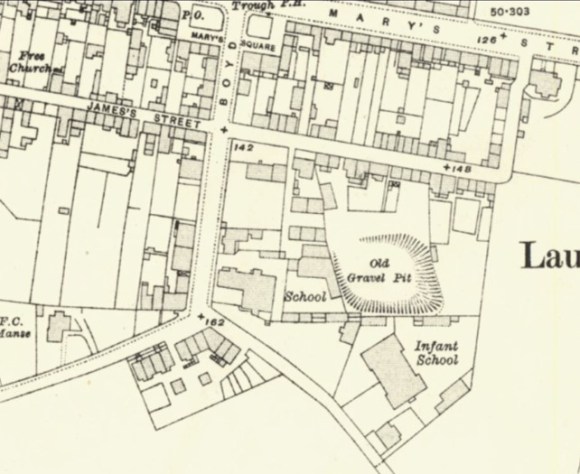
Even this extension was not enough to keep pace and in 1902 an additional school block to the east, designed by A & W Black of Falkirk, was completed for the infants. It occupied about 0.75 acre of the old playground and opened on 25 April 1902. It added five further class-rooms capable of accommodating 350 children as well as a cookery room. It was one storey in height with a front broken by gables at the flanks and having centre doorways with pediments covered by a central gable surmounted by a belfry. It was planned on the hall principle. Immediately upon entering there were cloak-rooms and lavatories on either side. From the central hall five class-rooms opened out; two of which could be thrown into a large hall by opening a sliding partition. The large cookery classroom and scullery was adjacent to the central hall, with provision for cutting it off when cookery lessons were in progress, a separate entrance from the outside being then used. There was also a teachers’ room, toilets, and stores. The floors of entrance, cloakrooms, and lavatories were laid with tiles and the central hall with wood block flooring. The building was heated throughout by open fireplaces, and ventilation was obtained by fresh air inlets in the walls and exhaust ventilators in the roof. The cost of the structure was between £3,000 and £4,000. The contractors were; masons – Ramsay Brothers, Laurieston; joiners – James Miller, Grahamston; glazier – Mrs O’May; tiles – David McNair; painter – John Graham; wood-block floor – Messrs Rodger, Lowe and Co, Bolton. The school now had running water.
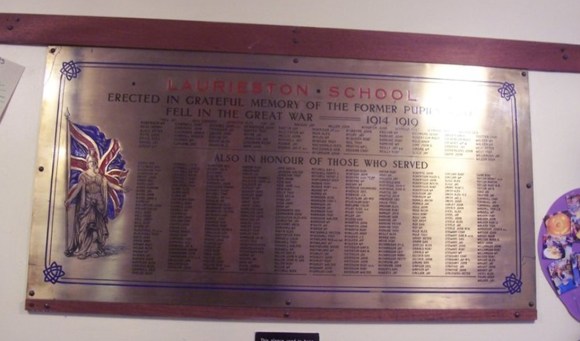
After the First World War James Mather, the headmaster, took great pains to ensure that the school had a fitting memorial to his pupils. The money was raised by public subscription for a large brass plaque mounted on a marble slab which was erected at the head of the central stairway in the in memory of the former pupils who fell in the Great War, and in honour of those who served and survived. It was unveiled by Lieut. Col. Alan Stein. M.C. in September 1920. The tablet was inscribed with the names of 411 former pupils who enlisted and served. Of this number no fewer than 82 made the supreme sacrifice.
Writing about the 1930s, the Laurieston Reminiscence Group added some colour to life at the school:
“All rooms throughout the Infant and Primary Schools were heated by large coal-burning open fires at the front of the classroom, where it could be stoked by the teacher from a huge coal scuttle which the janitor would reload each morning. Tall and heavy wire mesh fireguards enclosed each hearth. These fires had a homely quality… The tea cans of the pupils who wanted a hot drink with the packed lunch they brought because they lived too far away – Beancross, a distant farm, or Thornbridge – to manage home at lunchtime, were placed inside the fireguard near the fire, during morning lessons. They had their tea and “pieces” at midday “dinner time, at their desks, when teachers and other pupils left. No supervision… With the exception of the classrooms for the youngest infants all classrooms has tiered floors stepped up to the back of the room so that each pupil could clearly see and be seen. Double desks were fixed securely to each tier with a space between providing passages up and down from front to back… The ground floor of the primary building had a hall for drill, choir rehearsals and evening uses such as an impromptu lending library for adults. On the back of this hall there was a large varnished board in dark wood on which were beautifully lettered in gold, names of each year’s dux medallist from the school’s beginning in 1876. And each medallist would receive a specially designed gold medal with their name inscribed on the back along with the year it was presented. Sadly, in the transition from the original school to its replacement, this well-remembered artefact was so badly damaged that the inscription of dates and names over generations is now irretrievably lost.”
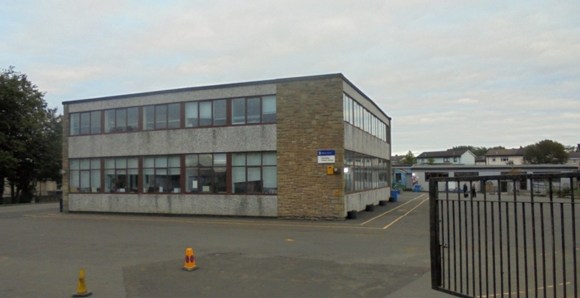
The callous disregard for the past by the school authorities was only too apparent during the school replacement in the 1960s as is illustrated by the treatment of the First World War Memorial. During the demolition work the discarded commemorative plaque was discovered badly damaged by one of the teachers in a workroom on the site. The new school opened in May 1969.
| Year Arrived | Headteacher | Year Left | No. Pupils |
|---|---|---|---|
| 7 February 1876 | David Davidson | 102 | |
| 25 October 1878 | David McRorie | 265 | |
| 25 October 1887 | Charles Johnstone | 271 | |
| 15 May 1894 | John Smith | 423 | |
| 12 August 1902 | James Mather | 514 | |
| 3 March 1930 | L A B Rae | 518 | |
| 30 June 1935 | Ireland | 492 | |
| 11 January 1937 | James Hogg | 462 | |
| 1950s | Joseph Lockhart | ||
| 1992 | Mr. Cowie | ||
| 1960s | Mr Bissett | ||
| Scott Ferguson |
Sites and Monuments Record
| Laurieston Primary School | SMR 1936 | NS 9108 7932 |
 Falkirk Local History Society