
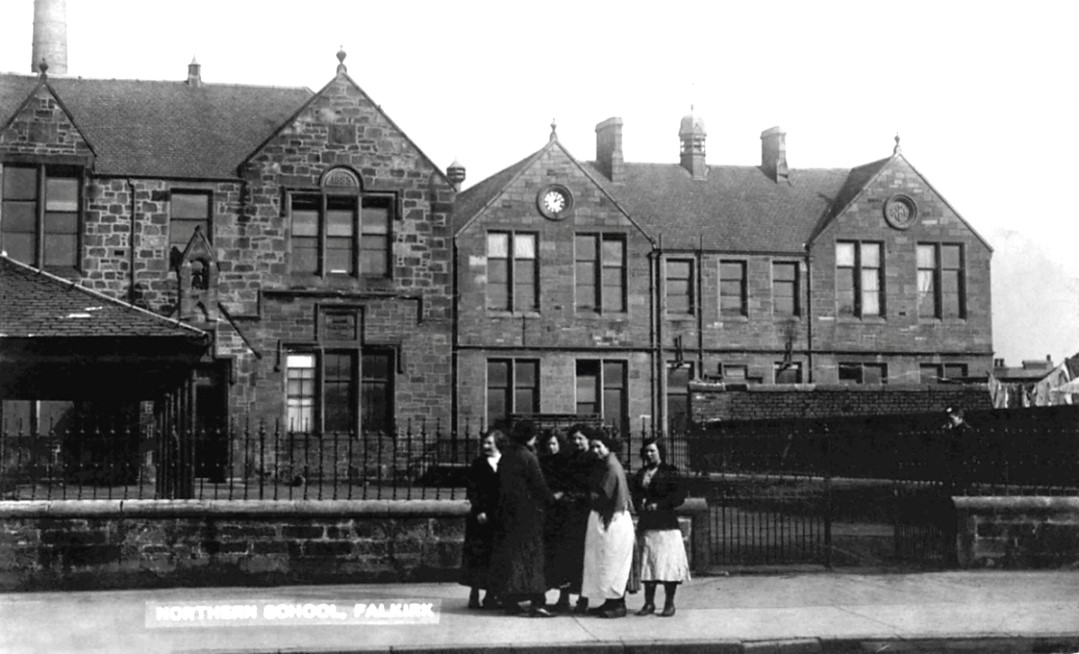
Immediately upon the formation of the Falkirk Burgh School Board it was resolved to have three elementary schools – one on the south to be the Southern School (using the old Charity School), one in the town to be the Central School, and one to serve the increasingly populous area of Grahamston and Bainsford to be known as the Northern School. Grahamston was the preferred location for the latter and by the end of 1873 two possible sites had been identified on the east side of Grahams Road. The one selected was to the west of the Falkirk Iron Works, a little north of the entrance on the other side of the road to Boyd Street. In September 1874 the plans by T B McFadzen were submitted with estimates and specifications to the Department of Education in London. McFadzen had won an open competition to supply the plans. The estimated cost for the school and a teacher’s house was £2,400. In November offers were accepted from the following contractors: mason work – Mr Learmonth, Laurieston; slating – David Draper, Falkirk; plastering – Mr Miller, Falkirk; joiner work – Grieve & Lamb. By the end of that month building operations had begun. A half-inch water pipe was laid the following November – making it one of the first schools in the district to have piped water.
During the construction work the Grahamston Subscription School, which stood adjacent to the site, was used for lessons, though the leaky roof meant that it occasionally flooded. At first work proceeded well but in 1875 Grieve and Lamb, who were doing the joiner work, went bankrupt. They had made a temporary arrangement with their creditors, but not long afterwards their cautioner also went to the wall and they were put in jail at the instance of the civil creditors. In late January 1876 their workmen threatened to leave the site unless they were paid their wages and a guarantee given that they would be paid every fortnight. In fact there was only a fortnight’s work left. This was arranged through McFadzen and as a result not only was the work completed but it did not cost the School Board more.
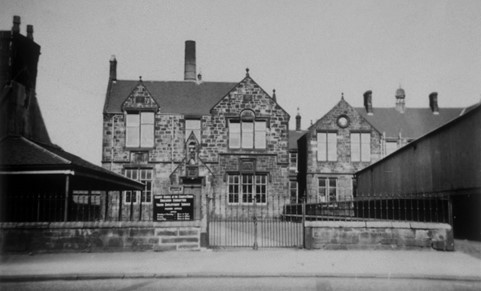
The Northern School opened on 27 February 1876. It was a stone single-storey building in the Gothic style of architecture, freely treated with square-headed doors and windows, having deeply relieved, moulded, and splayed ingoings. Panels and label mouldings over the doors and windows were inscribed with suitable monograms and dates. The school was planned on the narrow-roomed principle to accommodate 336 pupils and consisted of one large schoolroom, 57ft long by 20ft wide; an infant schoolroom 30ft by 20ft; and two classrooms 30ft by 20ft and 21ft by 18ft. There were two principal entrances, the west entrance for the boys and the south for the girls and infants. There were also suitable lavatories, spacious corridors and lobbies. Ventilation was managed by openings in the ceilings of each classroom with horizontal shafts in the roofs leading to the belfry and thence to the open air. Heating was by way of open fireplaces.
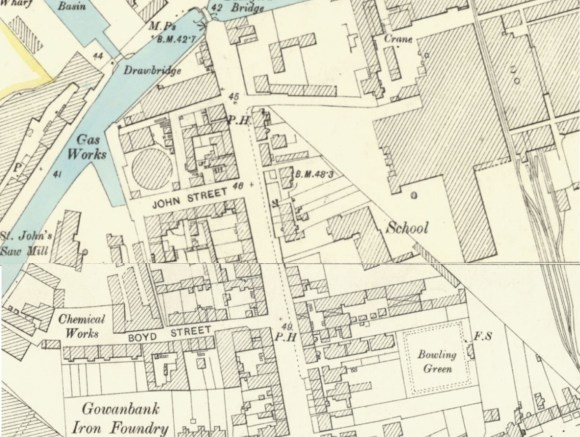
The Northern School was the largest in Falkirk. At the time of construction the large capacity of the school buildings was much criticised in the local press but it rapidly filled and just two years after its opening the old subscription school had to be rented to provide additional accommodation and desks had to be provided for it.
The population of the Grahamston and Bainsford areas continued to expand and even the provision of an infant school at Bainsford did not stop overcrowding at the Northern School. In 1883 the School Board asked William Black to draw up plans for additions. Black oversaw much of the routine maintenance work and alterations to the Board’s buildings. However, the work for the proposed extension, more or less doubling its capacity, led McFadzen to complain that he had not been given a chance to submit designs. Black’s plans were submitted to the Education Department which insisted on the separation of the sexes, adding an additional £100 to the overall cost and delaying the project. Work began that summer in the hope that it would be completed for the new term in late August. Given the scale of the project work this was clearly optimistic. It was October before the pupils were able to re-enter the building and another few weeks before all the work was completed. In the meantime, five public halls had to be rented so that the school could be kept running. The hall of the Grahams Road UP Church was used for Standards 4, 5 and 6; Mr Grossart’s school for 2 and 3; and Horne’s School (the old subscription school) for Standard 1 and the infants.
The project involved adding a new storey above three of the four existing classrooms. The three new upper rooms measured 27ft x 20ft; 26ft x 21ft; and 56ft 6ins x 20ft. The height of the ceilings of lower classrooms was now 15ft, and the upper ones 16ft, the upper ones being slightly combed. This necessitated the insertion of two staircases – one for girls and one for boys – with broad and easy flights. The large classroom below was divided using large four-leafed doors, and a new gallery was erected at the west end for a new infants’ room. What had formerly been the infant classroom was converted into an ordinary classroom. The offices were entirely rebuilt; instead of pans, w.c. troughs were installed and connected to a drain. The floors were laid with concrete and the whole of the division walls built with white enamelled brick. The heating of the school was effected by open fireplaces with Kennard stoves (Falkirk Iron Co), while the ventilation was by a number of Boyle’s ventilators in place of the large bell-fleech which formerly occupied the front ridge. The height of the front porch was also increased and a new belfry built on the gable top. The whole of the interior was size-coloured and oil painted andnew maps placed on the walls. Previous to the addition the school accommodated about 340 scholars, and now had room for about 600. The contractors were: mason work – Alex Reid, Larbert; joiner work, J & A Main, Falkirk; slater work – James Walker, Falkirk; plumber work – David Draper, Falkirk; plaster work – James Miller, Grahamston; painter work – Johnstone & Callander, Falkirk.
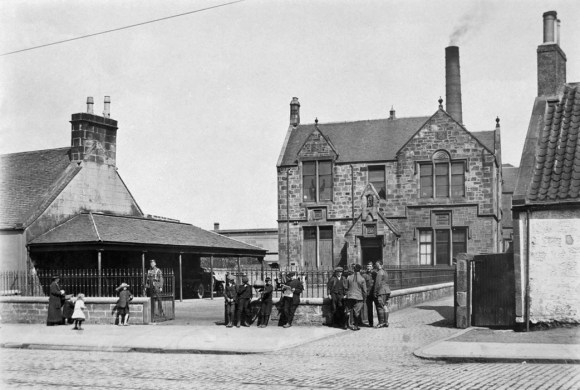
Note the contrast between the snecked rubble of the ground floor and the random rubble of the first floor.
School fees were still paid and the children would hand over 2d each week to their teachers, or 3d if they were over 6 years of age. As the numbers increased it became harder to distinguish those who had attained their sixth birthday and so in 1886 a flat fee of 2d was introduced in the Infant Department.
The industry in and around Grahamston continued to grow apace and incredibly yet more school accommodation was required by 1887. In April that year the Oddfellows’ Hall was secured for some of the surplus pupils and some new applicants had to be turned away. The school was hemmed in and needed more land. Enquiries about acquiring property to the north of the school from Malcolm’s Trustees failed. Probably because they were focussing on the north side they failed to take the opportunity of buying Captain McLean’s house to the south which came on the market at that time. The following year the School Board was able to purchase the orchard to the south of the school from Malcolm’s Trustees. Captain McLean’s house stood between that property and Grahams Road and now belonged to the Falkirk Building Society but it refused to sell the building at £265 even though it was only valued at £250. When William Black came to design an extension to the school it therefore lay behind that Grahams Road building. The extension was for an additional 500 scholars.
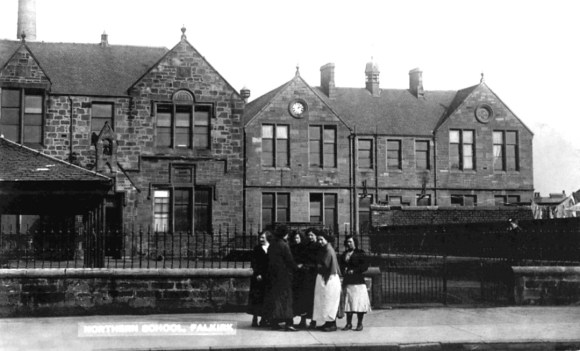
At the July meeting of the Falkirk Burgh School Board in 1888 Black’s plans for the proposed enlargement of the Northern School, providing accommodation for 564 additional pupils and including a class-room for cookery lessons as well as four rooms for teachers, were approved. The estimated cost of these additions was £4,400. They were subsequently approved by the Education Department. It took three attempts to get the plans through the Dean of Guild Court. Part of the problem was that the Falkirk Building Society wanted a 10ft high boundary wall against their property to ensure that the boys did not climb over.
More accommodation was taken at the Oddfellows’ Hall to allow the rooms at the east end of the school to be vacated so that the building work could begin in June 1889. The headmaster managed this situation and his teachers came up with the idea of using Crichton Park football field on several evenings weekly as a playground for the children. Clearly the architect and school board had learned from their previous mistake and the work was completed in ample time for the beginning of the August term. With accommodation for over 1,000 pupils, the Northern School was now the largest educational institution in the county. The school was divided into four sections, the infant and junior departments occupying the ground flats of the new and old buildings respectively, while the senior and middle classes were located in the corresponding upper flats. Entering the front door of the new building, a visitor would have found a large square open space or hall. To the right a schoolroom extended the whole breadth of that side of the square, divided into two rooms by a moveable wood and glass partition. On the opposite or left side of the square there was an exactly similar room divided in the same way. These four classrooms were for the infant and junior standards. Two were painted dark green and two terracotta (the hall was shaded a pale blue). The walls were enlivened with an array of W & A F Johnston’s colourful diagrams representing the various phases of animal, plant and piscatorial life. Here also the sewing of the senior division of the school was taught, and its apparatus and the sewing diagrams of Ruddiman Johnston were also to be found. All four rooms were galleried, the first containing accommodation for 250 pupils, principally intended for instruction in object lessons and musical drill; the second for class instruction only; while the third and fourth were fitted with desks so that they could be used for writing exercises. On either side of the front entrance was the boys’ lavatory and cloakroom, similar rooms for the girls were placed at the back entrance.
Three flights of steps from the front and back ends of the square gave access to the second floor, where there were another four classrooms, on the same plan as those below, for the fifth, sixth and ex-sixth Standards. Here pale blue and pale brown were the prevailing colours on the walls. As in the case of the infant department, glass partitions separated each pair of rooms. Bacon’s “Excelsior Maps,” Johnston’s “Scientific Diagrams,” as also “Aids to Model Drawing,” by the latter publisher, rendered the rooms bright and cheerful. In place of the lavatory and cloakrooms of the ground floor, three rooms were here set apart for the use of the head mistress and the male and female assistants.
The ground floor of the connecting link of the old and new buildings was utilised as a cloak and cap room for the boys of the junior and middle departments of the school. The upper floor formed the headmaster’s room, from which a series of speaking tubes branched off to the various rooms of the old and new buildings. The middle department (standards III and IV) in the upper floor of the old buildings consisted of five large galleried rooms. A lavatory for boys was also found in this flat of the school. Below these, on the ground floor of the old building, was the junior department (standards I and II) with four rooms and a special room for cookery.
Heating was still by fireplaces. In place of ordinary blackboards there were fixed plates of ground glass painted black on the back and furnished with frames. These produced a finer line than wooden boards. The seats of the writing desks were provided with backs for the first time. The plain west façade reflected that of the old building with a gablet at either end – the northern one containing a clock. Without the hood-moulds and panels it was crisper. The contractors were: mason work – John Gardner, Falkirk; joiners – Messrs Lorne, Falkirk; plasterer – Mr McNair, Falkirk; plumber and slater – David Draper, Falkirk.
In practice it was found that the cookery room was far too small and so in 1895 it was extended into the girls’ department. In a reflection of the school’s earlier history, the completion of this project was delayed by a strike by the joiners. When opened, the room served as a centre for schools throughout the immediate area. It was also used by the increasingly popular evening classes. Pans must have been used for boiling the washing-up water because it was 1914 before hot water was available on tap.
In 1901 local residents asked that the school clock would be lit and Falkirk Town Council offered to supply the gas free of charge. However, difficulties with the design of the clock meant that this does not appear to have been achieved. Gas in schools was a perennial problem. In 1912 it was discovered that there was considerable leakage of gas from pipes in the roof space. As it passed right through the ventilator it was some time before it was discovered and in the meantime cost the Board about 1s 4d per day. Just five years later, a gas pendent split in one of the teachers’ rooms and caused a leakage of gas. The gas built up in the room and when the janitor, Robert Hunter, was making his final round before closing the school at around 10pm on 18 October, the light that he was carrying set off an explosion. The floor joists were lifted up, the cornices were smashed, lamps of the ceiling were brought down and the door wrecked. Despite being burnt about the head and hands, Hunter turned the gas off at the mains and stamped out the paper fire in the office. But for these actions the result might have been the destruction of the whole school. He then made his way to his home in Alma Street where he sent a message to the headmaster. Due to the possible structural damage James Strang, architect, was brought in and with the insurance company fixed on the sum of £34 6s 4d for the damage.
This was not the first fire. In the early hours of Saturday 17 January 1914, a workman was passing the Northern School and observed smoke issuing from the building. The police and fire brigade were summoned. By the time that the brigade arrived, the fire had a firm hold on the basement where the infant department was located. The brigade was successful in limiting the spread but one room was gutted and another badly damaged.
The outbreak had originated in the lumber room in which a large quantity of cleaning materials was stored and the cause was unknown. On that occasion the insurance company paid up £130. The workman who had raised the alarm lost a whole day’s wage and asked the school for compensation, which it was content to do.
Even earlier, a fire in 1906 had destroyed the offices, and the Royal Insurance Company had paid £200. Contracts for the rebuilding them with new sanitary arrangements went to: brick work and drainage – George Sanderson (£115 10s); joiner work – Kellock & Kilgour (£31 18s 8d); plumber work – David Draper (£100 9s); total £247 17s 8d.
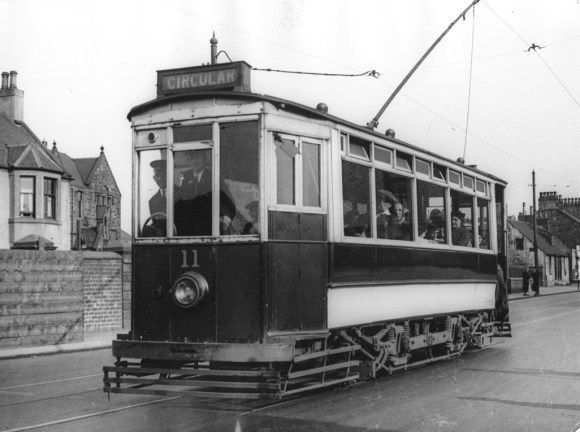
1906 also saw the arrival of a regular tram service which passed in front of the school.
At the outbreak of the First World War in September 1914 the Northern School was occupied by the Scottish Rifles. The pupils from the school were transferred to Bainsford School until August 1917. In March 1915 it was reported that the school was in a very bad condition as a result of the occupation and that every cupboard had been ransacked and damaged. In all £969 was received from the War Office as a result of damage to the Board’s schools caused by the military. The Northern School was completely repainted before the pupils returned.
However, nuisances of another kind were now more perceptible than before. The neighbouring foundry (Falkirk Ironworks) and brickworks (Towers’) had grown in size and noise. Nor was that the only problem: over the summer holiday of 1924 the girls’ playground was covered with a layer of fine red dust from a sand blasting machine. Increasingly the school buildings were seen as run down and the location far from desirable. Examination results remained very good. In 1932 the County Council proposed reconstructing the school on the same site at an estimated cost of £9,000. This was a time of price inflation and when, in 1935, the County architect produced a plan, the cost was put at around £13,000. The proposed scheme of reconstruction providing for 12 classrooms, 4 practical rooms for the junior instruction centre, a large hall with changing rooms, 4 staircases to outside walls, a medical inspection room, a headmaster’s room, three staffrooms with lavatory accommodation, inside lavatory and cloakroom accommodation in different parts of the school – all sufficient for 600 pupils and the junior instruction centre which was a separate unit. At the same time it was estimated that a new school in an open and more extensive site to accommodate 600 pupils would cost £21,000 without the junior instruction centre.
The Second World War led to a postponement of the plans and then to a radical rethink. During the war the pupils of Dawson Park School were transferred to the Northern School so that their own building could be used as a first Aid Centre. In 1941 the Northern School was allocated as a Rest Centre but this did not impair its functioning as a school.
After the war the Dawson Park pupils left and some pupils were allocated to Victoria School, thus diminishing the numbers remaining at the Northern School. Some classrooms remained empty whilst a decision was made what to do with the school. It was re-named Falkirk Northern Primary School about 1948, with a reduced roll. For a while its closure was mooted but in 1954 the suggestion was put forward that it could serve as a junior secondary school. Discussions continued and in 1956 an empty classroom was used to teach English to Hungarian workers resident in the area. Finally, in June 1958, it closed. The buildings were demolished around 1970, and in the late 1980s Castings Avenue was laid out across the site.
| YEAR ARRIVED | HEADTEACHER | YEAR LEFT | No. PUPILS |
|---|---|---|---|
| 1876 | Mowatt | 1885 | 334, 443 |
| 1885 | Andrew McLean Craig | 1901 | 610, 913 |
| 1901 | William Gilfillan | 1907 | 1010, 639. 750 |
| 1907 | George Nelson | 1923 | 702, 750 |
| 1923 | Alexander Baird | 1932 | |
| 1932 | David Stark | 1938 | |
| 1938 | Alexander G Beveridge | 1945 | |
| 1945 | John Fleming | 1950 | |
| 1950 | Robert Troup | 1958 |
National Grid Reference
| Grahams Road | NS 88828104 |
 Falkirk Local History Society