
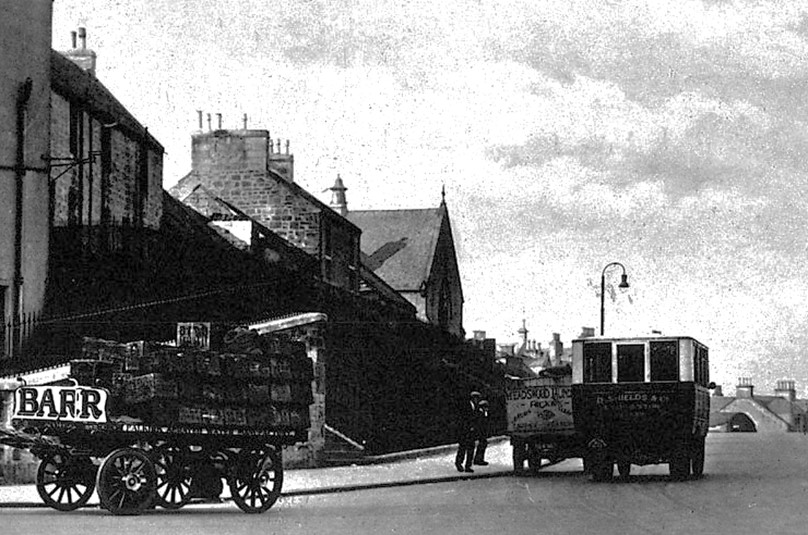
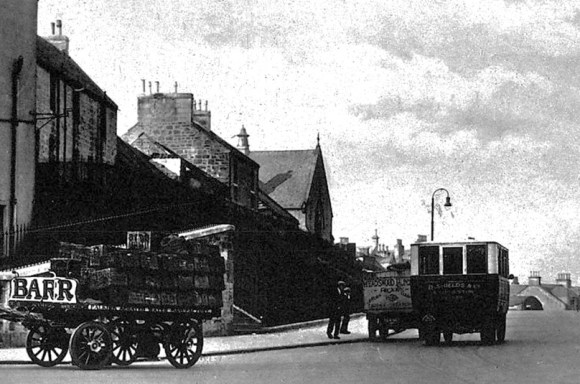
A Catholic school was established in Falkirk in 1852. Rev Paul Maclachlan motivated his congregation to purchase land on the south side of the Back Row and here they erected a single storey schoolroom set a little back from, and perpendicular to, the street. It consisted of a single large room and opened in January 1853. In 1860 the Ordnance Surveyors described it as:
“A substantial building one storey high, slated and in good repair. Situated in Back Row. Was erected by voluntary contributions from the members of St France Xavier’s Church, and other friends, and supported also by voluntary contributions from said members and school pence. Affords tuition in the rudiments of an English education. Average attendance about 120.”
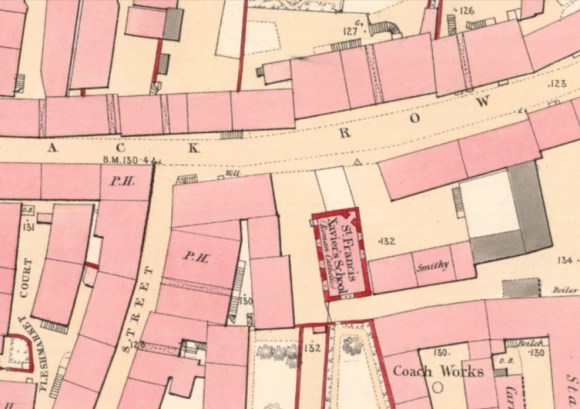
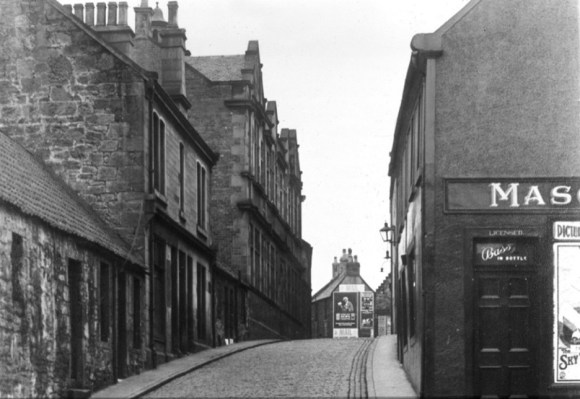
Just around the corner from St Francis Xavier School, on the east side of Silver Row diagonally opposite to the Masonic Arms, was a private adventure school which should not be confused with that run by the Catholics. Within five years of its construction the Catholic school in the Back Row was too small for the number of pupils wanting to use it. From the beginning it was inspected by the Education Department and in 1858 Inspector’s report described the performance as good, but
“the erection of larger and better premises with good offices, which are seriously projected by the excellent manager, whose personal influence combines, with that of the teacher, in producing the flourishing state of this school.”
It was 1880 before the new school was ready. In the meantime, the old building in Back Row presented problems of sanitation – neighbours objecting to the large privy. They were also annoyed by the far too common street fights with the pupils of the Falkirk Public School (Mr Liddle’s). These were particularly a feature of the snowy winters when the ammunition took the form of snowballs. The Catholics were often victorious, having the advantage of the higher ground.
The new school of 1880 was located a little to the south-east of the early adventure school in Silver Row. The new building lay on the rear of the plots in Silver Row, facing Callendar Riggs which at that time was owned and managed by the Feuars of Falkirk and was not a right of way. Access to the school could be had from Horsemarket Lane in the south or from a close off Kerse Lane in the north. It was of the Gothic style of architecture with the principal elevation to the east containing a large three-light window having mullions, labels, and deeply revealed ingoings.
Further gable decoration was provided by the corner buttresses with ornamental skews and a Gothic cross at the apex. A circular panel in this gable was left for future embellishment. It consisted of a schoolroom of large dimensions, with two class-rooms immediately to the rear. The two class-rooms could be thrown into the schoolroom by the aid of sliding doors. The large school-room had an elegant open timber roof, the principals of which rested upon stone corbels on either side wall, and the panels were filled in with plaster work so as to preserve the acoustic properties. There were separate porches for the boys and girls and a porch towards the south affording a separate entrance to the large schoolrooms. The projecting porches all had bold ingoings with label mouldings and panels, finished with finials. The mullioned side windows had pointed arches. The rather ornate building was designed by Thomas B, McFadzen, architect, Edinburgh.

Just seven years later a new infant school was erected for St Francis School. The Church owned the three dwellings fronting Silver Row and demolished the southernmost to make way for the addition. It was designed by James Strang and opened on 23 September 1887. The plot was an awkward one to work with and called for an unusual design. Built partly of brick and partly of stone, the walls of the new schoolroom were high and had no windows in the sides. Instead, light was admitted through glass frames placed along the tops of the three walls away from the street, piercing the rafter roofing of the building. This produced a more diffuse light and meant that the interiors of the walls could be used for educational material. Heating was by a substantial and ornamental stove. The accommodation provided for 130 children and cost only £250 all in. The mason work was by Mr Dalziel.

A problem arose with the route taken for the main drain. It ran eastward and then north to join a town sewer under Kerse Lane. This took it across Callendar Riggs and no permission had been sought. The Feuars of Falkirk therefore closed the drain, causing a severe nuisance at the school. Dr Peake recommended that the Police Commissioners close the building on the grounds of public health, instead of which the Commissioners got the drain re-opened and initiated negotiations with the two parties. The Church refused to pay an annual fee for the wayleave, saying that the Feuars’ land was essentially for the public good. The Feuars therefore resorted to the law. The Sheriff Court in Stirling found for the Church, but this was overturned by the Court of Session and the Church had to pay legal expenses as well as fixing the problem.
Scholars went to St Francis School from a wide area and included 25 from Muiravonside parish in 1894. Nevertheless, the school had accommodation for 315 and whilst there were 296 on the roll, the average attendance was only 208. This rapidly increased.
In 1904 the Church was able to purchase the house to the north of the buildings that it already owned on Silver Row. This allowed them to build a large new two-storey block on the frontage of that street and to move the main entrance there. The old buildings were swept away and six additional classrooms, with the necessary cloakrooms and teachers’ rooms, put in their place. At the back, it was joined to the west gable of the 1880 building. The contractors were:—mason work, John Gardner, Falkirk; joiner work – J & A Main, Falkirk; plumber – Robert Brown, Falkirk; Slater – Drummond & Crowe, Laurieston; plasterer – David McNair, Falkirk; tiles – George Cherry & Co, Glasgow; glaziers – Daniel O’May, Falkirk; cupola lights – Helliwell & Co, Glasgow; asphalt – Adam Locke, Edinburgh. The work was completed in January 1905 at a cost of around £4,500 and the school now had accommodation for 520 pupils.
The 1887 infant school had been retained, but in 1910 it was taken down and replaced by two additional classrooms to match the two-storey building on its north. The infant department took over the old Free Church School building in Meeks Road (later the Central School). The school was now a junior-secondary one. The following year arrangements were made whereby the children in the supplementary class at the Roman Catholic School got the use of the industrial department at the Public School.
With the passing of the 1918 Education (Scotland) Act the responsibility for St Francis School was transferred to the Falkirk Burgh School Board which had to lease the buildings, though the Catholic Church continued to manage the school. The 1930s saw a great shift in the population of the area. Slum areas in Falkirk were demolished and residents were moved out to the social housing at places such as Camelon and Bainsford. This resulted in the Catholics in Camelon petitioning the County Council for the erection of a new school there. In 1939 the Roman Catholic Church Trustees offered to sell St Francis RC School to the County Council in terms of section 18 of the Education (Scotland) Act 1918. It wanted offers on the same conditions as the sale of other Roman Catholic schools in 1922 (following the Bonnybridge Case). By this time the school was creaking at the seams but it would have to wait until after the Second World War was over before the problem could be tackled. Mr Farrell, the head teacher, became the Home Guard battalion officer for Falkirk.
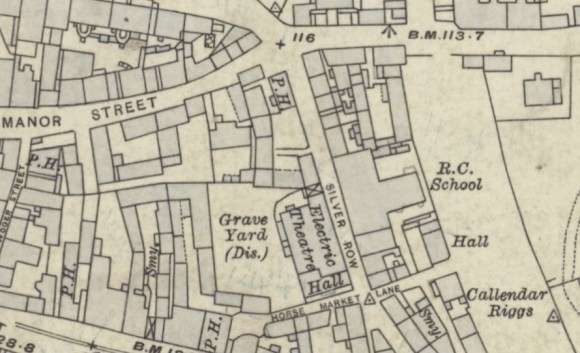
The Roxy Theatre on the other side of the road from the school was only a minor distraction for the pupils as normally it only opened its doors to the public in the evenings. After the war the buildings to the south of the school were soon demolished for redevelopment but lay empty for years.
Existing schooling problems were exacerbated in 1947 by the raising of the school age. One solution to the accommodation problem was to use the pre-fabricated techniques developed in the war but on a permanent building. It was therefore decided that the Roman Catholic secondary school which was to be built at Merchiston at a cost of £50,000 would take this form. That school opened in 1953 as St Mungo’s (see separate entry) and the older children moved there whilst the younger ones remained at Silver Row. St Francis Primary School was built on the other side of Merchiston Avenue from St Mungo’s and opened in 1959. The Silver Row School was then redundant and was demolished to make way for the Callendar Riggs Shopping Centre of 1961. The new centre had a deep basement and so the slight hill that the old school had occupied was completely removed.
| YEAR ARRIVED | HEADTEACHER | YEAR LEFT | No. PUPILS |
|---|---|---|---|
| (1885) | George Griffiths | 1898 | 208 |
| 1901 | 238 | ||
| 1925 | John Farrell | 1954 | |
| 1954 | Duncan O’Hara |
Sites and Monuments Record
| Silver Row | SMR 2175 & 1332 | NS 8888 7995 & 8898 7993 |
 Falkirk Local History Society