
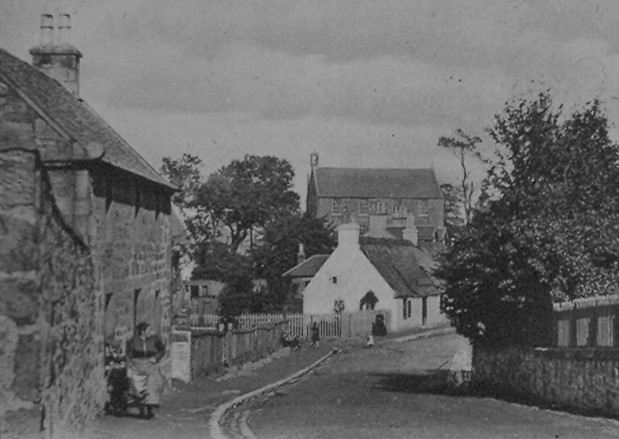
By 1690 there were nine Grammar Schools in Stirlingshire and Slamannan was one of them. These were schools where Latin or Greek were taught. Robert Tennent was the school master at the time. He first comes to our notice in 1688 when he brought a case against John Shaw of Greenhill for money owing to him for having taught Shaw’s four children (Reid Notes).
The quick turnaround in schoolmasters during this period was largely due to the lack of any free dwelling, which many other parishes provided. In 1694 the Kirk Session acknowledged that this was a great want, but it was many years before it was remedied. One quarter of the new teacher’s salary that year came from money received for the use of the mortcloth at funerals. Thomas Young was also to receive £3 Scots extra for teaching at the east end of the parish. This latter circumstance was a peculiarity of Slamannan. For six months a year the school was held in rented accommodation in the vicinity of the parish church, and for the other six it was conducted near Avonbridge at the east end of the parish. The eastern venue was generally on the Lands of Dalquhairn belonging to the Shaw family.
At a meeting of the Kirk Session on 12 May 1695 the minister, James Stevenson, reported that he had trouble finding a house at the west end of the parish for the school at a reasonable price every six months. He suggested that a piece of ground at Kirkburnhead belonging to the Lands of Rashiehill could be bought so that a school building could be erected there. The Session empowered him to buy it for 200 merks and on 19 May 1695 he reported that this had been done. The sasine describes it as:
“all or about thrie roods of land or thairby boundit as follows, viz by the Kirkburne and Gleib on the north By ane butt of Mothall land att the bridge on the east, Bye ane march dyke betwixt it and Castlehill land on the south By ane poffill of land called Mosscastle belonging to George Rankine on the west thairof lyand in the parochine of Slamanan and sheriffdom of Stirling with the free ishe and entrie thairto, and with all liberties and privileges of the samen for building of ane school and schoolhouse thairon, and other pious uses.”
Although there are no direct references to it, it seems that a school building was erected at Kirkburnhead and from then on the rotation with the east end of the parish took place after each full year. In 1705 James Shaw gifted the Easter Schoolhouse to the Kirk Session “for all time coming.” It was on the south side of the road leading from Avonbridge at Dykehead (at NS 8890 7200) which was part of Wester Dalquhairn. The walls were of wood and the roof was thatched. It had to be completely renovated by the Session before the school rotation of 1 January 1706.
The two schools continued to be held in the parish, one near the church and the other at Easter Dykehead, in alternate years. A move arose in 1788 to fix the school at one central location though it was 1794 before a house was rented at the Hill, 1½ miles east of the church, from William Wise. This trial ended at harvest-time 1795 when it was decided to return to the old way of doing things. Shortly thereafter, in 1803, the Kirk Session came into the possession of a house near the church known locally as “the Slate House.” The name seems to result from the use of slates rather than tiles for the roof which was rather unusual at this date; it was not from the use of school slates for writing. The two storey house had a lintel over the door bearing the date and initials “17 D A M S 76,” divided by a false keystone. As the schoolmaster in 1776 was Donald Archibald it seems reasonable to assume that he had the house built. At 38 years, Archibald was the longest serving schoolmaster that century – the average for the other twelve teachers being a mere 5½ years. The fact that he had his initials, together with those of his wife, engraved over the door suggests that this was a private venture rather than a building sponsored by the heritors. It was, however, built on Kirkburnhead which had belonged to the Kirk Session. The house was properly named “Clerkshall,” a name probably derived from the appointment of the schoolmaster as the Session Clerk. It appears as such on Forrest’s plan of the parish in 1806. The building was repaired and prepared for use as a school. This may have included the enlargement of the ground floor windows to allow more light into the schoolroom which measured 34ft 7in by 18ft 9in externally (SMR 499 at NS 8557 7323 ). The insertion of a window at the back (west) side of the schoolroom is specifically mentioned.
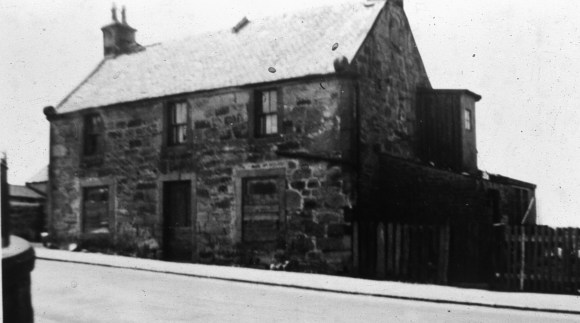
The ground floor of Clerkshall opened as a school at Whitsunday 1804 with a house for the schoolmaster on the upper floor reached by a new external stair to the rear of the building. Despite this provision, discussion continued for another four years about moving the school to a more central location near North Arnloss.
The parish minister, Alexander Davidson, in the 1841 Statistical Account tells us that:
“The branches of education taught in the parish school are, English, writing, arithmetic, book-keeping, mensuration, Latin and Greek. The salary is the maximum, and there is a glebe of one acre attached to the school. The fees are from 2s 6d to 5s per quarter.”
The school building was far too small but it was 1849 before moves were made to replace it with a new one on a new site. Andrew Rankin of Castlehill was approached and agreement was reached to acquire land behind the post office at the east end of the village. Part of the deal was that Rankin would take over the old school building at valuation. The new building was to cost £260 over and above what was received for the old one. As often happened, there was a change in plan. Instead, it was decided to build on a plot adjacent to Clerkshall and to use the old school building as offices as well as the schoolmaster’s house. This scheme was put into practice and it was this school that was handed over to the Slamannan School Board in 1873.
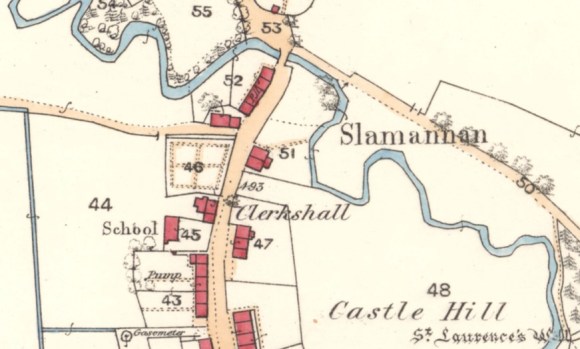
The Ordnance Survey described Clerkshall as:
“A two storey dwelling house near the centre of the villageof Slamannan, the residence of the parish school master. It is two stories and has a good garden attached… It is the property of the Heritors of the parish.” Of the adjoining school they say: “The parish school of Slamannan is a small one storey building, with one apartment, which is used solely as a school, the teacher’s residence being in another part of the village. The teacher’s salary is £34.4.2 ½ with a free house and garden. The average attendance is 90, two thirds of whom are males. In addition to the elementary branches Latin, French, Greek and mathematics are taught.”
| YEAR ARRIVED | HEADTEACHER | YEAR LEFT | No. PUPILS |
|---|---|---|---|
| 1680s | Robert Tennent | 1693 | |
| 1693 | George Young | 1694 | |
| 1694 | Thomas Young | 1697 | |
| 1697 | William Mirke | 1701 | |
| 1701 | James Mochry | 1702 | |
| 1702 | John Chalmers | 1710 | |
| 1710 | Alexander Simme | 1716 | |
| 1716 | Patrick Salmon | 1719 | |
| 1719 | John Adam | 1722 | |
| 1722 | Harry Clerkson | 1730 | |
| 1730 | Alexander Gray | 1750 | |
| 1750 | Donald Archibald | 1788 | |
| 1788 | William Cowan | 1790 | |
| 1790 | Jonathon Rankine | 1794 | |
| 1794 | Joseph Wilson | 1799 | |
| 1799 | Samuel Seggie | 1800 | |
| 1800 | John Graham | 1801 | |
| 1801 | John Baird | 1805 | |
| 1805 | John McNaught | 1808 | |
| 1808 | William Cowan | 1812 | |
| 1812 | Robert Main | 1858 | |
| 1859 | Robert Horne | 1873 |
Upon the opening of the Slamannan Public School in 1876 the buildings in Main Street were put up for sale. For many years Clerkshall was used by McAlpines as a scrap-yard and was eventually demolished in the 1960s. The 1849 block was bought by the Orangemen as a meeting hall. After the erection of the Masonic Hall on the corner of Mosscastle Road the old hall was used as a workshop before it too was demolished.
Sites and Monuments Record
| Slamannan Parochial School Main St, Slamannan | SMR 1103 | NS 8530 7300 |
 Falkirk Local History Society