
In 1888 Denny was still dependent for its water upon a small number of public wells and an increasing number of private wells. Analyses of the different public wells disclosed the alarming fact that nearly the whole of them were polluted and unfit for domestic use; and notwithstanding that improvements in their surroundings, including cementing the inside castings, were effected, subsequent analyses exhibited no improvement. Some of these analyses were made by Mr McAlley, who had been the public analyst for Falkirk, and among the wells reported on by him as unfit for domestic use were – Bessie’s Well, Boghead Well, Wright’s Well, Davie’s Row Well, Stripeside Well, Sclander’s Well, Lady’s Well, and Wellstrand Well. One of these wells, that at the Wellstrand, was thought to be the cause of an epidemic of typhoid fever in 1888 which nearly proved fatal to one of the medical men of the place and some members of his family.
The authorities at Denny were well aware of the burgh’s dire need for a better water supply. In 1886 when Falkirk applied to Parliament to take water from Loch Coulter, the Burgh of Denny opposed the Bill in order to force a concession by Falkirk to supply it with water at a certain price per 1,000 gallons, but the Bill was thrown out. Falkirk then invited Denny to join them in the Faughlin Burn scheme. Denny Council thought that it might be able to do better on its own and in 1887 the Denny Commissioners employed Kyle, Dennison, & Frew, C.E., Glasgow, to survey the district and report upon the best water scheme. The Garvald Burn and the Overton Burn were examined, both of which were intended to be used to provide a gravitational supply. It was shown that Overton could supply a sufficient quantity on its own and had a convenient hollow area which could be utilised for a reservoir, keeping the costs down. Furthermore, it would not be required to provide as much compensation water to the local millowners as would the Garvald scheme. So, a Provisional Order was restricted to the Overton Burn with a single reservoir. The estimated cost of this scheme was £6,541 4s 2d, excluding engineering and legal fees. The Act allowed for money to be borrowed and paid back over 50 years, with interest at 3.5%.
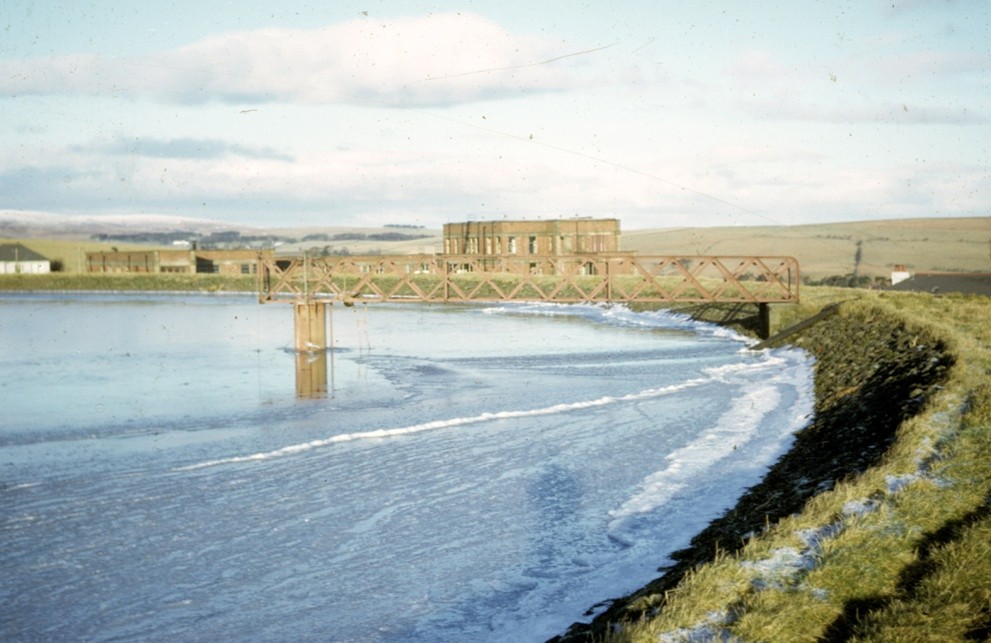
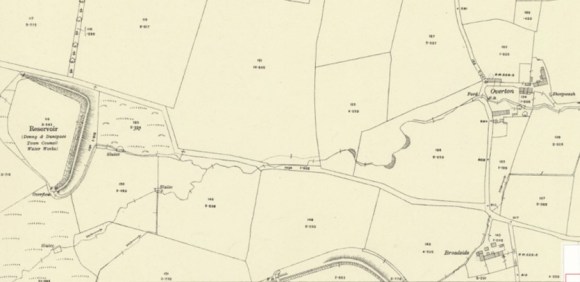
The Broadside reservoir at Overton was placed in a large natural hollow, the storage capacity being increased by forming an embankment. The greatest height of the embankment was to be 16ft, and it was intended to excavate the material required for it from the site of the reservoir. The depth of the excavation would in no part of the reservoir exceed 6ft. Four trial pits had shown that stiff tenacious brown clay, the very best material, occurred at the depth of 6ft. This would bring the cost to a minimum and insure a water-tight job. The reservoir would cover a little over 10 acres and would hold 16,000,000 gallons, and if the embankment was raised 2ft there would be storage for 21,000,000 gallons. The clear water tank was to hold one day’s supply of 123,000 gallons. The Upper Overton ground was wholly hill pasture, with steep slopes and very little moss. The gathering ground covered around 250 acres at an elevation of 700-1200ft above sea-level. The clear water tank would be at 220ft above the highest point of the burgh. The line of the main pipe had a favourable gradient for pressure. The Provisional Order allowed for 60,000 gallons per day as compensation water.
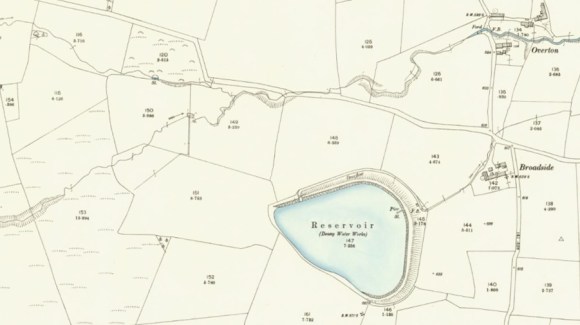
The reservoir was constructed in 1890 for a capacity of 21 million gallons, but when it was completed to the formation level a patch of moss was laid bare. This was taken out with the result that the capacity was increased by nearly three-quarters of a million gallons. It was formally opened on 5 July 1890. Demand rose and in 1902 a smaller reservoir was required to supplement it. This was placed a small distance up the hill and was known as the Overton Reservoir with storage for 11 million gallons. No filters were provided at either.
During operation it was found that the water pressure in the town was rather high and so a pressure reducing tank was constructed at Cromnock Steps.
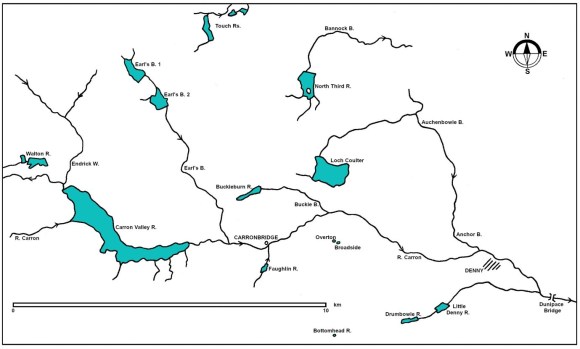
Dry summers in the late 1910s placed stress on the water supply from Overton and so in 1919 the Denny Town Council applied for a Provisional Order to empower them to introduce a supply of water from Loch Coulter (plans by Crouch & Hogg may be found in the National Records of Scotland RHP 5853). The loch was about half a mile long by a quarter of a mile broad and its waters flowed north into the Sauchie Burn to the Bannock Burn. The new water works were to cost £100,000 and included the diversion of several streams into the loch, which was to be embanked at the Stirling end and enlarged, with the level raised so that the water flow, which was in the opposite direction, would be diverted to the Denny side. The Falkirk and Larbert Water Trust opposed the move because the various water authorities in the district were in discussions about amalgamating, which would bring about a more efficient use of water over a wider area. In the meantime, an exceptionally dry summer caused an acute shortage of water. The emergency was met by pumping water from the Carron at a point above Carrongrove, as an auxiliary supply into the water mains, and very few were aware of the change of source.
The officials at Denny struck another beneficial deal with the Falkirk and Larbert Water Trust. Its existing works were capable of giving the supply in the winter months and so the new water supply would be delivered into the Broadside Reservoir. Under the agreement of 7 May 1920 the Council was given power to draw water at a rate not exceeding 600,000 gallons per day, up to a maximum of 110 million gallons yearly from either the Trust’s filtered water mains or from Loch Coulter. An odd phrase stipulated that the Loch Coulter water was to be derived from its catchment area. The daily limit was not needed during the winter, but turned out to be restrictive in the summer.
The Falkirk and Larbert Water Trust amalgamated with the eastern and central districts of Stirling County to form the Stirlingshire and Falkirk Water Board in 1921 and it was bound to honour the 1920 agreement. A pipe was installed to take filtered water from its mains to the Broadside Reservoir.

The Stirlingshire and Falkirk Water Board took over the works of the eastern district at Buckieburn, raised the level of Loch Coulter by 12ft 6ins, and constructed filter plants at Longhill and Sauchie. Denny remained independent and in 1924 increased the size of the water main from Broadside Reservoir to the burgh from 9 to 10-inches in diameter allowing a storage tank to be dispensed with, borrowing £10,000 for the purpose. The Reservoirs (Safety Provisions) Act, 1930, meant that the Burgh had to have its reservoirs inspected annually and it appointed John Hogg, Chief Executive, of Glasgow for this purpose. As a result some repairs were required to the pitching of the reservoir down to water level below the point at which the Water Board’s supply was discharged into it, and therefore the water was cut off temporarily, and then reconnected to fill the reservoir.
In 1942 Crouch & Hogg were asked to produce a report on increasing the catchment at the Broadside and Overton reservoirs. Upon examining the potential costs, the Burgh then asked the Stirlingshire and Falkirk Water Board for terms for supplying additional water in excess of that stipulated in the 1920 agreement. Demands for water throughout the area served by the Stirlingshire and Falkirk Water Board meant that in 1946 it was not able to supply filtered water to the Broadside reservoir and it proposed to replace it with unfiltered water from Loch Coulter. The Burgh of Denny and Dunipace decided to stick to the letter of the 1920 agreement and so the water from Loch Coulter was no longer acceptable as it was supplemented by water from the Buchieburn Reservoir and the new Carron Valley Reservoir. The Stirlingshire and Falkirk Water Board decided to temporarily close the aqueduct from the Carron Valley Reservoir to Loch Coulter so as to conform to the provisions of the Stirlingshire and Falkirk Water order Confirmation Act of 1921 which stated that Denny had to be supplied with filtered water, or water only from the catchment area of Loch Coulter. It then laid a pipe from the Longhill filters to Broadside to take Loch Coulter water to Denny Burgh’s reservoir. Denny again negotiated a change and agreed to exchange the requirements of filtered water for an increased supply which could also come from beyond Loch Coulter.
Denny Burgh remained responsible for the provision of water to the public until the passing of the Water (Scotland) Act 1967 which created thirteen regional water boards.
Sites and Monuments Record
| Broadside Reservoir | SMR 2343 | NS 7640 8305 |
| Overton Reservoir | SMR 1984 | NS 7643 8350 |
 Falkirk Local History Society