
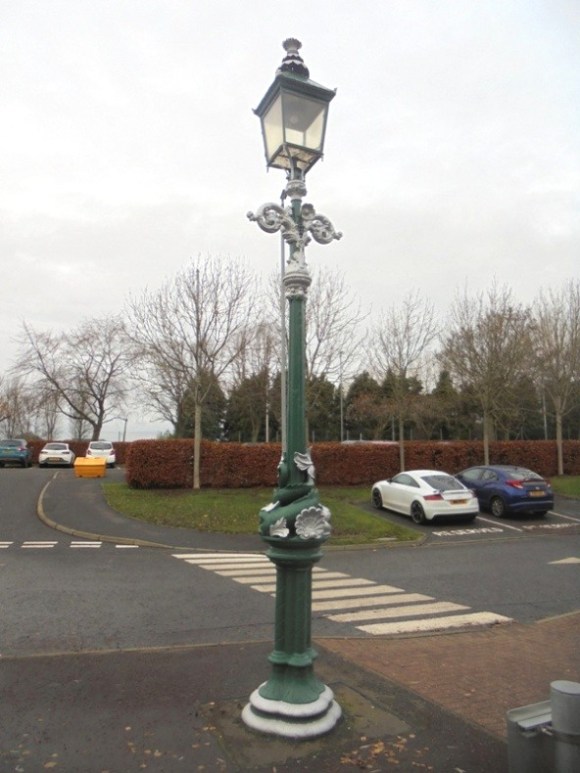
By the late 1860s many of the old burghs in central Scotland had especially ornate lamps strategically located outside of the residences of their provosts. As the chief magistrate of the local burgh, the Provost was often required to be contacted at any hour of the day and the lamps acted as beacons, making their abodes easier to locate and distinguish from those of their neighbours. Police officers from outside of the area found this particularly useful when requiring a warrant signed. At this period street lights were few and far between. The provost’s lamps were an insignia of the office and indicated the honour in which the office-bearer was held. The early lamps were of the bracketed type, affixed to a wall, and were often made by the local plumbers. Thus, for example, when the burgh of Crieff was looking to set up such a lamp it looked to its neighbour at Stirling and, finding that its provost’s lamp had been made by a Stirling plumber, had a Crieff plumber make one for it. Inevitably these lamps also became a symbol of civic pride with different burghs vying with each other for a more decorative or larger example. At first they were physically moved each time a new provost was selected, which could be every three years.
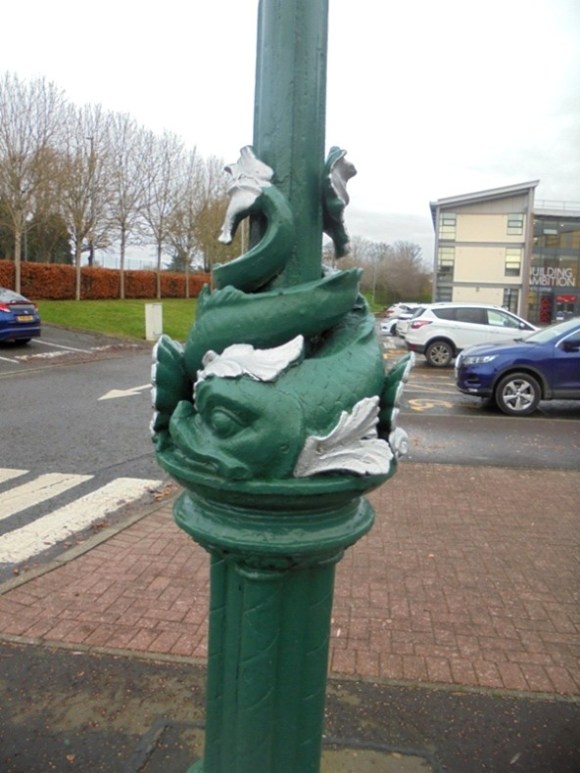
During the 1880s elaborate cast iron lampposts were introduced and these were placed at the gates of the larger residences of provosts, or on the pavement outside the humbler ones. Linlithgow got its first cast iron lamp in 1886, which cost £20. At this time they were lighted by gas – which could be a problem if the provost lived “off the grid.” The first lamp and post “of tasteful design” erected at Bo’ness was in 1884 in front of Chief Magistrate Allan’s residence. His house was a little remote and when the lamp was moved to South Street in November 1887 after the election of Provost Simpson, it was noted that more of the public would notice it. The glass was of a reddish colour, each of the four panes bearing a representation of the burgh arms, viz. a ship in full sail, with the motto “Sine metu.” When, in turn, Provost Ballantine took over, it was decided to leave the old post where it was and to acquire a new for the new provost’s house at the East Partings. The new lamppost was even more substantial than the old one. When, in 1895, George C Stewart became provost, yet another new and larger lamppost was erected, having two burners. It arrived and was set up with a basic priming coat of paint. It was then painted in several colours and gilded, and the four plates of glass were sent away for further adornment with the burgh’s coat-of-arms. The lamppost was made at the Saracen Foundry, Glasgow, of Walter Macfarlane & Co. The previous lamp was moved from South Street to Dock Street.
In February 1895 the elected members of Grangemouth Burgh Council looked at Bo’ness and their other neighbouring burghs and realised that they all had such lamps – and so they wanted one. Within a month one was erected in front of John Mackay’s dwelling. He was away from home when it was put in place and he got quite a surprise when he returned not only to find the piece of street furniture standing there, but fully illuminated. It bore the coat-of-arms of the burgh. John Mackay was followed by Hugh MacPherson and then Andrew Mackay. In 1900 Andrew Mackay junior was elected and in April the following year he helped to select the locations of the two lamps now used to mark his residence. At the same time Falkirk Burgh was also using more than one lamp as a mark of respect and significance. By contract, the provost of Kilsyth was asked in 1895 where he wanted his two lamps and stated that he considered the proposal profligate and so none were acquired.
Bo’ness seems to have stuck with a single lamppost and renewed it with each provost. In 1906 the lamppost for Provost Welsh had a pillar of “chaste design” fitted with wrought iron brackets for two lights and having the burgh coat-of-arms on the globes. It was still lighted by gas. The paintwork had just been finished when the new provost died. The last lamppost is now in front of the Bo’ness Academy.
The burgh of Denny and Dunipace does not seem to have erected any such lamps. In February 1928 Denny Town Council voted to erect two lampposts outside the home of the then provost, Provost Allan, and one each at the houses of two of the ex-provosts, Messrs Hunter and Lochhead. Unfortunately, all three lived in Glasgow Road, which would have made the street a little crowded. All three men did not want the lights and public sentiment soon made it clear that in a time of austerity the expenditure of £128 would have been excessive and the scheme was abandoned.
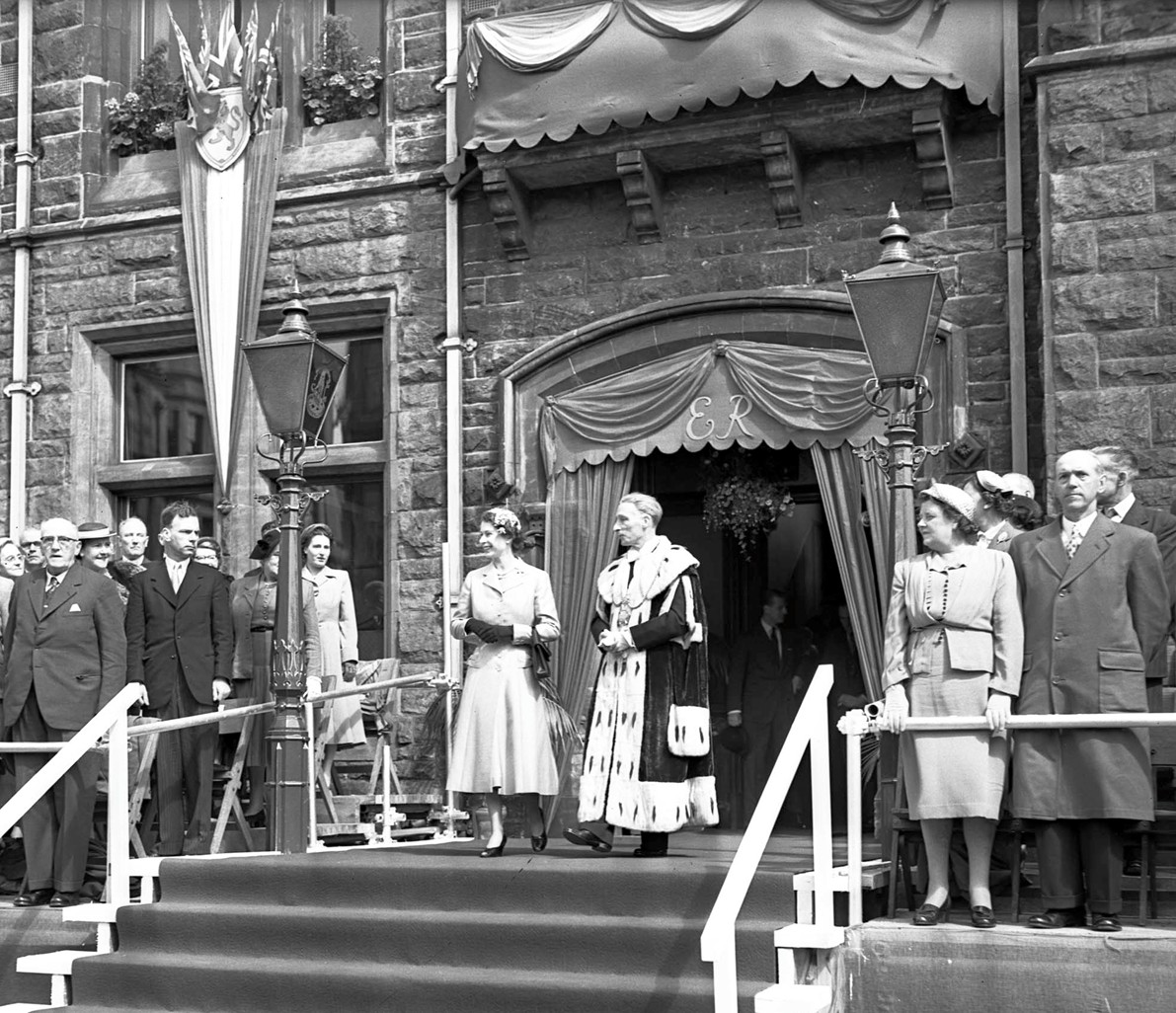
When the Burgh Buildings was built in Newmarket Street in 1877 two lamps were provided at the main doorway. The buildings contained the court and administrative offices of the Burgh Council and so it was appropriate that when these lamps were later replaced it was with ones of the ornate style associated with provosts – complete with coat-of-arms on the glass. They stood sentinel at the entrance until around 1967 when they were removed. This was the time when the new Municipal Buildings in West Bridge Street was opened, but they do not appear to have ended up there.
It was around 1975, at the time of government reorganisation, that the provosts’ lamps appeared at that venue and we must presume that included amongst them were those from Grangemouth.
With the demolition of the Municipal Buildings at the end of 2023 six provosts’ lamps were moved from the site to the gravelled area in front of Callendar House and are low lighted by electricity. As with every move, the opportunity was taken to freshen up the paintwork,
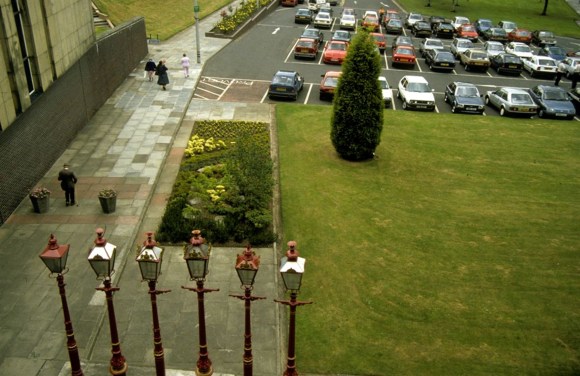
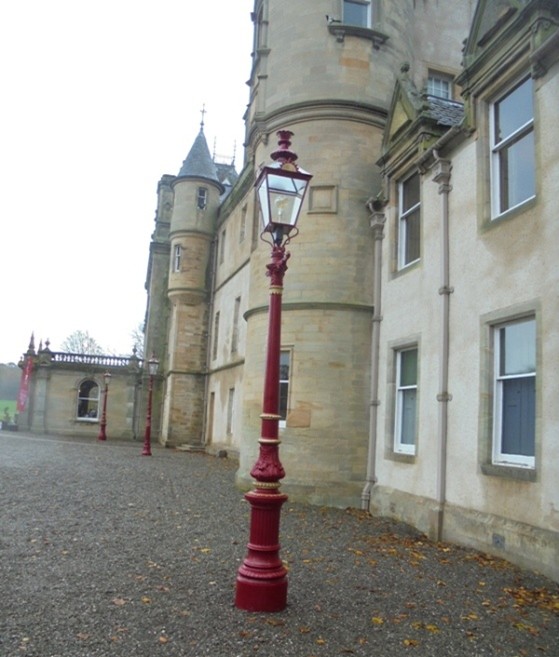
SMR 2330 Provosts’ Lamps.
 Falkirk Local History Society