
A Bo’ness Architect
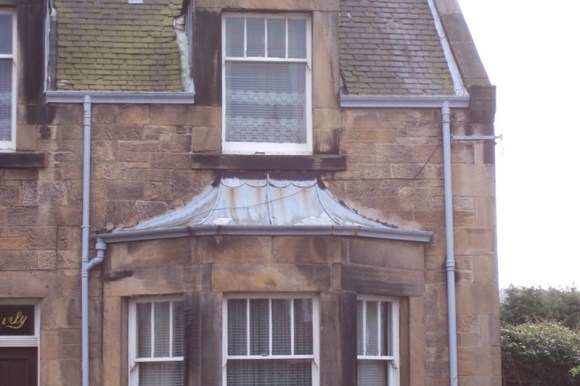
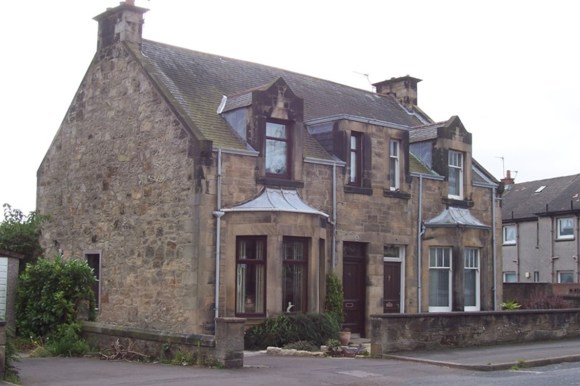
Matt Steele set up his architectural practice in 1905 and his first commission appears to have been a double cottage on Dean Road for William Gardner.
I. 47-49 Dean Road (1905)
is a relatively traditional plain stone built dwelling with a few individualistic features. The basic structure is a one and a half storey house with two canted bay windows on the ground floor. However, the leaded roofs are concave with scalloped flashings. Set above these are stone dormers surmounted with inset triangular gablets and swept skews. These contrast with the lower shared flat-roofed central dormer, echoed at the shop in South Street.
II. South Street Shop (1907)
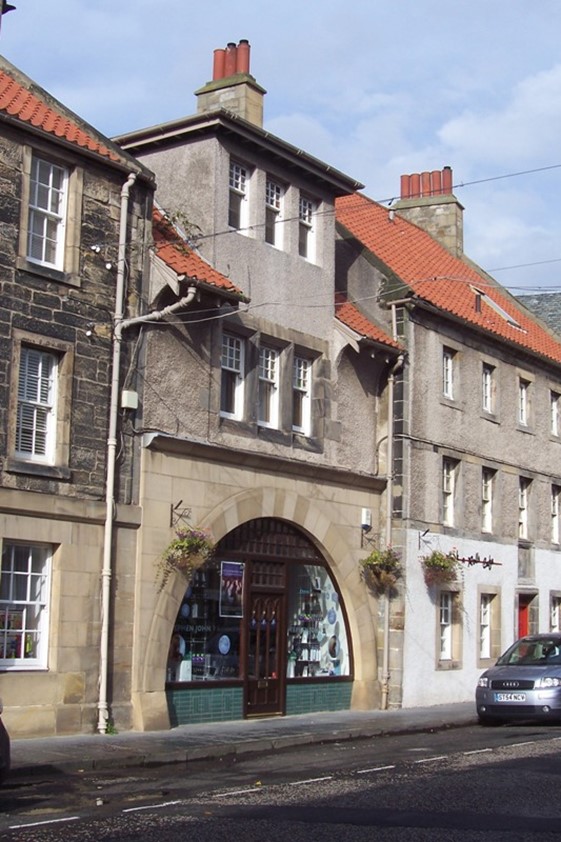
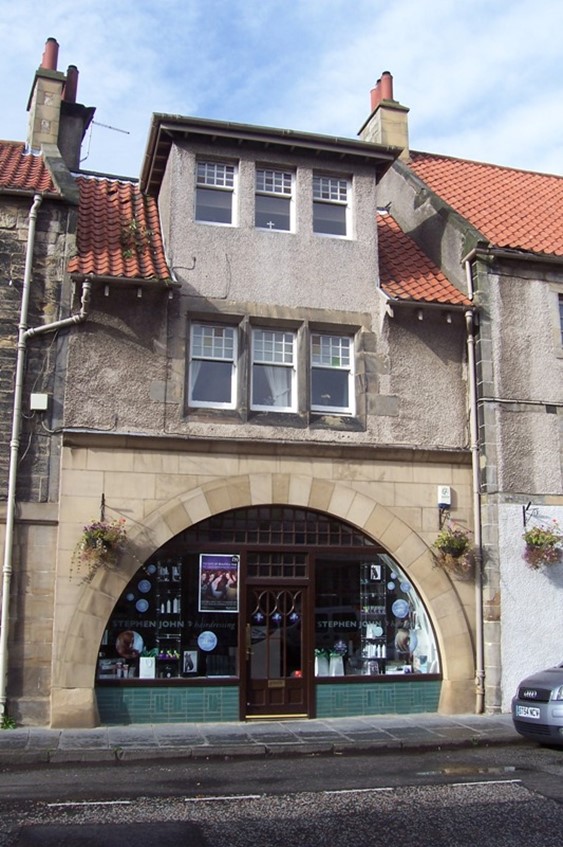
Steele designed the bakery and shop at 11 South Street in 1907 for John Paris. On the narrow frontage he created a contemporary shop front with the stone-clad ground floor contrasting with the harled upper floor and dormer. The central square dormer with three sash windows whose upper element is divided is typical of Steele’s work. The pantile roof was common in Bo’ness and other Forth coast ports, but here it oversails the exaggerated coved eaves in Baltic fashion.
The most prominent feature – the large semi-circular arched display window and entrance – is redolent of the kind of relationship that often exists between architect and client. Paris preferred, and got, a conventional shop window. The present truncated arch springing from splayed blocks was inserted by the architect William Cadell working for Falkirk Council during town centre improvements in 1984.
III. Gilburn Cottage, 5 Grangemouth Road (1907)
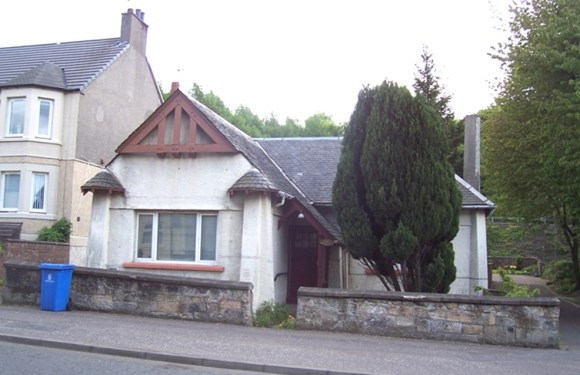
Some of the style is now lost by inappropriate replacement glazed units.
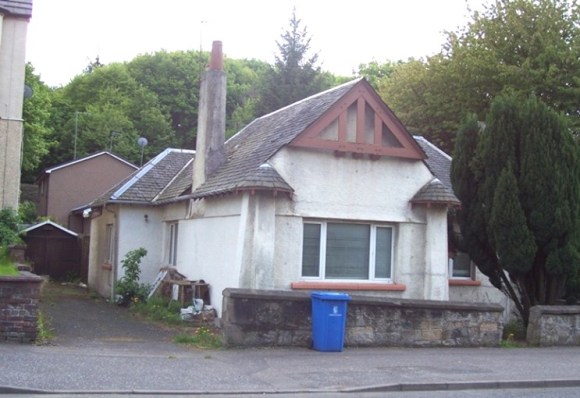
At the foot of the Snab stands a distinctive small three—roomed cottage which greets travellers approaching Bo’ness from the west. It was commissioned by George Denholm for the manager of the nearby woodyard and designed by Matt Settle in a playful Voyseyesque style. Although obscured by an evergreen bush this characterful building attracts much attention with its corner buttresses and tall tapering chimneys. It presents a gable with a 45 degree pitched roof to the main road. Here the end buttresses are topped with circular caps of slates. The porch is tucked into the re-entrant angle and is oversailed by the roof without any change of angle.
IV. Seaforth (1909)
In 1908 Steele was given a commission by Robert and Grace Simpson to design and erect a block of four flatted dwellings on the corner of Linlithgow Road and Dean Road. This gave him the opportunity to wrap the building around the corner and to create a landmark.
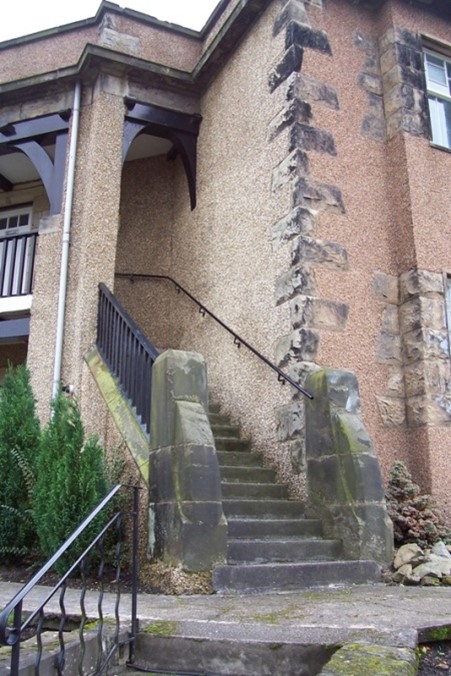
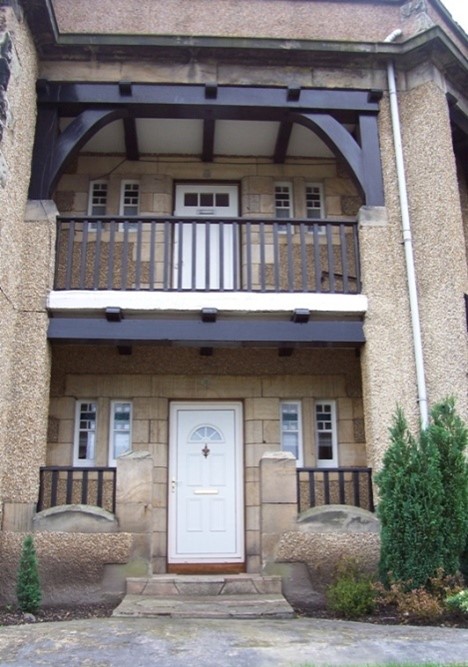
The angular articulation of the block is enhanced by the plain parapet with five square openings over each advanced bay. The parapet, like the mains walls, is rendered with Dorset pea grit, except at the quoins and jambs which are of hammer-dressed stone. Even the sills and lintels are covered, adding emphasis to the traditionally moulded eaves course and window mullions. By contrast, the recessed backs of the loggias and balconies are of well-dressed stone.
It is a collection of architectural styles and so has been called Free Style, though Arts and Crafts are to the fore.
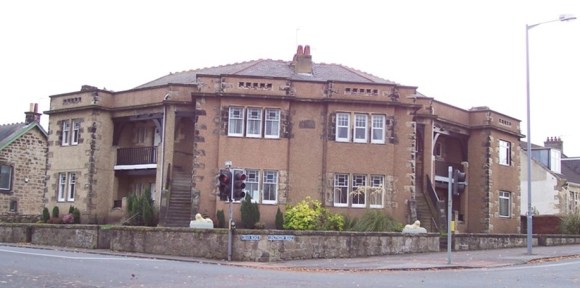
Given the location it might have been normal to produce varying facades on the two streets and to cap the apex with a taller section. Instead, the building is unexpectedly symmetrical and the corner is canted with a flat top. This canting is used to articulate the structure and has two advanced bays on it, with another at each end of the whole block. Further insets between the angle block and the wings are used to house the external stairs to the upper flats. These start at tall curvaceous stone newels and turn through 45 degrees as they reach the recessed first floor balconies. The balconies have canopies that allow the continuation of the roof parapet around the building and are framed by prominent heavy timbers; the curved brackets of which form parabolic arches. Below the balcony the loggias have dwarf walls between stone piers and are surmounted by hammer-dressed arched stone blocks that carry low banisters.
V. Bo’ness Masonic Lodge (1909)
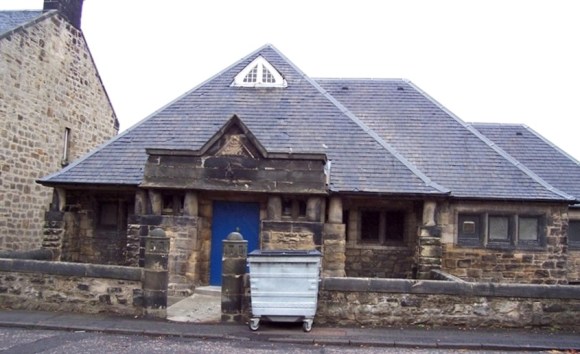
Near the apex of the roof is a boat-shaped dormer with a broad wooden frame and tiny glass panels. Below this the entrance porch is capped by a stone cornice with an inset triangular gablet (similar to the dormers at 47-49 Dean Road) and moulded skews. The tympanum is carved with the name of the lodge set within a compass which echoes the angle of the pediment. The lower part of the cornice curves outwards to form a bell-cast. All of this stonework is supported on stubby round pillars at the front and square columns at the back, set on tall plinths. To either side of the porch are bipartite lights recessed behind buttress-like piers carrying more squat columns. The two stepped bays to the east have triple and double lights. The entrance through the low boundary wall is through two circular sectioned gate piers which are capped by inset hemispheres above a band of eight incised rectangles.
No. 409 Lodge Douglas moved from Corbiehall to Stuart Avenue in 1910. The new building was designed by Steele and the foundation stone lain with Masonic honours on 14 August 1909.
The site lies on a steep north-facing slope and so the building possesses a basement floor which is little noticed from the main south façade. This façade is dominated by a cascading series of piended slated roofs set on low rock-faced stone walls with ashlar dressings. The features here are deliberately small, as if hiding something, and are laid out relatively symmetrically.
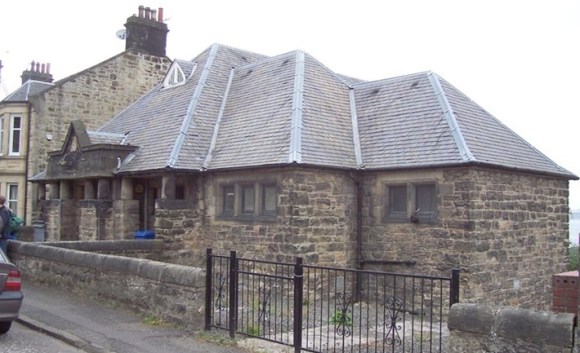
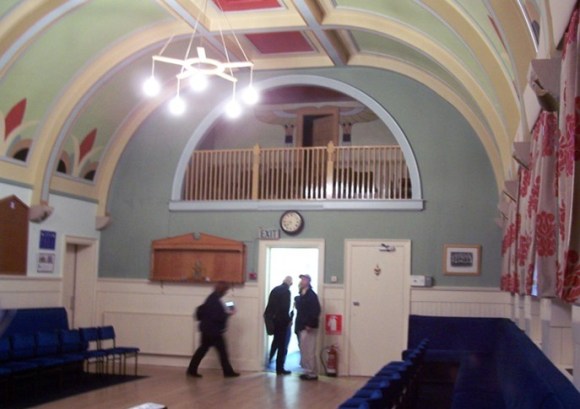
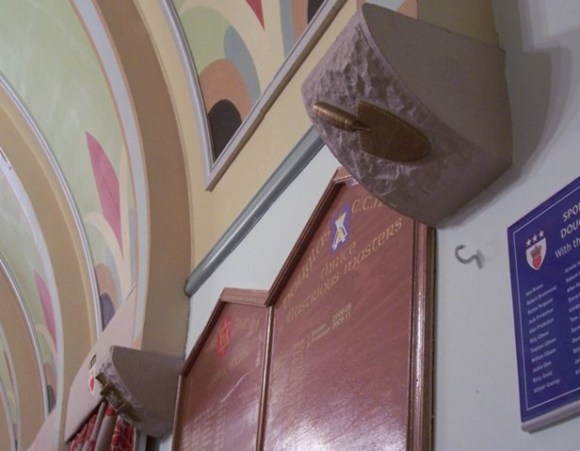
The basement or undercroft contains the office accommodation and inner sanctum. The main floor houses the ribbed and barrel-vaulted hall which has Masonic symbols carved on the corbels.
VI. The Hippodrome (1911)
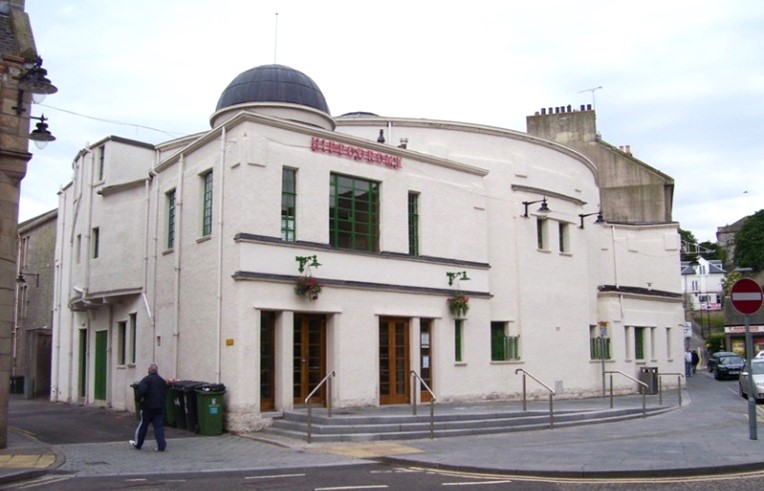
Commissioned by Louis Dickson to design a purpose-built cinema in 1911 on what had been Hamilton Lane – an area not long cleared of slums and reclaimed from the Forth.
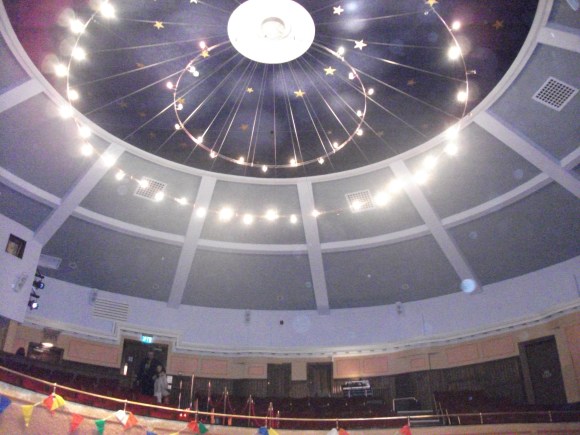
The building focuses on a round auditorium around which the ancillary accommodation is organised. In the original severe-looking design the huge auditorium drum was clasped at the cardinal points by low square-headed blocks interspersed by narrower taller blocks, whilst on the north side the curving projection booth breaks out at first floor level. A smaller flat-roofed cylinder on the corner of Hope Street and Hamilton Lane set back from the straight dwarf wall continued the contrast between the linear and the curved.
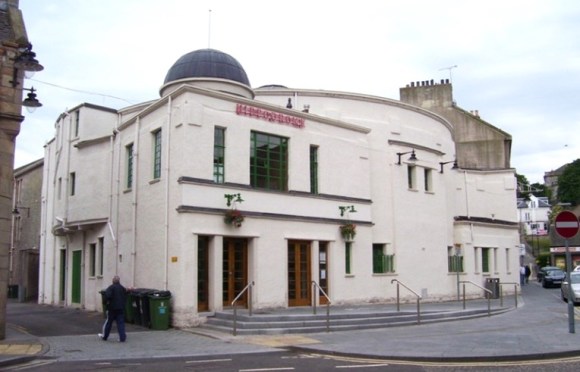
The basic form of a classical drum with a dome gripped at four points on its circumference by corner towers was known from the concert hall at the 1908 Scottish National Exhibition in Saughton Park, Edinburgh; but Steele’s treatment of it is more modern and the absence of windows in the main drum gives it an appearance of solidity made all the more imposing by its mass. This is further emphasised by hiding the roof and giving it a relatively plain wall head with a slight offset below it sporting a regular series of pastilles or square blocks in light relief.
It has been likened to a film reel bearing sprockets and cogs – the slightly projecting vertical projections with the sunken first-floor windows acting as guides or stays.
Cinemas were new and the building reflected this modernity. It was a changing world with telephones, aeroplanes and electricity – a great contrast to a converted church or town hall.
In 1936 extra accommodation was incorporated into the building by placing an additional storey on the ticket office and removing the corner roundel. The architect for this was John Taylor who has done a remarkable job of marrying it to the earlier work – using the same plain wallhead, offset and pastilles, vertical window apertures and topping it all with another cylinder – this time domed. The effect, as pointed out by Emmerson, is of a seaside resort – but Bo’ness is on the sea.
The wooden panelling within the ticket office and foyer may have been reused from a ship broken up at McLellan’s Yard.
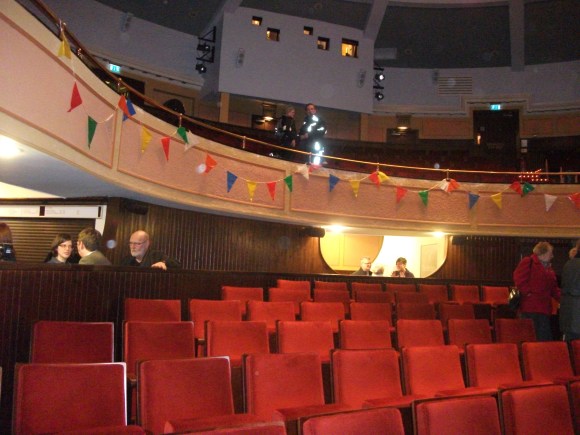
The building stood empty from the mid 1980s and deteriorated inside with dry rot in the floor boards. In 1996 a local organisation gifted ownership of the cinema to The Scottish Historic Buildings Trust; studies to determine feasibility of proposals followed. Restoration works, largely funded through the Bo’ness Townscape Heritage Initiative, and included the installation of new seating and repair and re-upholstering of old seats; reinstatement of the 1926 decorative scheme and repair of the original copper dome above the manager’s office. The project was completed in 2009.
VII. Star Cinema (1921)
The old Parish Church, which had been used by the Episcopalians, was converted into the Star Cinema.
The oblong church building had a broad brick bowed frontage added in “cinema” or modernistic style to house the ticket office and foyer, toilet accommodation, offices and stairs. Its smooth harled surface is indented with vertical panels and a recessed central section set between piers contained the entrance. The flat roof forms a balcony. This typical 1930s frontage with its vertical elements and metal-framed windows contrast with the functional box-like projection booth that was bolted onto the outside top of the east gable – held aloft by steel exposed beams. This feels almost industrial in character and anticipates future developments in architecture.
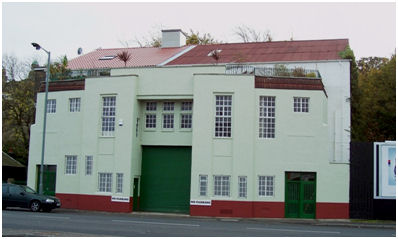
The first church was erected on this site at Corbiehall in 1638. It was replaced in 1776 but in 1820 the South wall and part of the East wall had to be replaced, and galleries were constructed. When the congregation moved to their new building in Panbrae Rd in 1888 the old one was used by the Episcopalians until the 1920s, when it became a the Star Cinema and later a bingo hall. It was opened on Christmas night 1919. There was a major fire at the Star Cinema in 1944. Following the war there was a delay in getting building materials, but it did re-open in 1947. The cinema could seat 720 people. The cinema closed in 1967. It was then used by a removal and storage company and the original entrance replaced by a garage door so that the van could be safely locked away.
VIII. Bungalows, Cadzow Crescent (1924-25)
In 1924 and 1925 Steele designed three small bungalows in Cadzow Crescent – two for Charles Low and a gardener’s cottage for Mrs W Denholm of Tidings Hill, It is evident that the clients wanted the familiar bungalow of the period without too much fuss or embellishment and Steele stuck to his brief with only minor features of note.
Each of the bungalows is L-shaped with a gable on the toe facing the street. At the apex of these gables Low’s house has a miniature Diocletian window and the gardener’s cottage a slit. The wall treatment was pretty standard – whitewashed render with red brick and tile inserts – the later matching the Rosemary tiles on the roofs.
The gardener’s cottage is adjacent to the Episcopalian Church building. It has a flat-roofed porch at the re-entrant angle (now masked by a later addition) and a cantilevered corner window. It also has a distinctive Gothicised pointed arch detailing on the chimney head and rustic stone gatepost. 16 Cadzow Crescent has domed gateposts with small vertical tile inserts; whilst number 14 has rustic posts capped with a broad flange and pimple.
On the way to the Masonic Hall we pass the Sunshire flats in Stuart Avenue mentioned under XI below.
IX. Coffin Close (1932).
Bo’ness Town Council was building massive amounts of housing for local people in the 1930s with the aid of government grants. In the suburbs this meant conventional housing schemes, but nearer the urban hubs it chose to erect flats.
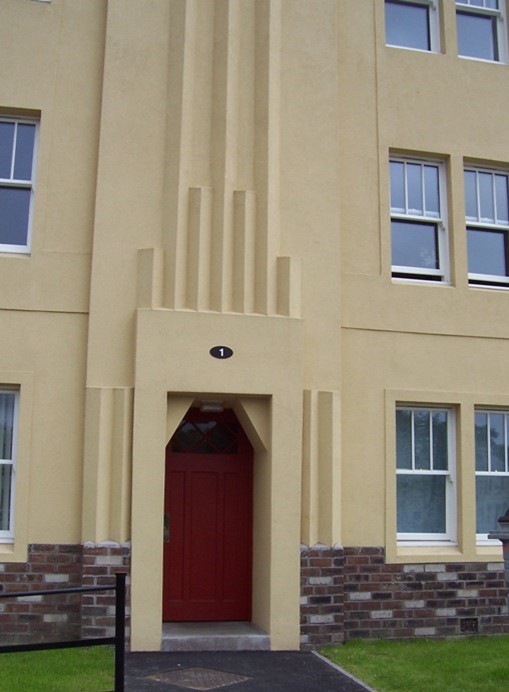
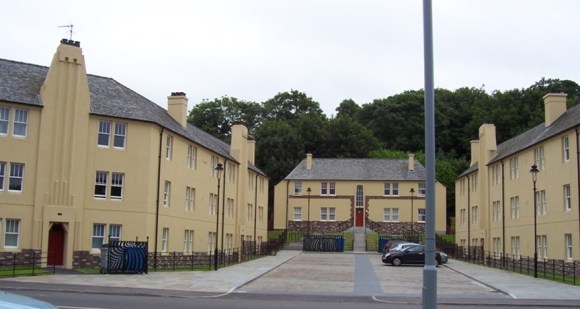
The flats at 43-51 Corbiehall consist of three blocks arranged around a spur road on ground that rises to the south. The difference in contours means that the central block at the end of the road is of two storeys and the framing L-plan ones to either side are of three storeys with canted corners. All are unified by their distinctive stair windows with canted jambs reflected in the chimney stacks and doorways. The latter, in their size and shape, reminded local people of something more mundane and earned the blocks the name of “Coffins Close.” Another unifying element are the tall slightly projecting piers or “chimney breasts” that extend from the battered stacks to the ground floor where they embrace the entrances – their verticality emphasised by concrete ridges in an Art Deco form. The ridges terminate at the top in a stylised crenallation. The cement render sits neatly on a band of red and white bricks that reaches to the ground floor cills adding a Northern European touch.
The symmetry of the whole development is focused on the doorway of the southern block and the canted window that surmounts it. A band of red bricks forming a stringcourse at first floor level descends to either side of the door and meets the rising basal band.
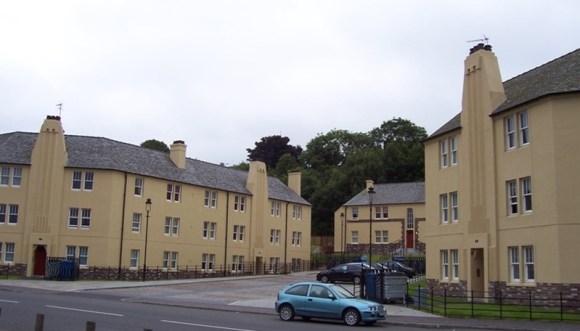
Falkirk Council renovated the flats in 2012 with the aid of the Heritage Lottery Fund and renamed the complex “Matthew Steel Court.”
X. Queen Mary Flats (1932)
More flats (191-199 Corbiehall) for Bo’ness Town Council were built in 1932, further west along the road to Grangemouth and set against the coastal escarpment capped by the Old Parish Church.
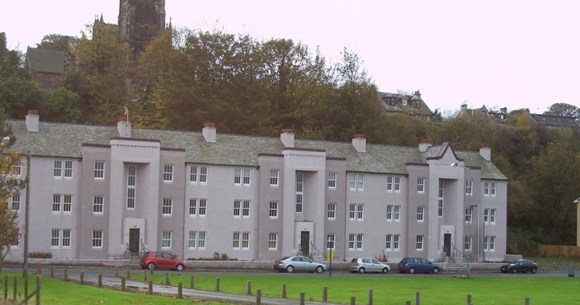
The elongated black is known locally as the “Queen Mary Buildings” because of its likeness in style to that of the ocean liner launched in 1934. Here the sparingly used Art Deco embellishments on the strikingly symmetrical three-storey block are dominant.
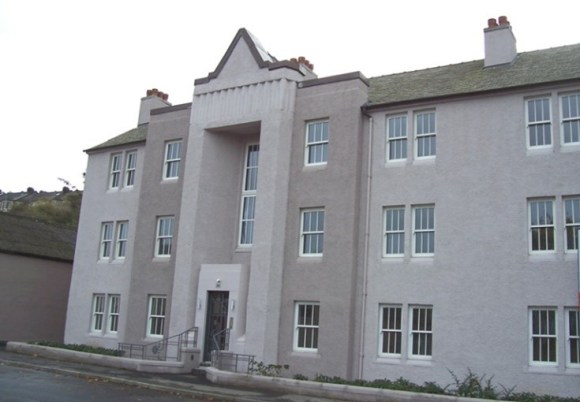
The rear or south elevation has regularly spaced entrances with railed double balconies on the first and second floors.
.
The flats were sold to a private developer in the late 1990s in order to facilitate their renovation which was accomplished in 2008.
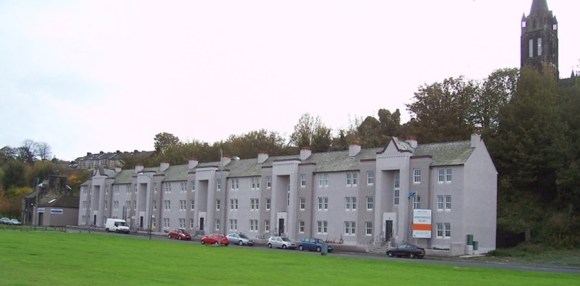
It is a long cement rendered building of 25 bays with only minor variations in the colouring. The straight façade is broken by advancing five of the bays at regular intervals. These bays break the eaves where fluted friezes crown tall deeply recessed stair windows at the base of which are chunky flat-roofed door pieces reached by external steps. The centre three of three bays are parapeted and the outer two steeply gabled. The bays to either side are also slightly advanced and of intermediate height.
The windows in the main body of the block are bipartite whereas those of the advanced bays are single. The symmetry even extends to the chimney stacks that occupy the ridge of the slated roof.
XI. Cadzow Crescent (1935)
As well as designing large blocks of flats for Bo’ness Town Council, Steele worked on the more traditional four-in-a-block variety and despite financial constraints those that he designed in 1935 were distinctive.
At Cadzow Crescent and Stuart Avenue the two-storey flats project the horizontal elements of the buildings to the viewer. Originally they had flat roofs, long windows with horizontal glazing bars, and four short protruding concrete courses between the windows. Even the vertical lines of the corners are cut by the use of cantilevered windows.
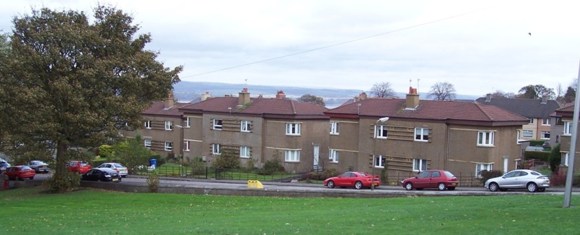
This exaggeration of the horizontal led locals to nickname them the “Venetian” flats after the Venetian Slice with its proliferation of layers. Such a commonplace item was at odds to architectural historians who preferred to assume that the clever Bo’nessians had intended the word “Viennese in reference to ‘moderne’ villas in central Europe – the kind of thing occupied by Viennese professors! At Bo’ness the tenants probably came from slum clearance operations. The European affinities were noted by the local newspaper on Steele’s death when it referred to them as the “Continental Sunshine flatted house.”
Flat roofs are not consistent with the Scottish climate or culture. When first built, it was found that the coal fires would not draw and Steele had to experiment with cowls and shields for the chimneys. What architects failed to realise at the time was that air flow over a flat roof was turbulent whereas over a pitched roof it rose to the ridge relatively evenly, helping to pull air up the chimney. Low pitched roofs were added later.
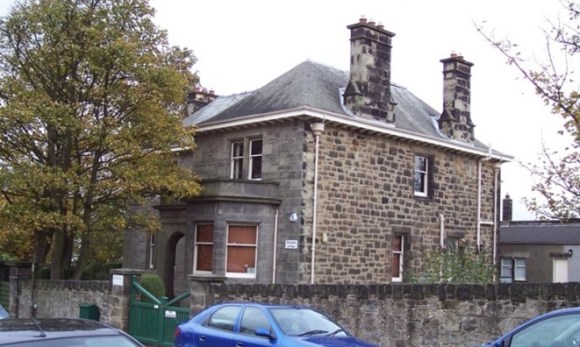
Continuing down Cadzow Crescent, we pass the Duchess Nina Nurses’ Home of 1910 which was funded by the Duke and Duchess of Hamilton. Steele seems to have acted as the supervising architect for its construction working to plans provided by James Macaulay.
III. Seaview Hotel (1936)
1936 was a boom year for architectural developments in general and for Steel in person. The large block that was erected opposite Bo’ness Station contained the Seaview Hotel for Captain Miller, a chip shop and flat for the Corvi family, and flats (1-11 Corbiehall) for Bo’ness Town Council. To its east are the steps at the bottom of Providence Brae – named after its use to spot home ships returning from long journeys. Several of these braes branch off the main street. This steep slope was utilised by Steel to provide rear access to the flats.
Its most characteristic feature is the use of coloured concrete blocks – buff with green strips at the base and wallhead.
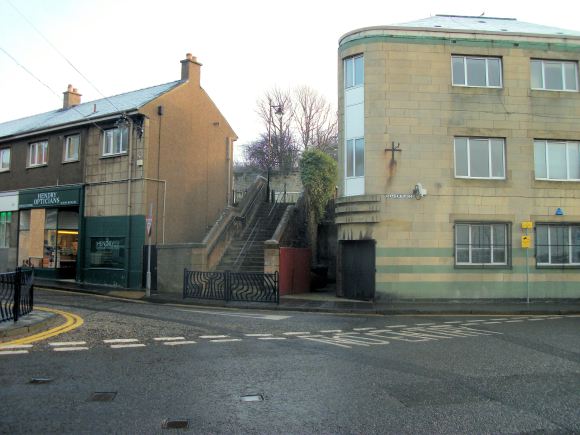
The tight joints provide a neat finish which is made even cleaner by hiding the downpipes internally. The long two-storey central section is flanked at either end by three-storey bays with a tightly rounded terminal on the east. The terminal adjacent to providence Brae contains a broad entrance at the base of a narrow vertical sequence that has three projecting curving concrete canopy bands above the door followed by a two-storey window aperture with intervening panels. In earlier periods this might have been capped by a finial, turret or entablature – but here the wallhead is deliberately plain giving it a bold starkness. Instead, decoration is added to the three bands by the use of semi-circular cut-outs.
The vertical arrangement just described is repeated along the front façade at the junctions with the central block. The regularity of the fenestration on the façade belies internal differences in the floor levels. The horizontality is maintained by the use of metal-framed windows with astragals.
In the early 21st century the hotel was used as a women’s refuge and protective screens were placed on the lower windows, but it closed and in 2019 was converted into flats.
Sites and Monuments Record
| 47-49 Dean Road, Bo’ness | SMR 1661 | NT 0000 8106 |
| 9 South Street, Bo’ness | SMR 370 | NS 9979 8164 |
| 109-111 Dean Road, Bo’ness | SMR 1483 | NS 9967 8098 |
| Gilburn Cottage 5 Grangemouth Road | SMR 1787 | NS 9849 8102 |
| Bo’ness Masonic Hall | SMR 376 | NT 0004 8152 |
| Hippodrome | SMR 361 | NS 9984 8168 |
| Bo’ness Old Parish Church (Star Cinema) | SMR 283 | |
| Coffin Close (43-51 Corbiehall – Matthew Steel Court) | SMR 1459 | |
| Queen Mary Buildings (191-199 Corbiehall) | SMR 1460 | NS 9937 8135 |
| Duchess Nina Nursing Home | SMR 1508 | NS 9995 8124 |
| Station Hotel, Bo’ness | SMR 1486 | NS 9974 8160 |
 Falkirk Local History Society