
SMR 266 / NS 9538 7887
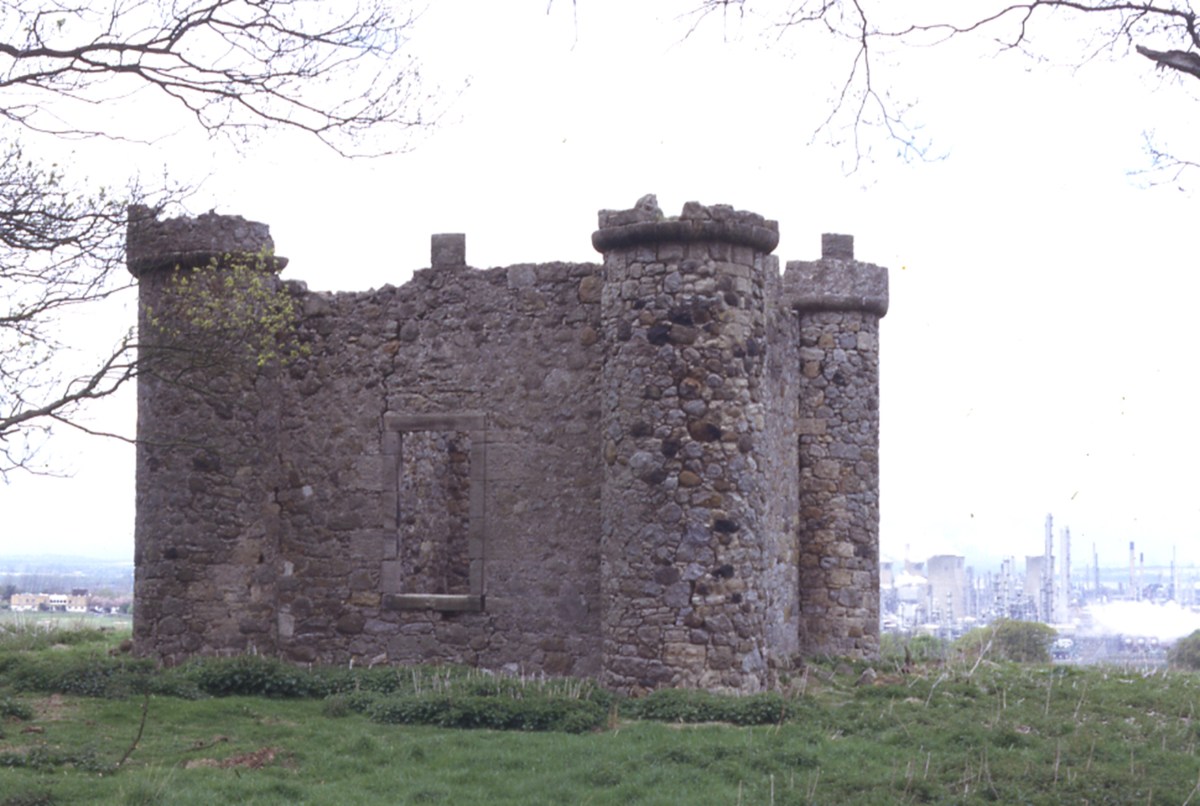
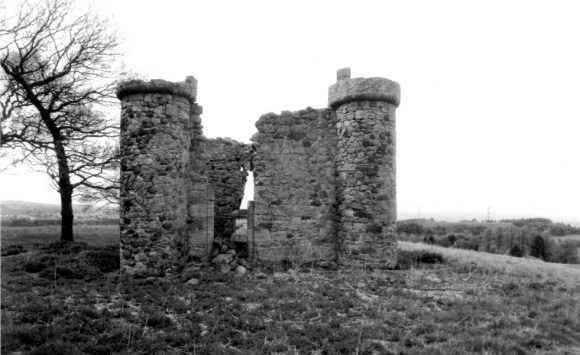
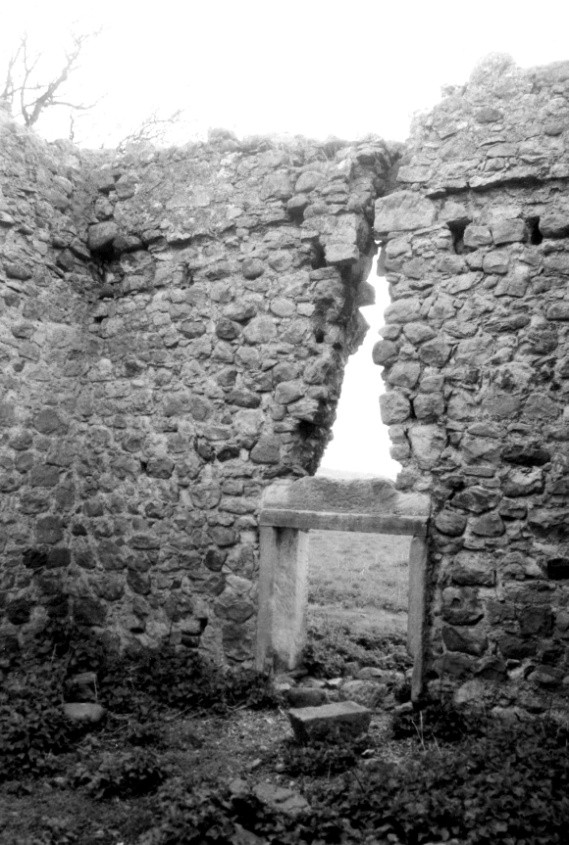
A folly belonging to Avondale House stands on a prominent knoll to its south and is clearly visible from the M9 motorway. It takes the form of a small square (8m by 8m) pavilion or gazebo with large rectangular windows in the north and south sides, an entrance doorway on the east and an internal fireplace in the west wall. The door and window surrounds have backset margins suggesting that the building was originally harled. The walls are made of small quarried sandstone and whinstone from field clearance. A small round turret has been added to each external corner. Although not properly tied to the main block these were evidently original. Each turret has a corbelled top capped with battlements.
The fireplace has large single-piece cheeks of sandstone and a lintel with a backset margin. The flue above it had collapsed by 2005, probably because the sandstone was affected by the heat. The fireplace indicates that the building was intended as a summer house/study and not merely as a picturesque ruin. A continuous recess with joist holes for timber beams suggest that the leaded roof had a very low pitch and was probably used as a viewing platform. There were indications of a stair and hatch in the north-east corner. The roof would have been hidden from view externally by the parapet.
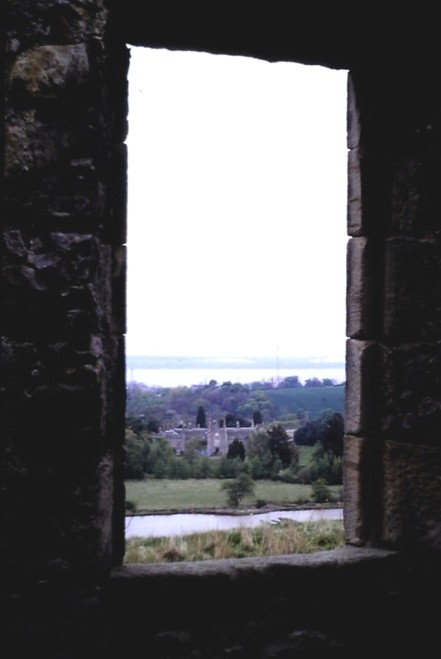
The picture window in the north face overlooked Avondale House and the Forth (and presently the refinery). According to Hart (Bailey & Mearns 2020) the building was a miniature copy of Inveravon Castle and was built around 1794. Thomas Livingstone of Avondale was so concerned that the remaining south-west tower of that castle, which lay in a neighbour’s lands, was being destroyed by the activities of local people that he arranged for an excavation which recovered the ground plan of the whole. The results were then preserved in the folly which was intended as a record of that ancient monument.
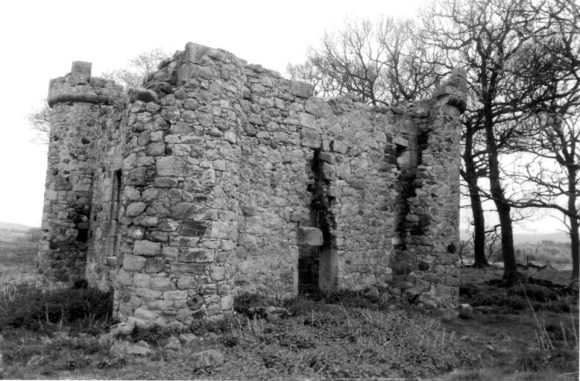
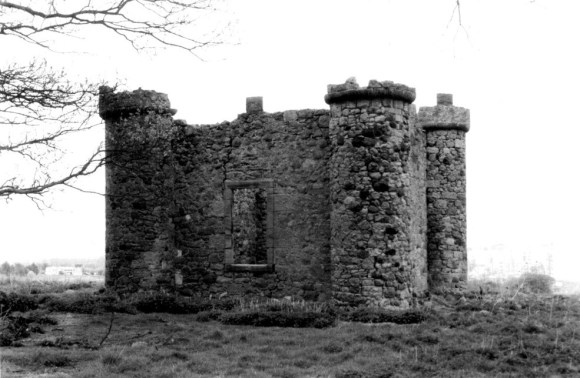
The folly building was consolidated in 2005 by the Avondale Landfill, at which time some detailing was lost.
Bibliography
| Bailey, G.B. & Mearns, J. | 2020 | ‘John Anderson and the Antonine Wall,’ Breeze, D.J. & Hanson, W.S (ed) The Antonine Wall: Papers in Honour of Professor Lawrence Keppie, 394-415. (quoted below) |
| Jaques, R. | 2001 | Falkirk and District, an Illustrated Architectural Guide. “Folly, Avondale Park. On hill south west of house, castellated small squae pavilion with circular towers at the angles looks like the real thing – from a distance! Must have fooled many a traveller on the motorway nearby. Now roofless ruin. [p125]” |
| RCAHMS | 1963 | Stirlingshire: An inventory of the ancient monuments. “Folly, Avondale House. This folly stands on a knoll a quarter of a mile S. of Avondale House and about 1 mile E. of the village of Polmont. It is a small square pavilion in the castellated style, with a circular tower at each angle and an embattled parapet. It contains a single apartment, which has a fireplace, but the building is now roofless and falling into decay. 953788 NS 97 NE (unnoted) 3 May 1956″ [p353.]; |
John Hart wrote in 1834:
It now takes a North East course till it crosses the Avon water at Inneravon – here the remains of one of the flanking towers of a castellum still exists (Figure 3) (1). Some country people attempted to take it down about 40 years since, but the strength of the Mortar and the persuasion of a neighbouring proprietor preserved it to this day. This Gentleman caused the farmer dig round the found by which they discovered that the Building had been an oblong square with a tower at each corner (2). As he was not the proprietor he could not do more to preserve it but from the measurements obtained he built a similar Castellum on the opposite side on his own property (Figure 1) (3).
- This was the south-west corner tower of the outer defences of Inveravon Castle. The tower still remains. The walls are thick and the ground floor vaulted – held together by a strong white mortar.
- An exercise repeated by E.J. Price in the 1970s (unpublished), with the same results.
- This must be the folly on the lands of Avondale (formerly Clerkston) which also has corner towers – in miniature. It stands on a hill to the south of Inveravon.
 Falkirk Local History Society