
SMR 265 / NS 9534 7916
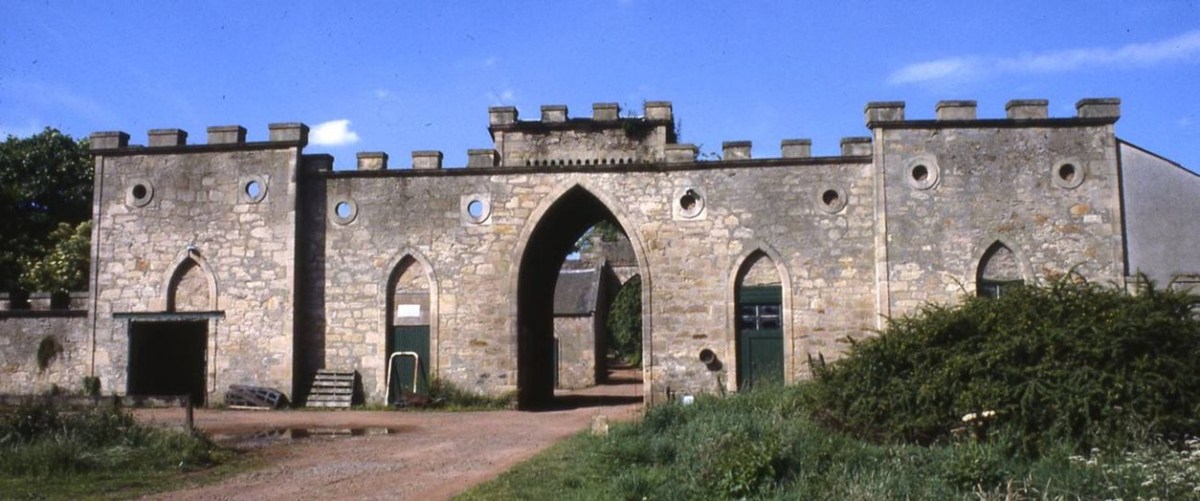
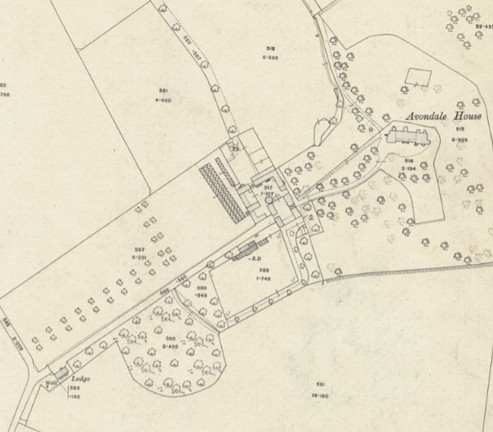
This must rank as one of the finest stable blocks in Scotland displaying a unified plan that ties it into the layout of the estate. Its central axis with its two imposing gateways sits astride the main approach avenue. Visitors enter the estate from the west through an ornate gateway and continue along a straight drive edged in by walls and hedges. They then pass under the lofty west archway into the spacious courtyard of the fortress-like stable block, through the tower passage opposite to emerge into open parkland with the sweeping curve of the drive in front of them leading across the grand lawn to the main door of the spreading Gothic House.
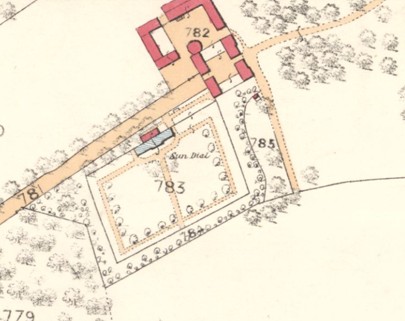
To the north of the stable block is a later larger courtyard containing the home farm which is now derelict. To the south is the old orchard, and attached to the west side of this is a large walled garden – both bounded by ha-has to separate them from the pasture sloping up the hill to the castle-like folly (SMR 266).
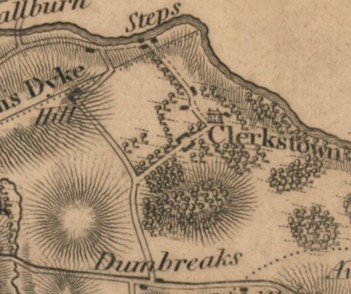
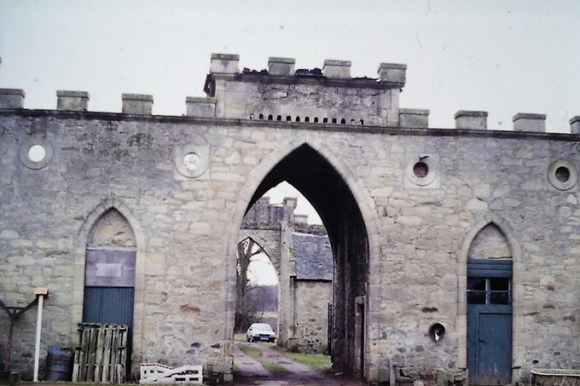
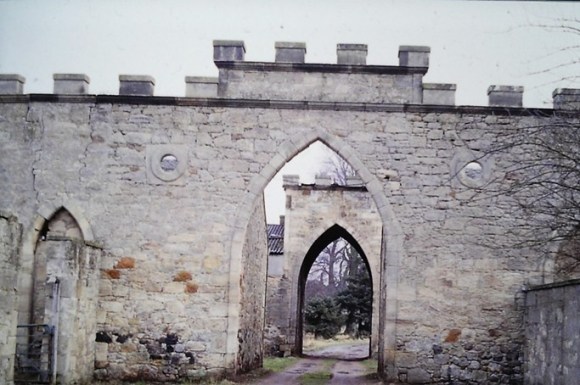
The architectural theme for the stable block is an Arabic fortress with a battlemented wall head, squat towers, roundels set high in the tall curtain walls, and pointed arches to the windows and gateways; devices which were popular in Scotland in the first quarter of the nineteenth century when there was a revival of interest in the Gothic architecture of the medieval period. Here, however, the style points to a slightly earlier period. There is a marked similarity to the Gothic style used at the deercote at Sudbury in Staffordshire which was built about 1720–23, of red brick with sandstone dressings. Closer to hand we have the Fyrish Monument in Easter Ross which was built in 1782 for Sir Hector Munro who had served as a general in India. That folly has three pointed arches, the central one larger than those to either side, and was a representation of the gate of Negapatam near Madras which General Munro captured. A similar arrangement of three arches occurred on the mansionhouse at Avondale itself (SMR 264). Avondale contains no inscribed stones to provide an exact date or the name of the patron but the stable block is clearly depicted on Grassom’s map of 1818. A date in the mid 18th century would be appropriate.
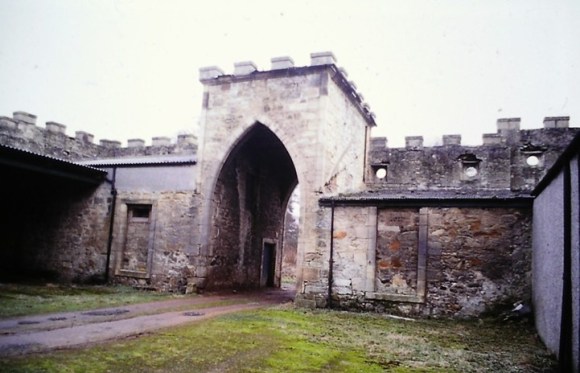
The stable block is almost square in plan, measuring 28.4m externally from north to south, and 27.8m from west to east. The external or curtain wall which envelopes the complex is merely a mask hiding the two ranges of internal buildings which face each other across a rectangular courtyard. Originally the courtyard was 27.0m long by 14.0 across, but the two ends have since been cluttered with modern agricultural sheds. The long axis of the yard was at right angles to the entrance drive.
The curtain wall is 6.4m tall to a moulded string course, on which sits the capped crenelations of the battlements. At each corner the wall head is raised by 0.7m to simulate towers, and above the west gateway a 1.0m entablature is introduced for the same effect. The only real tower stands above the east gateway and is slightly taller.
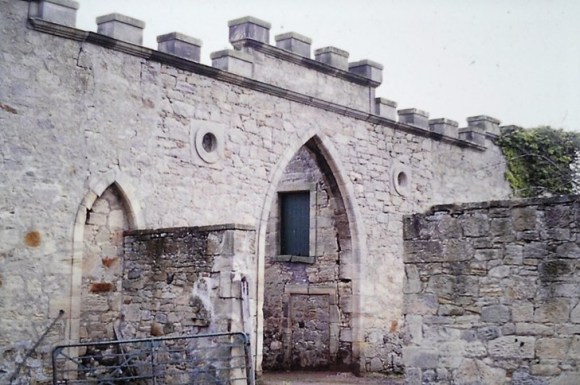
It housed a doocot, the entrance holes being placed along the top of the string course above the east-facing carriage arch. On the main facade, which faces east towards the House, the appearance of the sham corner towers is further enhanced by bringing these sections of the curtain wall forward by 0.6m.
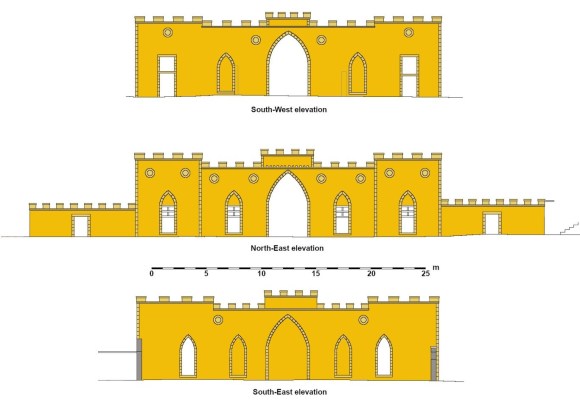
Both ranges of the courtyard buildings were single storey with a loft space and had ridged roofs aligned north/south. On the courtyard side the roof rested on the wall head, but on the outer side it was leaded into the curtain wall some way below the parapet. Each range was interrupted by the entrance passages. On the east the roof raggle may still be seen on the side walls of the tower. On the west the entrance passage was tidied up by erecting a screen wall which removed the rear pitch of the roof from view.
The east, west and south facades are all similar, with central carriageway arches (that to the south being blank) and two large lancet windows symmetrically arranged to either side. Between each of these, set high up in the curtain wall are a series of roundels or portholes. They are placed above roof level and did not function as lights. All of these features, and the corners of the block, have backset margins, as do the doorways. There are some obvious differences between each façade. That to the east has had its windows converted into doorways by removing their low sills and the wall below. In the south façade the inner two windows were blank, as were those in the west front. Here, the two outer apertures were designed as square-headed doorways and not as windows; that to the north also having a loft door above it. The north façade is quite different as it faces the farmyard. There is no central tower, real or imitation, nor are there any lancet windows. Instead, the roundels are set 2.0m above ground level and interspersed with square headed doorways. The chambers adjacent to the west entrance were designed as coachhouses and have wide stone arched doorways into the courtyard. Above each was a hay loft, that to the north of the entrance reached by the loft door already mentioned at the north end of the west façade. The loft to the south of the entrance was reached by a door in the south side of the entrance passage, above a ground-floor door. Internal doors connected the coachhouses to the tackle rooms on either side. The stables were located in the east range. They were originally entered by doorways from the courtyard, but these were later changed to windows, and later still blocked up. The last arrangement of the interior can still be discerned by the footings of the stall divisions, and the survival of a loose box. The floors of the stalls were paved with glazed bricks and cast iron box drains can be seen in places.
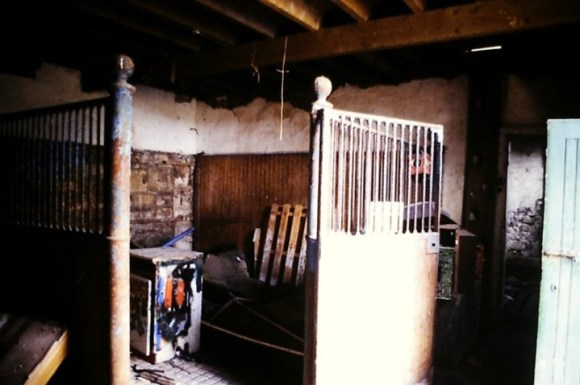
Again there were hay lofts above, reached either by centrally placed doors on either side of the tower passage, or by internal ladders. The ladders took the form of thick planks of wood with horseshoe-shaped foot holes cut out. Water for the horses would have been obtained from a large underground water cistern or well in the courtyard. It has now been covered up, but would have housed a pump to feed a trough at ground level.
The main façade facing the mansion is extended at both ends by lower battlemented wing walls. Each contains a central doorway, that to the north giving access to the farmyard, that to the south to the orchard. Despite the alterations, which include access for a motor vehicle, it still remains an impressive façade.
.
The appearance of the west front was diminished in the nineteenth century by the addition of an extra orchard enclosure and potting shed to the south of the drive, and by an extension of the farm complex to the north of the drive. The walls of these enclosures now obscure much of this elevation.
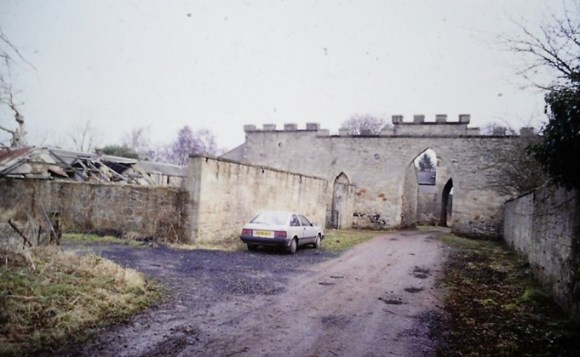
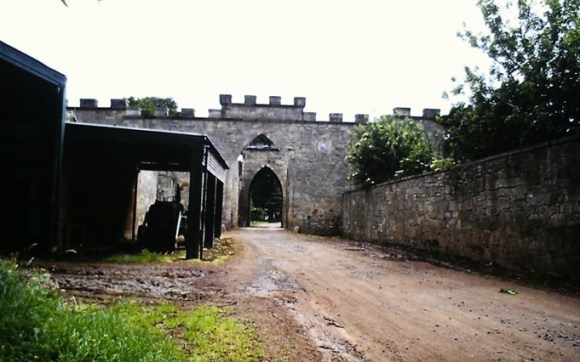
The lofty pointed arches, the crenellated wall-heads, combined with the series of small roundel windows with backset margins give the stable complex the appearance of a fort which would be at home in a Beau Geste film featuring the Foreign legion.
Bibliography
| Jaques, R | 2001 | Falkirk and District, an Illustrated Architectural Guide p42.; Courtyard stable block, early 19th century, in similar vein integrated with entrance approach to the house. [p125] |
 Falkirk Local History Society