
SMR 120 / NS 959 784
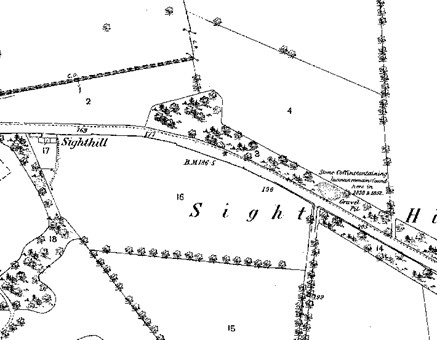
A number of stone cists containing human bones were found at Sight Hill during work on the turnpike road from Linlithgow to Polmont. According to the Ordnance Surveyors this was in the year 1838 where the road cuts through the hill. In 1852 a gravel pit was being dug on the north side of the main road opposite to Tinkers’Houf which runs to Almond Castle and more “stone coffins” were found. The pit can still be seen as a prominent hollow.
Bibliography
| Bailey, G.B. | 1996 | ‘The Graveyards of the Falkirk District: Part I,’ Calatria 9, 1-34. p.5, 30 |
| New Statistical Account | “The origin of the most ancient remains in the parish is involved in deep obscurity. (continued at 1. below) | |
| Ordnance Survey Name Book | SIGHT HILL (Quoted at 2. below) |
- New Statistical Account: “The origin of the most ancient remains in the parish is involved in deep obscurity. They consist of a series of fortified eminences, extending from Harlelaw, near Easter Manuel, by Castlehill, to Sight Hill. The last two present a steep face of about 150 feet in height to the valley of the Avon, upon which a triple trench had been formed, presenting now the appearance of three parallel roads towards the north-east, as if the attack were expected from that quarter. Whether they were raised by the original Celtic inhabitants against Danish invaders from the Lothians, (* Chalmer’s Caledonia) or to retard the advance of the Romans or the Scots towards Camelon, long defended against both, (~ Holinshed) it is impossible now to determine with any certainty. The quantity of stone-coffins found at Linlithgow Bridge, Castle Hill, Sight Hill, and Brakes, on the flanks and in the rear of these defences, leave no doubt that the place was one of carnage.”
- “SIGHT HILL (stone coffins containing human remains found here in 1838 and 1852). A long narrow ridge of slightly elevated land, partly arable and partly wooded. Some few years since the N.E. face of the hill bore trace of having been fortified, the land is now cultivated, and all evidence of fortification entirely removed. It has, doubtless, been the scene of a conflict, from the number of stone coffins found at it at the time improvements were taking place on the Edinburgh & Glasgow Road which crosses it. Stone coffins have also been discovered in it at a more recent date, by workmen engaged in digging for gravel in the adjacent gravel pit. All these coffins contained human remains. It is on the property of Wm Forbes Esq, Callendar House, Falkirk.”
 Falkirk Local History Society