
SMR 121 / NS 957 786
Further cists (see SMR120) were found at Avonglen when gravel extraction was renewed in 1973. Discoveries continued up until 1980 when work finished. Most of these cists were recorded as they eroded out of the working quarry face and so details are scarce.
1973: Three long cists found, two examined and found to be slab built with one of them paved. Both contained extended inhumations.
Three photographs in Falkirk Museum pertain to be of Avonglen Quarry from Doreen Hunter and are dated to 1973. She had already moved to Edinburgh by then but it is possible that she collaborated with Joanna Close-Brooks.
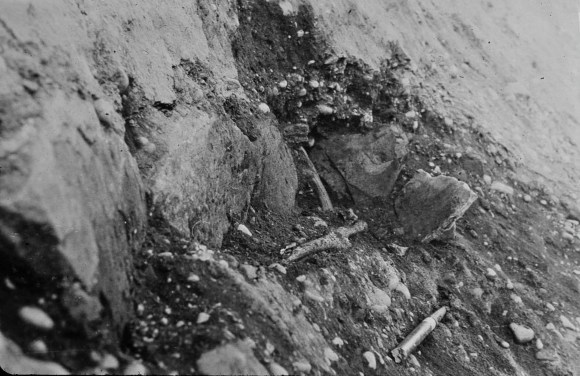
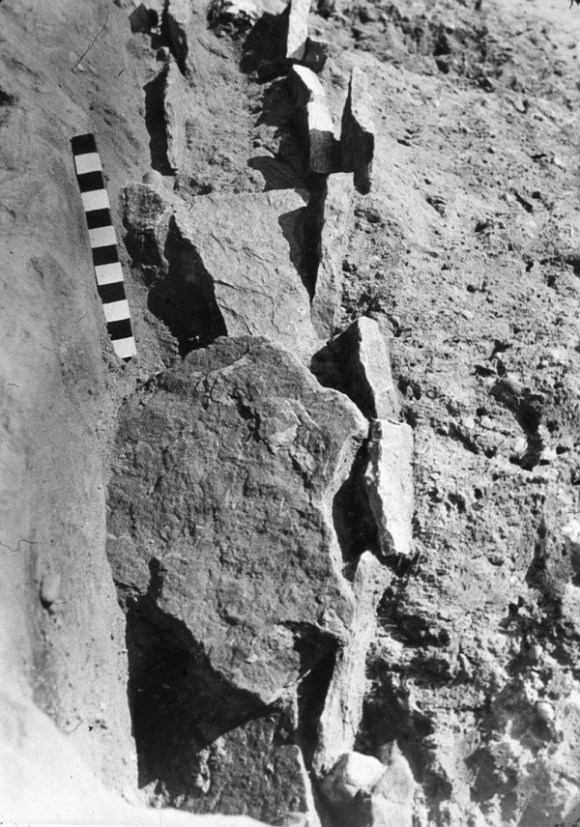
1974: Two more long cists were exposed. The larger was 1.80m by 0.56m in size and contained an extended inhumation. The smaller was 0.97m by 0.36m, and contained a child.
1976: The quarry face collapsed taking with it an unrecorded long cist.
.
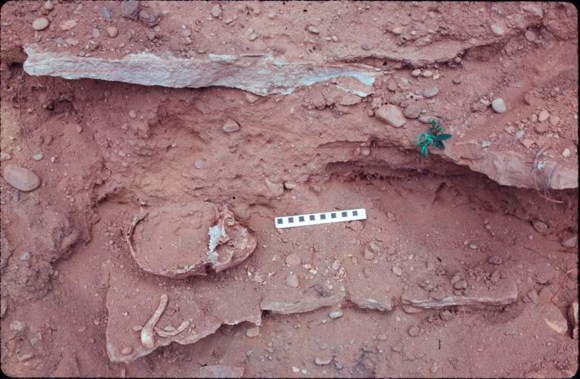
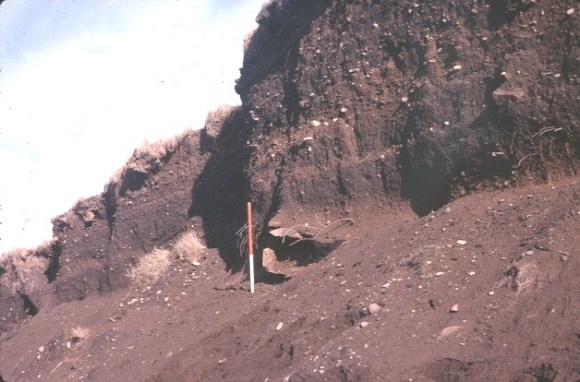
1979: Tom Astbury photographed a long cist burial at the eroding quarry face.
1980: Part of a long cist recorded before it too was destroyed. It was slab built and paved, measuring 1.32m by 0.44m. In it was an extended inhumation of which the skull was removed to the National Museum.
.
The type of burial – long as opposed to short cists – and the lack of beakers of any sort suggests that this was part of an early medieval graveyard similar to one at Kerse Hill near Millhall (SMR 123).
Bibliography
| Bailey, G.B. | 1996 | ‘The Graveyards of the Falkirk District: Part I,’ Calatria 9, 1-34. p.5, 30. |
| DES 53: | 1973 | “NS 957 784. At least three long cists have been exposed by weathering in the north face of the quarry. The two examined were slab built, one being also paved, and each held an extended inhumation. Some 3m of modern overburden covers the site at present. It appears to be the southern edge of a cemetery recorded (OSNB, 21, 1860, 20) as found in 1838 and 1852 during road improvements, and in a gravel pit just N of the road. [Joanna Close-Brooks] |
| DES 66: | 1974 | “NS 957 785. Two long cists were exposed by weathering in the N face of the quarry. One (that of a child) measuring 3’ 2” x 1’ 2” was badly destroyed; the other 5’ 11” x 1’ 10” contained an extended inhumation. Both have now been destroyed. [James J Walker] |
| DES 60 | 1979 | “NS 957 786. A further long cist was exposed by weathering in the N face of the sand quarry, but a collapse in the quarry face destroyed in before examination could take place. [L.J. Main] |
| DES 3 | 1980 | “NS 957 784. Another cist has been increasingly exposed in the N face of the quarry since the winter of 1979. On recent examination it measured 1.32m in length (incomplete) by 0.44m, was slab built and paved, and contained an extended inhumation of which only the skull was recovered. Further collapse of the quarry face will destroy the cist. [L.J. Main, J.F. Murray.] |
 Falkirk Local History Society