
SMR 1391 / NS8582 7260
Binniegreen lies 70yds to the SSE of Balquhastone House and may have been its predecessor. It is a substantial building, aligned west-east, of the 17th or early 18th century, as is shown by the offset margins of the only original window on its southern side and the presence of a cavetto moulded eaves course. Re-used roll and hollow moulded stones in the small western window here may have come from the doorway. The north side, facing Balquhatstone House, survives better. It had an ornate central doorway with lugged roll and hollow moulding interrupted by blocks, Gibbs fashion, surmounted by a moulded pediment containing the date 1734. This is clearly an insert and may have been transferred from the south façade at a late date. To either side of the doorway were two windows and five others were set symmetrically at first floor level. The walls were made of random rubble largely derived from field clearance which would originally have been harled. The east gable of Binniegreen was unusually thick in order to accommodate a large fireplace on each floor. The upper hearth setting is huge, suggesting that this was the principal floor and also indicates an early date.
.
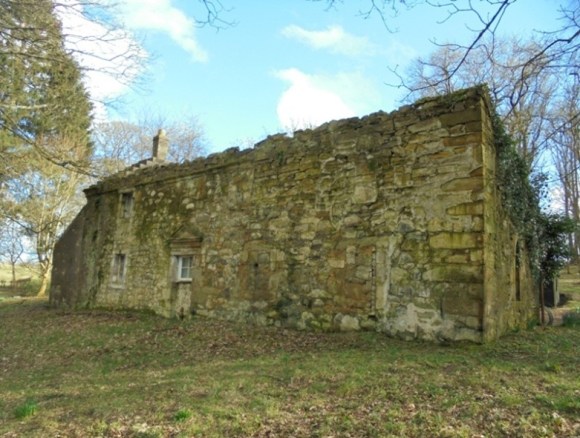
Right – the 1734 doorway.
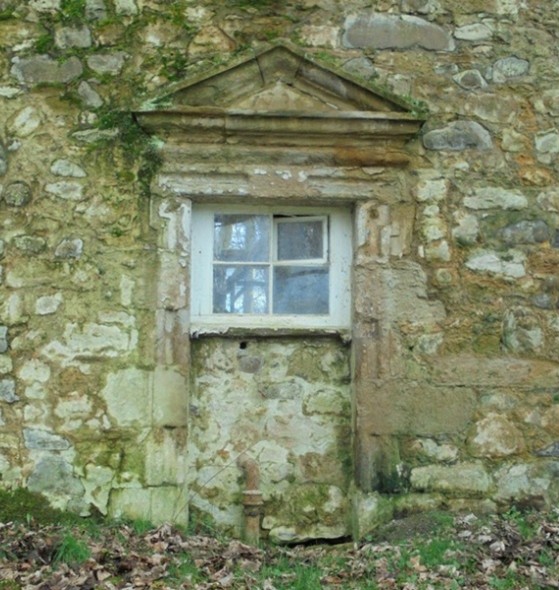
Binniegreen could easily qualify as a laird’s house and may have been the principal residence in the early 18th century. Its alignment and more elevated location than Balquhatstone House meant that it captured the sun better than its northern neighbour. Yet it was abandoned as the main residence and the building was incorporated into a stable and service complex. We can only presume that there was a catastrophic fire which resulted in the partial collapse of the south wall because when it was refurbished that wall was reduced to a single storey and a monopitched roof was inserted.
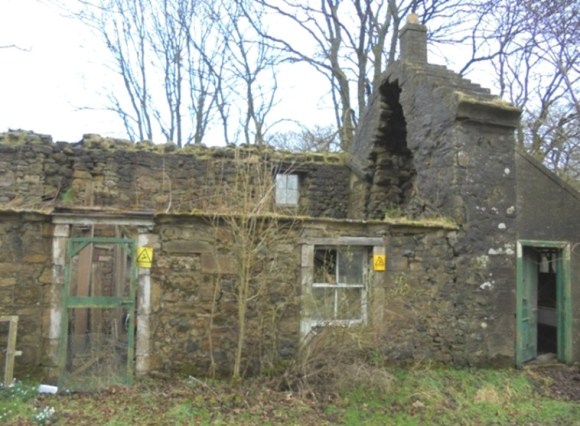
The collapsed chimney breast can be seen in the gable on the right.
Roy’s map depicts a rigid set of rectilinear enclosures around Balquhatstone House, which would be in keeping with a 16-17th century designed landscape. The walled compounds are small as suits the nature of the local topography and the comparative wealth of the estate. Two buildings appear – one is square and is placed at the north-west corner of the enclosures; the other, to the south, is rectangular and aligned almost west/east. It is tempting to associate these with the dwellings of Binniegreen and Balquhatstone.
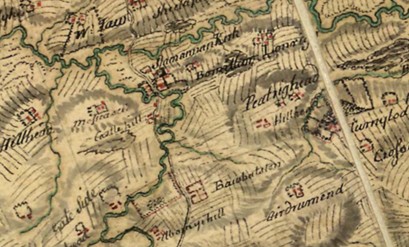
On the opposite side of the main road to the west is a much larger walled enclosure. Normally we might interpret this as a walled garden, but here the land is low lying, damp and north-facing. The incorporation of part of the Culloch Burn into the area might mean that is was for holding cattle.
The switch from the southern building to the northern one must have occurred before 1806 as William Forrest’s map of that date shows Balquhatstone as a small mansion with a courtyard of buildings to its south called “Binnygreen.” The “green” of Binniegreen would have been the grazing field for the toon of Balquhatstone – that is the field to the south. “Binnie” in this context, as with Binniehill, means physically above or behind – and refers to the fact that the green was higher than Balquhatstone. The location of the new house of Balquhatstone is confirmed by John Bisset’s plan of the estate drawn up in 1803.
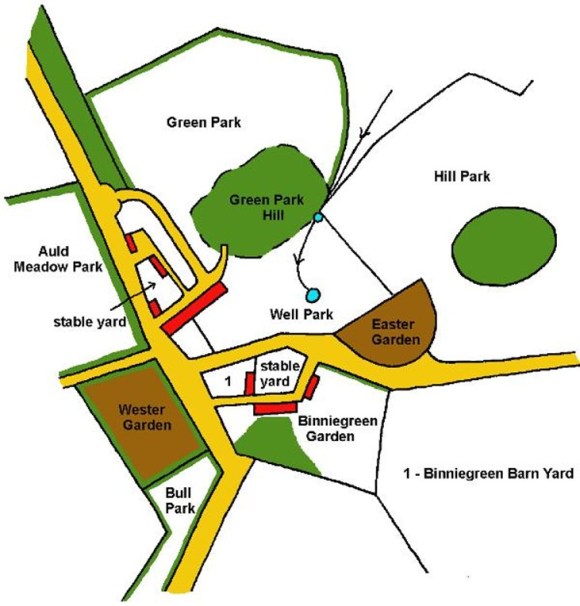
This shows Balquhatstone House as the eastern end of a range of buildings aligned south-west/north-east. The house was smaller than its predecessor at Binniegreen.
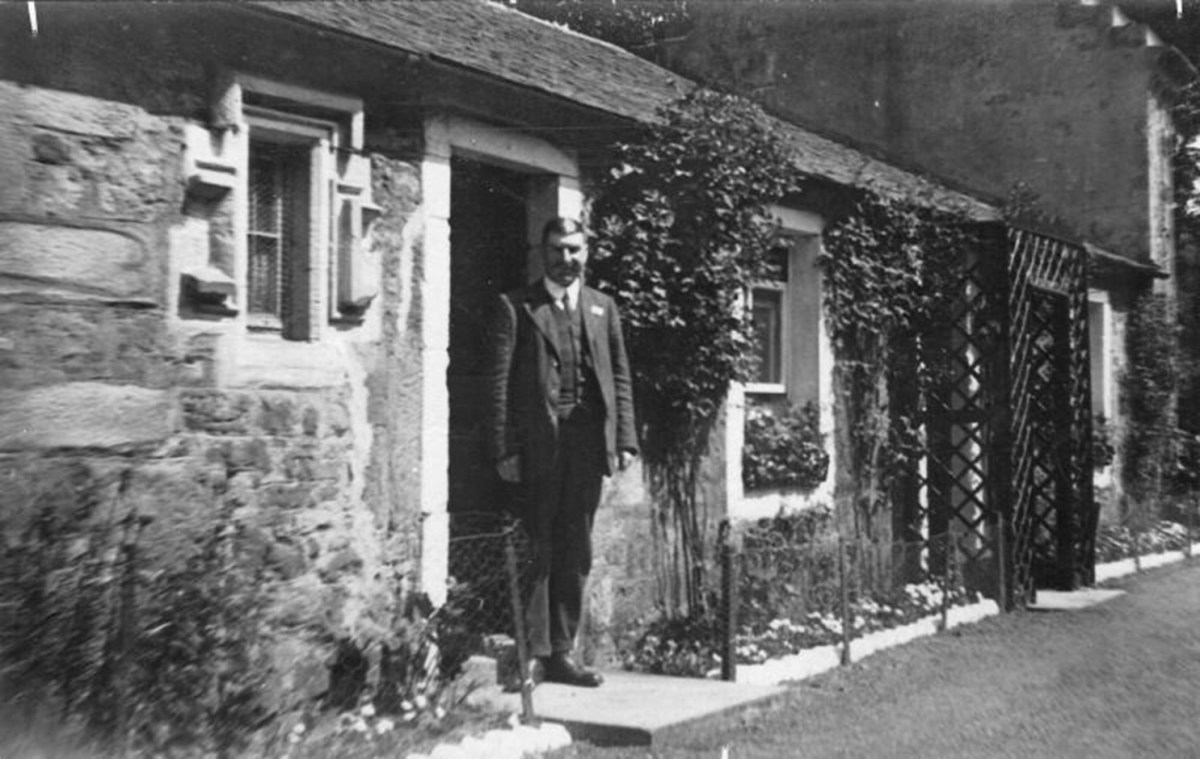
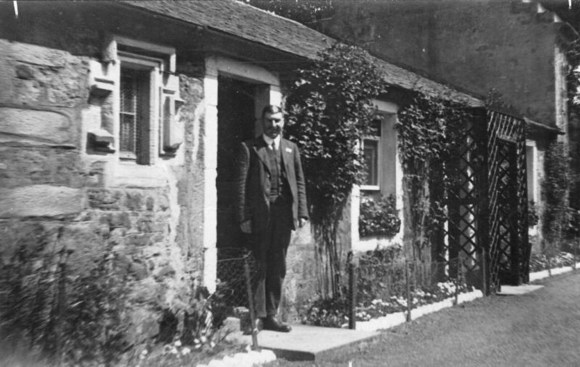
The old building at Binniegreen was rebuilt sometime before 1860 when the Ordnance Survey described it as “A small uninhabited house situated about 100 yards south from Balquhatstone House. It is one storey, slated and in good repair.” At the turn of the 19th/20 century it was used as living accommodation. This was achieved by removing the first floor masonry from the south wall and installing a mono-pitched roof. The deputy factor and forester lived there
Bibliography
| RCAHMS | 1963 | Stirlingshire: An Inventory of the Ancient Monuments. (Quoted below) |
- “Binniegreen, Balquhatstone. The house of Binniegreen, now converted into a forester’s cottage, stands within the Balquhatstone policies 70 yds. SSE. of the mansion. Though the building is greatly altered, enough of the original features remain on the NW. face to show that it originally possessed a central entrance with two windows on either side and five others set symmetrically at first-floor level. The masonry is rubble and there is a cavetto eaves-course. The doorway, now changed into a window, shows a lugged roll-and-hollow moulding interrupted by blocks, and is surmounted by a moulded pediment containing the date 1734. Apart, perhaps, from a small window with an unusual moulding, the SE. face is probably of somewhat later construction. 858725 NS 87 SE 16 April 1954” [p. 383]
 Falkirk Local History Society