
SMR 1733 / NS 8525 7203
Binniehill Colliery commenced in the 1840s shortly after the opening of the Slamannan Railway. In 1841 John Brown of Ballochney paid George Waddell, son of the George Waddell who had bought Balquhatstone in 1818, the sum of £1,275 for coal, ironstone and other minerals in and under the lands of Above-the-Hill of Balquhatstone, Burnbrae and other lands. The coal here was deeper than in the neighbouring colliery at Balquhatstone and Brown introduced the use of wire ropes.
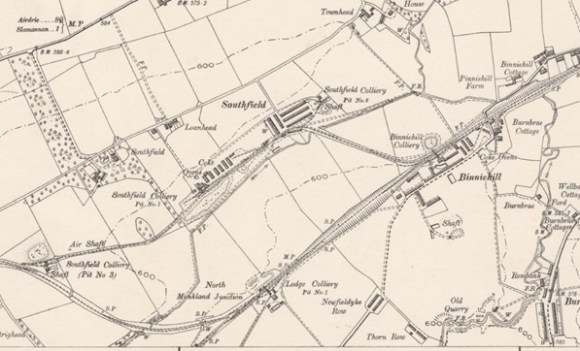
Binniehill Colliery stood on the south and north sides of the Slamannan Railway east of the junction with the Southfield branch – NS 8517 7207. The main coal seam was the Lady Grange Coal, but in the 1850 the Wee Coal at a depth of 22 fathoms was also worked, as was the ironstone. An advert for second-hand pumps makes it clear that they were then working at a depth of 30 fathoms. Binniehill Black Band Coal had a ready market in Edinburgh because it burnt cleanly.
Over the years there were a number of fatal accidents and these are reported below. By 1896 the field was exhausted and the colliery closed.
| OWNERS | |
|---|---|
| 1841-1858 | Dr. John Brown |
| 1858-1868 | Alexander Campbell Brown |
| 1868-96 | John Watson |
| 1890-96 | John Watson & Co Ltd |
| 1896 | Closed |
Bibliography
| Murray, A. | 1911 | Fifty Years of Slamannan Co-operative Society Limited “Then Binniehill colliery began in the days that Mr Russell was operating at Balquhatstone. The coal here was much deeper than in any other pit in the neighbourhood and Dr Brown, who worked the field, was considered a very forward man through his adopting wire ropes for the shaft, and the colliers at first entertained considerable fears in trusting themselves to “so thin a cord.” (p.17). |
| Newspapers | Various, listed and quoted below |
Glasgow Herald 12 April 1850, 1:
“Ironstone and Coal to let, Stirlingshire. The Seam of Ironstone in connection with the Wee Coal under the lands of Binniehill, Slamannan, and also the Lady-Grange Seam of Coal. The winning of both will be about 22 fathoms deep.
“Ironstone and Coal will be raised at a moderate cost. From analysis the ironstone appears to be of good quality, and easily smelted.
“The Bo’ness Railway, in connection with the Slamannan and other Railways, and Union Canal, will afford every facility for the transit of the Minerals to markets on the East, and to the Ironworks in the Monkland district on the West.
“Mr. Reid, at Binniehill Colliery, will point out the boundaries, and will give all information. For particulars apply to Mr. Williamson, Mining Engineer, Fingal Place, Edinburgh.”
Falkirk Herald 14 November 1850, 2:
“Collier killed at Binnihill Colliery from a mass of stone in the roof of the mine having given way and crushed him. Accidental causes.”
Glasgow Herald 6 May 1853, 1:
“Second-hand pit pumps wanted. A pile of 30 fathoms of 7 ½ inch Pumps, to include suction, clack, and bucket, door pieces, and working barrel of 7 inch diameter. Address Binniehill Colliery, Slamannan.”
Glasgow Herald 4 June 1858, 4:
“SLAMANNAN-FATAL ACCIDENT. – On Tuesday, as a man named Peter Thomas was engaged at his work in a pit at Binniehill Colliery, a large mass fell upon him from the roof of the pit, crushing him so severely that death must have been instantaneous..”.
Edinburgh Evening Courant 10 December 1862, 2:
“Explosion.—On Saturday morning last, a serious gunpowder explosion took place in No. 1 pit, Binniehill Colliery, near Slamannan, whereby two young lads, named respectively Thomas Smith and Richard Paterson, were severely burned. They are employed as drawers below ground, and one of them at the time of the accident was engaged carrying a flask, containing 8 lb of powder, to a miner for blasting purposes. Instead, however, of taking the powder direct whence he was instructed, he sat down, and, with the assistance of his comrade, poured a small quantity of it on a stone, and lighted it. The concussion caused Smith to fall back, and in so doing he knocked over the flask, emptying nearly the whole of the powder on the ground. The sparks speedily ignited it, and both were blown from where they were seated. Smith, on being examined, was found to be frightfully bruised about the face and arms, but is expected to recover. Paterson’s injuries were chiefly confined to the face, and are not very serious (Falkirk Herald).”
Glasgow Herald 6 June 1863, 4:
“FATAL COAL-PIT ACCIDENT AT SLAMANNAN .- On Wednesday last an accident occurred in No. 2 Coal-Pit, Binniehill Colliery, Slamannan, by which a young lad, named David Shaw, lost his life. It appears that he was engaged as a drawer, and that he had been engaged on the day in question, along with his brother, in removing loaded hutches in the bottom of the shaft at the higher workings of the pit. In running one of these towards the shank, the deceased called to his brother to get a pin – that is a token used for identifying hutches when they go to the top – as he thought the cage on which the hutches were drawn up was standing all ready. This, however, was not the case, and the poor fellow, not observing the mistake, pushed the hutch right over the edge of the shaft, and, losing his balance thereby, he tumbled headlong with it. The noise caused by the accident being hear by some of the miners, an alarm was instantly raised, when two men descended to the middle workings, where the hutch was found to have got jammed betwixt the “bombs” on which the cage rests. Shaw was discovered suspended by one of his legs. He was immediately extricated from his perilous situation, but died in a few minutes thereafter. His left arm and skull were found, on examination by Dr Boyd, to be severely fractured. The deceased was thirteen years of age.”
North British Dailey Record 21 November 1863, 3:
“One of the most frightful and alarming accidents we have had to record in this district for a length of time, occurred on Wednesday at Binniehill Colliery, near Slamannan. The occasion of the catastrophe was a gun- powder explosion, and it has resulted in the death of one, and the serious injury of seven individuals. The colliery is occupied by Alex Campbell Brown Esq, residing near Binniehill, and the scene of the explosion was the joiners’ shop connected with the workings. A contractor for brushing, named Mr Daniel Thomson, had been in the habit of keeping his casks of gunpowder in the joiners’ workshop. About five o’clock in the afternoon, some of the men employed by Thomson proceeded to the shop to get their flasks filled with powder previous to beginning work. The quantity of easiest access was insufficient for their purpose, and accordingly a new cask containing 25 lbs was pierced by one of the party, named Robert Craig, who is the most seriously injured of the surviving sufferers. Having bored a hole in the cask, he took it under his arm, and proceeded to empty out powder into the flasks of the workmen. He did this without the use of a proper funnel to guide the powder into the flasks, and while in the act of filling one which was held by a fellow workman, named Archibald Thomson, a quantity went over the side of the flask, and fell amongst the shavings on the floor. Observing the difficulty experienced by Craig in pouring the gunpowder out of the barrel, a boy, names John Cuthbert, incautiously approached him with a lamp, in order that he might the better accomplish his purposes. A moment thereafter a terrific explosion occurred, which was heard at a great distance from the scene of the accident; the whole of those assembled were scattered about, burned and bruised; and the workshop reduced to a heap of ruins. How the accident immediately happened remains a mystery. Possibly the flame had touched the strea of powder flowing from the cask, or possibly a spark from the lamp may have fallen on the small quantity spilled on the floor. The joiners’ shop, which was built of brick, was levelled to the ground, and now lies a heap of blackened ruins. All who were present were more or less seriously injured, and a young boy, named Alexander Burt, was killed on the spot. Robert Craig was blow right up through the roof of the building, and had his clothes set on fire in several places. He was terribly burned, but had presence of mind enough to throw himself into a pool of water to extinguish his burning clothes. Archibald Thomson, the man who held the flask, was knocked down, and partially covered with the rubbish of the falling house. His clothes also caught fire, and it was with difficulty that he could be extricated in life from his perilous position. The boy Burt, who was killed instantaneously, was only eight years of age. He was not in the shop at the time, but playing outside, near the door, with another boy names David Ferguson. When the accident happened and the walls fell, or rather were blown out, the two youths were burned under the mass. When they were taken out, the dead body of Burt was found to be lying on the top of his playfellow, Ferguson, who is not very severely wounded, having only sustained a slight cut to the hand. The other men and boys were all scatted about more or less hurt. The people in the neighbourhood rushed at once to the spot. Exertions were at first made for the relief of those of the sufferers who were buried under the rubbish. They were removed as quickly and carefully as possible, some of those who resided at a distance being conveyed into houses at Binniehill. Meantime a messenger had been despatched to Slamannan for medical assistance…”
Falkirk Herald 29 March 1866, 4:
“SERIOUS ACCIDENT.—A somewhat serious accident took place at No. 1 Pit Lodge, Binniehill Colliery, Tuesday, between five and six o’clock the morning. It appears that while four man, named respectively Brown, miner…”
Northern Warder 19 May 1868, 6:
“deaths – At Binniehlll House, Slamannan. Stirlingshire, the inst, Mrs Ann Campbell Brown, widow of Dr John Brown, of Binniehill Colliery, Slamannan”
Edinburgh Evening Courant 30 October 1868, 2:
Serious Accident. —On Wednesday a serious accident occurred to a miner, named James M Ewan, in No. 1 Pit, Binniehill Colliery. M‘Ewan was filling a hutch with coal, when piece of rock, weighing nearly a ton, fell upon him and crushed him severely …
Edinburgh Evening Courant 7 December 1868, 2:
“The Original Binniehill Black Band Coal, without exception the very best Scotch Coal in the Edinburgh Market for their Durability, Cleanliness and heating Powers, and far superior to most of the English Coal sold in the Edinburgh market.”
“The Subscriber having been connected for nearly Twenty years as a partner of the late Dr Brown, and his Son, the late Alexander Campbell Brown, formerly proprietors of Binniehill Colliery, he begs most respectfully to intimate to his Friends, his Customers, and the Public, that he has been appointed by John Watson, the present proprietor of Binniehill Colliery, his Sole Agent at Bo’ness, Edinburgh, and Leith, & c for the sale of these deservedly much esteemed Coals, and that none can be genuine except those got through him or his accredited Agents and the Public are… James Leggat.”
Falkirk Herald, 16 May 1896 :
“Extensive sale of colliery plant at Binniehill and Lodge Collieries, Slamannan, on Thursday, 21st May, at 11 o’clock, Shirlaw, Allan & Co have received instructions from Messrs John Watson, Ltd, to sell by auction: eight pumping, winding, and driving engines; eleven steam boilers and mountings, pit pumps, pipes, and connections; wagon, cart, and hutch weighing machines; pit cranes, pithead frames, pulleys, screes and scaffolding, railway wagons, brake van, hutches, & c; about 450 tons railway rails, points and crossings, &c & c. Also building material of workshops, offices, engine, and boiler seats, and chimney stalks. For trains see NBR timetable. Catalogues from auctioneers. Hamilton, 12th May, 1896.”
 Falkirk Local History Society