
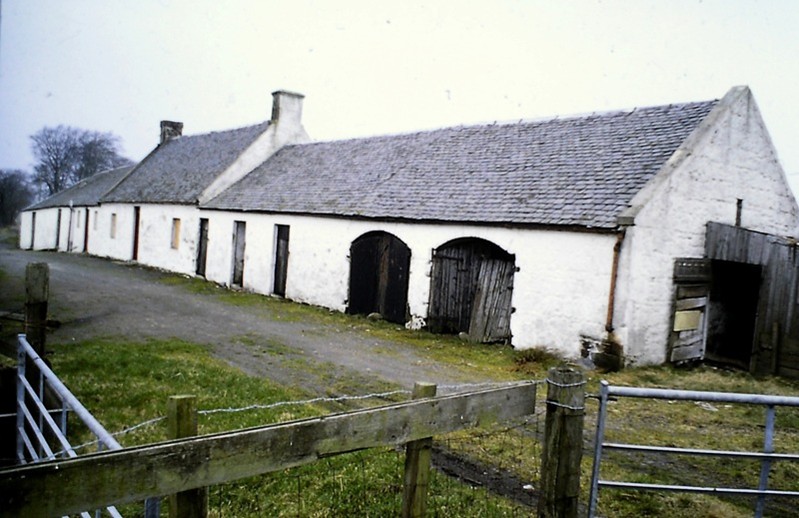
SMR 2349 / NS 9080 7552
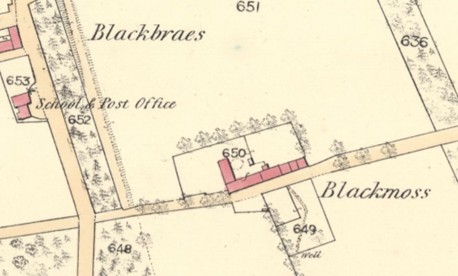
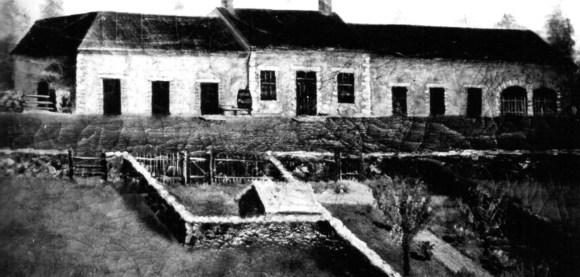
Until it was completely overhauled in the late 1990s the farm buildings at Blackbraes were a good example of an improvement farm. They were typical of the smaller farmsteads constructed on the higher ground in the Braes area in the late 18th and early 19th century. Essentially the buildings consisted of a long row of single storey stone-built structures which ran along a road with the slightly taller dwelling in the centre. The dwelling was of two apartments, each with a fireplace having a chimney in the gables. These would have been the kitchen/living area, and the bedroom. Consequently the main façade which faced south had a central doorway with a small window to either side. To the right of this were the dairy, stables, and two cart sheds with their characteristic arched openings. To the left was a cattle shed and behind that, set at right angles, was the barn with its thrashing machine driven by an open-air gin mill in the rear yard.
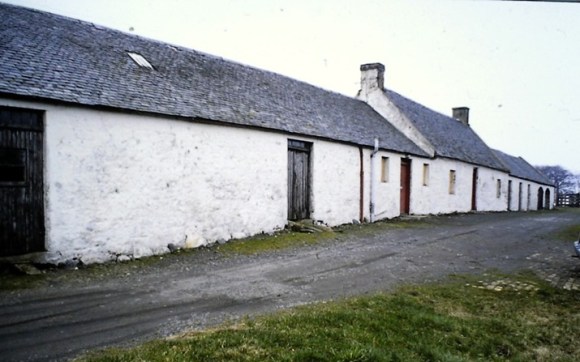
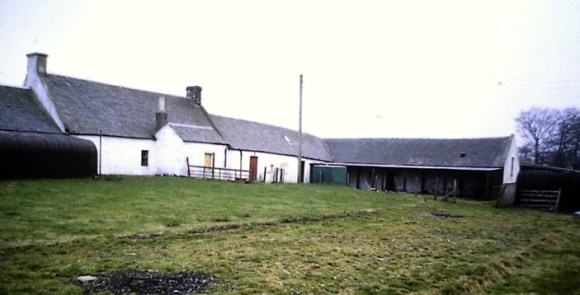
The buildings had no detailing to give architectural pretension but derived their aesthetic from their combined mass. The plain skews, dressed quoins and slate roofs suggest a date of around 1820 for their construction. Since the middle of the 18th century the farm had been in the hands of the Russel family. The farm had been created out of Muiravonside Muir and subsequently expanded through marriage and purchase of adjoining lands. Oats and rye grass were the main products. Though in 1805 they were also growing a fair amount of flax for which the tenant, Robert Ferguson, received a premium of £2 16 3 from the government (Caledonian Mercury 1 April 1805, 4). Potatoes were also grown and some livestock were kept. The Russel family had lived there until 1795 when they moved down into Falkirk. The family prospered and James Russel became a lawyer and provost of the town. In 1845 the large scale exploitation of the coalfield at Blackbraes began. Further coalfields were leased and the Almond Ironworks established. Despite their subsequent wealth the head of the family was styled as “of Blackbraes.”
Bibliography
| Leask, D. | 2017 | A Historic Tour of the Parish of Muiravonside. |
| Reid, J. | 1994 | ‘The Feudal Land Divisions of Muiravonside Parish: the principal subdivisions,’ Calatria 7, 21-85. |
NEWSPAPERS
Scots Magazine 1 February 1823, 132:
Deaths – At Falkirk, James Russel of Blackbraes.
Glasgow Herald 20 January 1826, 2:
Marriage – at Falkirk on 16th inst., by the Rev. Dr. Belfrage, Capt. Thos. Callender, to Mary, youngest daughter of the late James Russell Esq. of Blackbraes.
Caledonian Mercury 25 September 1843, 3:
Marriage – on 19th current, GRAHAM HARDIE, Esq. Manager of the Falkirk Iron Works, to ELIZABETH, daughter of James Russell, Esq. of Blackbraes, writer, Falkirk.
Falkirk Herald 14 November 1850, 1:
RYEGRASS AND MEADOW HAY, MILCH COWS, QUEYS, AND POTATOES, At Blackbraes, on Friday, 15th Nov. To be Sold by Public Roup, on Friday the 15th day of November, 1850, on the Farm of Blackbraes, near Shieldhill, THE whole of the RYEGRASS and MEADOW HAY, MILCH COWS, Queys, &c, belonging to the Heirs of the late Mr Alexander Taylor, and which comprises
- 12 ricks of ryegrass hay,
- 4 ricks of meadow hay.
- 3 milch cows, in calf,
- 9 two-year old and six-quarter-old queys, some of which are in calf,
- 1 two-year old Ayrshire bull, and 1 stot,
- 20 bolls of oats, and
- 30 bolls of potatoes, in 10 three-boll pits…
Falkirk Herald 25 October 1855, 1:
EXTENSIVE SALE of CORN STACKS, MILCH COWS, QUEYS, HORSES, HAY, CATTLE, FARM STOCKING. &c. At BLACKBRAES, ox MONDAY the 29th Octr To be Sold by Public Roup, on Monday the 29th day of October, 1855, on the Farm of Blackbraes, in the parish of Muiravonside, possessed by Mr Taylor…
Falkirk Herald 11 February 1858, 3:
James Russel died. He was born on 4 May 1787 and was the eldest son of James Russel of Blackbraes in the parish of Muiravonside, which had been in the family for three generations. It consisted of four sons – James, John, Alexander and Henry, and three daughters – Elizabeth, Helen and Mary. Mr Russel’s mother, Margaret Russel, was the daughter of a proprietor whose land lay in the neighbourhood of Blackbraes. In 1795 the family removed from Blackbraes to Falkirk, where they resided on a small property near the eastern extremity of Kerse Lane, which had been purchased by the father of Mr Russel and on which he built a house…. he became an apprentice to James Aitken, writer… mineral resources at Blackbraes worked from 1845 onwards.
 Falkirk Local History Society