
SMR 299 / NT 0516 7993
St Ninian’s Church
Blackness Episcopalian Church
Blackness St Ninian’s Mission Church
A room at Blackness Castle was used as the chapel for the garrison there. It was 1912 before a new Episcopal Mission Church was established in the village. The services were held in Mrs Paterson’s Hall, then in the old disused school (SMR2282) at the east end of the village. They were conducted by students from Old St Paul’s, Edinburgh. The empty school building was part of Carriden Estate and belonged to Mr Verney. It was cleaned and painted at the expense of the villagers. However when the estate changed hands the church was given notice to quit. The mission services were then held in the village hall, headed by Rev F.W. Moore of St Catherine’s Church, Bo’ness, and were well attended.
The population of the district was about 450, but the village was expected to grow rapidly with an increase in the scale of operations at the castle and the development of the oil industry. Consequently, after serious consideration, the church decided to erect “a substantial permanent building, and one capable of easy extension.” Land was acquired from the Marquis of Linlithgow at the south end of the village on an elevated site beside the main road and in March 1914 the foundation stone was laid by Sir Douglas A. Seton Steuart using a silver trowel bearing the following inscription: “Presented by the architect and contractors to Sir Douglas A. Seton-Steuart, Bart. of Touch, Stirling, on the occasion of his laying the foundation stone of St Ninians’s Episcopal Church, Blackness – 7th March, 1914.” Dan Baikie had previously set the foundation stone and so Sir Douglas simply tapped it three times, and formally declared it well and truly laid. Mr Braes, who farmed Burnshotts, remitted the compensation normally payable for the loss of the land, and helped in carting material to the building site. Mr Robertson of Mannerston also helped in this way.
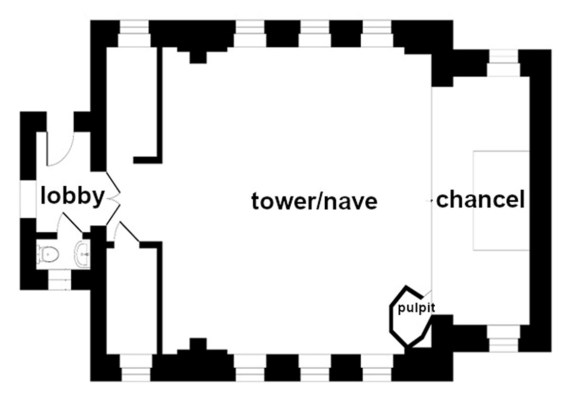
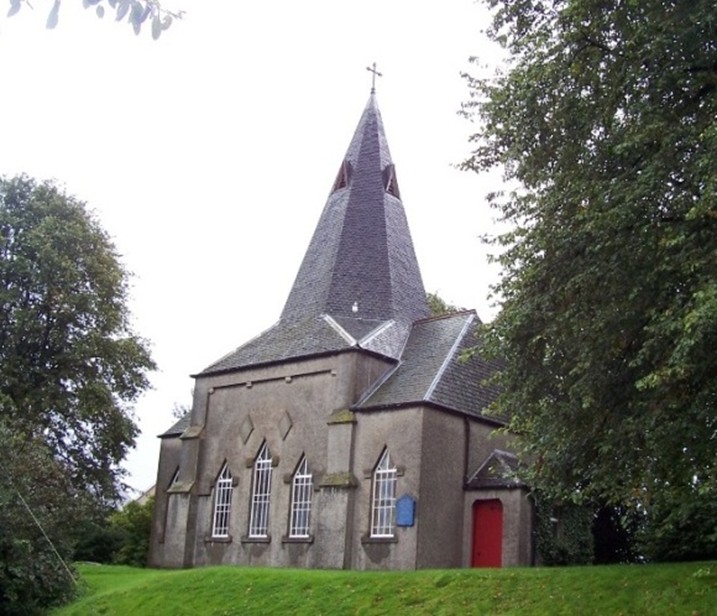
The church was designed by James Thomson of Bo’ness to form a prominent and complimentary feature in the historic landscape of the ancient maritime port and deliberately departed from conventional schemes. The dominant feature is a squat octagonal slate-clad spire, with dwarf spires (actually piended roofs) clasping it on either side over the transepts. It is built in the Norman style of architecture to seat 120 in such a way that it could easily be extended.
It consists of four stone arches forming a square, and carrying the central spire. The west and east arches opened to the entrance lobby and chancel respectively; whereas the north and south arches were filled in with brickwork and harled, so that they could be opened out for future extensions. The contractors were: masons – Sellars & Co; joiner – John Whitewright; plasterer – James Begg; and plumber – Charles Anderson – all of Bo’ness. As built, it cost around £700 and was formally opened on 16 January 1915.
The church was dedicated to St Ninian, as had been the older edifice on Chapel Hill near the castle. The furnishings of the church included a number of gifts. Hangings for the chancel were sent from Edinburgh Cathedral and Canon Wakeham, who was born at Blackness Castle in 1852, sent several articles. The hassocks were from the late Mrs Cornwall Dalyell of the Binns. The lectern and font were from South Queensferry, per the Rev F. Smith.
The petrol gas lighting, removed from the old Mission-room, was the gift of Mrs Forbes, the Binns Gardens.
The church was opened at a difficult time during the First World War. After the horrors ended, a war memorial was erected to commemorate those from the area who had died (SMR587) and was unveiled in December 1922. The church authorities gave permission for it to be placed at the northern edge of its land next to the road. The expected growth of Blackness did not occur and over the following decades the population struggled to maintain the church. Fundraising events were held in the village and in Linlithgow. However, after yet another world war, the Episcopalian mission closed in April 1949.
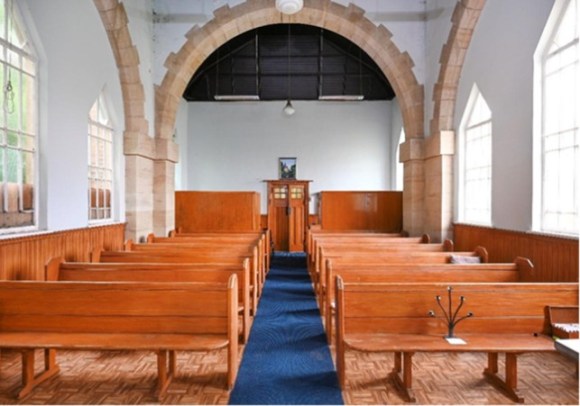
The following year, Carriden Kirk Session was successful in obtaining grants to buy the building and to undertake repairs. A loan of £200 came from the Church of Scotland Central Funds and ownership was transferred in 1951, but it was 9 March 1952 before it re-opened. Extensive repairs, plastering and painting, have been carried out and new furniture installed. The walls were cream in colour and the woodwork was stripped and varnished. Instead of pews there were now 100 new chairs. Mrs J.C. Liddle of the Knowe in Bo’ness gifted a model of a three-masted British man-o-war which was suspended from the roof. It had been built in the 1870s by her uncle, John Stewart, who served in both the British and US navies. The model ship was almost 4ft long including the bowsprit, and over 3ft in height. A new baptismal font was inserted as a war memorial.
The church remained at the centre of community life with flower shows and sales held there at intervals. In late 1959 new heating and lighting were installed. A set of overhead radiant heaters was suspended from the roof. The £180 cost of the installation was raised by a special appeal to the members of the church.
Inevitably the congregation dwindled and in 2025 the property was put up for sale.
Bibliography
NEWSPAPERS
Falkirk Herald 30 November 1912, 3:
BLACKNESS EPISCOPAL MISSION. —The desire of many residents in Blackness and surrounding neighbourhood has now been met by the establishment of a new Episcopal Mission Church in the village. The church was formally opened for public worship on Tuesday……
Linlithgow Gazette 13 March 1914, 4:
The white-surpliced procession of choristers and clergy that was to be seen on the hillside above the village of Blackness last Saturday afternoon carried the mind to other scenes. The Episcopalian body, looking forward no doubt to a realisation of the hopes that are entertained for this seaside place owing to the oil boom, have undertaken the building of a church in the seaside village. They are taking time by the forelock. If and when the population of Blackness increases, there will be a place of worship ready for those of the Episcopal faith who find themselves drawn to that place, Our use of the word “if” does not imply any doubt as to the likelihood of the village receiving a very considerable lift as a result of Admiralty enterprise. Preparations have already begun, we understand, for the extension of the pier, and this work will not be undertaken without an ulterior purpose. In regard to the Episcopal body, their Blackness church is to be built meantime on comparatively modest scale, but if the requirements should increase it is likely that an extension of the edifice may be undertaken in the future.EPISCOPAL CHURCH FOR BLACKNESS. Laying of Foundation-Stone. Amidst some ceremony on Saturday afternoon, the foundation stone was laid of a new Episcopal Church for Blackness. The church is to be known as St Ninian’s, and it will stand on the mound by the side of the public road leading to the village. At present the mission services are held in the village hall. These services are evidently being well attended, and in connection with the mission good work is also being done among the young. Indeed, it is said quite frankly that there are more children on the roll of the Sunday School than of the Board School, which speaks volumes for the zeal of the church workers. At the head of all this missionary enterprise is Rev F.W. Moore of St Catherine’s Church, Bo’ness, who has also in view the erection of a new church in Linlithgow, on behalf of which a sum has already been subscribed.
The building of a church for Blackness was in a way, forced upon the diocesan authorities. They were for long indebted to Mr Verney for the use of the schoolroom for their services. But the Carriden estate, on which the school is situated, having recently changed hands, the new proprietors gave notice that the tenancy must cease. Encouraged by a large measure of support from the villagers and other friends, the church authorities, after very serious consideration, decided to erect “a substantial permanent building, and one capable of easy extension, if, as is expected, a large population comes to Blackness.” The present population of the district is said to be 450.
A service was held on the site of the proposed church. The weather was bright and bracing, and there was a large gathering of people from Blackness and the surrounding districts. At 3.30 a procession was formed, and marched up the hill from Mrs Paterson’s Hall… The Dean of Edinburgh conducted the service… then Sir Douglas A Seton Steuart stepped down to bed the lime, using in this operation a silver trowel. Dan Baikie having set the foundation stone. Sir Douglas tapped it three times, and formally declared it well and truly laid…
Mr Whitewright, on behalf of the architect and contractors, presented Sir Douglas with a silver trowel, bearing the following inscription: “Presented by the architect and contractors to Sir Douglas A. Seton-Steuart, Bart. Of Touch, Stirling, on the occasion of his laying the foundation stone of St Ninians’s Episcopal Church, Blackness – 7th March, 1914.”
…the services had first been held in Mrs Paterson’s Hall, then in the old disused school where the services were conducted by students from Old St Paul’s, Edinburgh.,, the school was cleaned and painted at the expense of the villagers… the first portion of the church about to be built would cost £700…
The dominant feature is a spire, which will add to the quaintness and beauty of the village. So far, only the foundations have been excavated. Built on Norman style of architecture, with spire, the building will seat 120, but provision is made for future extensions. Mr Thomason, Bo’ness is the architect, and the successful contractors are: masons – Sellars & Co; joiner – John Whitewright; plasterer – James Begg; and plumber – Charles Anderson – all of Bo’ness.
Falkirk Herald 14 March 1914, 5: NEW CHURCH FOR BLACKNESS.—On Saturday afternoon, in presence of a large gathering, the foundation-stone of a new Episcopal church for Blackness was laid. Within the past year or two the church has been conducting a mission in the village, which has a population of 450. A large increase is expected as a result of oil developments in the district. The church is being erected on an elevated site acquired from the Marquis of Linlithgow. Built in Norman style of architecture, with spire, the building will seat 200, but provision is made for future extensions. The estimated cost of the portion about to be built is £700. A service was held on the site, and was conducted by Rev J.S. Wilson, Dean of Edinburgh. The ceremony of laying the foundation stone was performed by Sir Douglas A. Seton Steuart, Bart of Touch, Stirling. Sir Douglas was, in name of the architect, James Thomason, and the contractors, presented with a silver trowel by Mr Whitewright, joiner, Bo’ness
Linlithgow Gazette 8 January 1915, 1:
THE NEW CHURCH AT BLACKNESS Will be Opened on SATURDAY NEXT, 16th JAN,, 3.30 pm. By the LORD BISHOP OF EDINBURGH. BRAKES from LINLITHGOW STATION and BO’NESS TOWN HALL…
Linlithgow Gazette 8 January 1915, 2: EPISCOPAL CHURCH FOR BLACKNESS. A new church has been in course of construction during the past year, and it is being prepared for dedication on Saturday afternoon, 16th January, by the Bishop of Edinburgh. This church is a stone’s-throw from the site of ancient church of St Ninian, and it will bear the same dedication. After three hundred years Blackness will once more have its St Ninian’s Church.
The church is of quaint design, and the site is being carefully laid out by Mr Forbes, of the Binns gardens, in conjunction with the architect. The amenity of the village will gain greatly. The spire, projecting above the tees, when seen from a distance, has a beautiful old-world appearance. As seen from the Forth, it will be a prominent landmark…
In the present uncertainty as to the future of Blackness, it was difficult to decide the proper limitations of the plans. A small building suffices for the present population, but it is known that several schemes are well advanced which may bring a considerable increase of population. The present building, therefore, is small and complete in itself, seating 120; but it is so designed that it can easily be extended with the minimum of loss. It consists of four arches forming a square, and carrying a central spire. These arches give sufficient height, and being filled in with brickwork, harled, they can be opened out into transepts, chancel, and nave should the need for extension arise. With the full extensions the interior will show beautiful Norman arcading, with a small chapel on one side of the chancel, and on the other vestries and organ chamber. On the outside the transepts will be finished with dwarf spires on either side of the central spire. The whole effect is quaint and beautiful, and succeeds in departing a little from the hackneyed designs which it is usually so difficult to escape from.
The furnishing of the church has also been very carefully thought out, and it will be most comfortable and attractive. Some of the gifts are of special interest. Valuable hangings for the chancel have been sent from Edinburgh Cathedral. A number of beautiful articles have been presented by Canon Wakeham, who was born at Blackness Castle. The hassocks were a gift from the late Mrs Cornwall Dalyell of the Binns; lectern and font from South Queensferry, per the Rev F. Smith. The petrol gas lighting, removed from the old Mission-room, was the gift of Mrs Forbes, the Binns Gardens. It is delightful to record the unanimity of support received. Almost every resident in the district has subscribed or helped… Mr Braes of Burnshotts remitted the compensation payable, and gave much help in carting material. Mr Robertson of Manorston also helped generously in this way…
Linlithgow Gazette 9 April 1915, 5:
Horse trough near Blackness Church should be removed to a less prominent position.
Linlithgow Gazette 22 January 1915, 5:
Cannon Wakeham was born at Blackness Castle. He gave items to the new Episcopal Church of St Ninian at Blackness. Some time ago a good deal was heard about the prospects of Blackness being enlarged in the near future in consequence of promised industrial development, but the intervention of the war has put an end to this meantime…[Mr Wakeham was born in Blackness Castle on the Firth of Forth, in 1852]
West Lothian Courier 22 April 1949, 5:
BLACKNESS CHURCH TO CLOSE. Bishop’s Regret. The Episcopalian Church at Blackness has closed down. The last service was held there on Sunday. The decision was taken by the Bishop of Edinburgh, Rev K.C.H. Warner. He gave three reasons for the decision. The first is that the number of Episcopalians who are accustomed to worship at Blackness is too small to justify maintenance of a church and services. The second reason is that the Priest-in-Charge at Bo’ness cannot properly provide services in three places on Sundays, and if relieved of the duty of providing them at Blackness he will be able to develop the work at Linlithgow, where there are increasing opportunities. Lastly, the cost of maintaining the church at Blackness greatly exceeds the income from the small endowment and collections… The trustees are now taking steps to sell the church without delay.
Falkirk Herald 10 May 1950, 1:
BLACKNESS CHURCH The Clerk reported that a grant had been authorised to acquire the former Episcopal Church at Blackness if possible and a loan sanctioned to do necessary repairs. The schedule stated that Blackness is two and three-quarter miles distant from the Parish Church and there is no suitable bus service. The church service would be held at 10.30am.
 Falkirk Local History Society