
SMR 2348 / NS 9352 7405
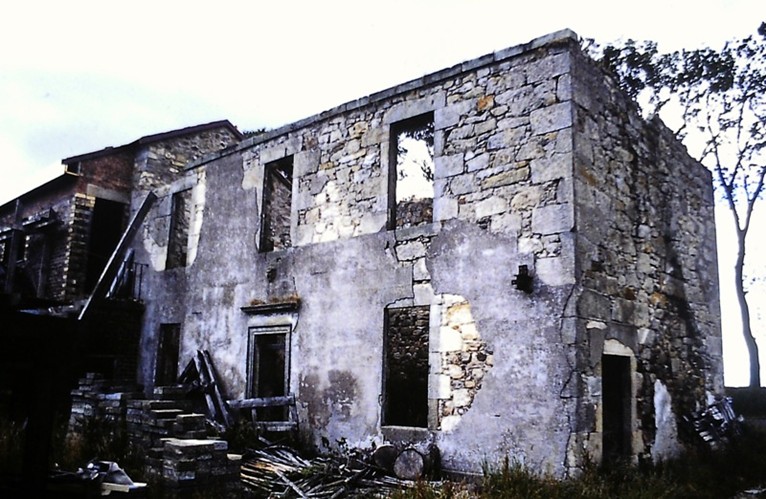
The farmhouse at Candiehead in Muiravonside parish is somewhat of an oddity. It now lies in ruins but it was at one time clearly a substantial two-storey stone dwelling with some delusions of grandeur. No direct evidence as to why this should be has come to light.
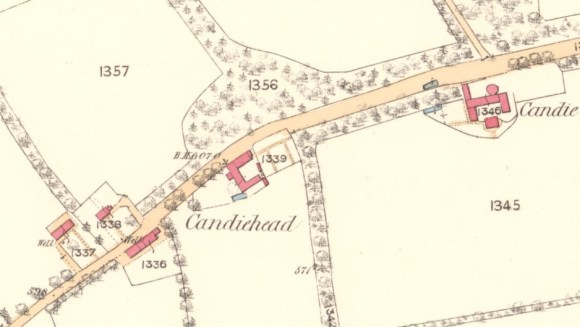
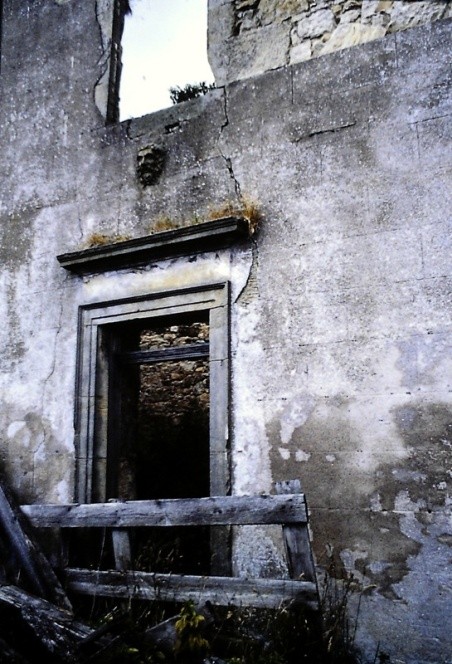
The dwelling formed the northern block of the farmsteading and backed onto the public road. Its principal façade faced south into the farmyard and was of the typical symmetrical form with a central doorway, a window to either side, and three windows above. The walls are of random rubble with well-dressed margins and were topped by a square eaves course. The south wall and the east gable were given a cement render and their faces scored with lines to resemble large ashlar. The door surround was moulded and provided with a moulded hood.
In 1859 the name referred to a cluster of buildings to the south-west of Candie, as noted by the Ordnance Surveyors:
“The name applies to two farmsteadings and two cothouses, all of which are one storey in height, partly slated, thatched, tiled, and apparently in good condition, property of Messrs Walker, Calder, and Hamilton respectively of Candiehead, Hill & Beedyke, Muiravonside.”
This suggests that the two-storey farmhouse in question was built after this date. The style of the building suggests that it cannot have been long after 1859 and it may be no coincidence that in 1860 David Turner of Cadiehill who had previously farmed at Coxhill was declared bankrupt and his assets sequestered (The Scotsman 22 February 1860, 2).
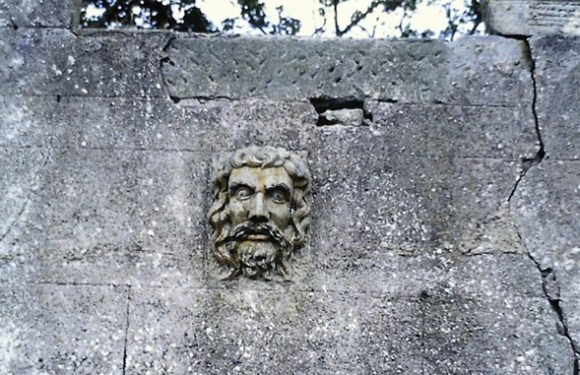
Above this was a relief head of a man with long braided hair, a beard and a moustache. When photographed in 1989 this, and the wall, was covered in whitewash and may have been of terracotta.
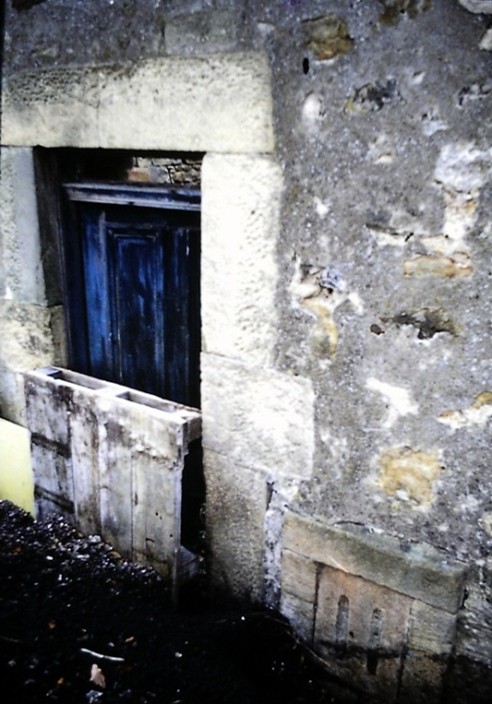
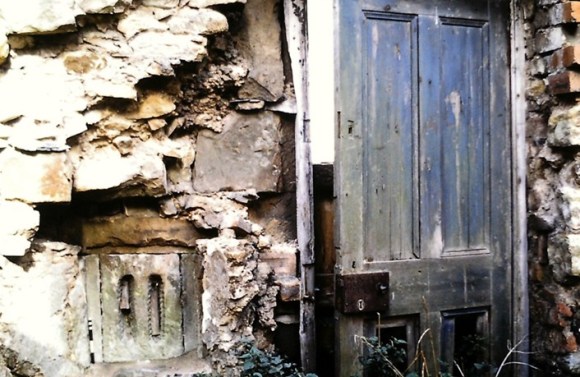
The north wall was rendered in the normal way with a lime mortar and was much plainer with fewer windows. The doorway was not unusual, but set down, just above ground level, on the righthand side was a small squarish opening with a backset margin. This surround contained a stone slab with two vertical slots having chamfered and frilled internal edges. It looks like a letterbox.
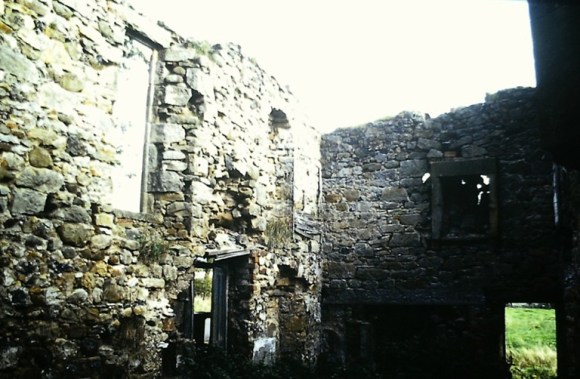
A large fireplace occupied the ground floor in the east gable. Above it the wall was supported by a huge wooden lintel. This might suggest that the building was originally of a single storey and it is odd that such a feature should have been retained.
Bibliography
| Scotsman | February 1860, 2 | “David Turner, sometime farmer, Coxhill, in the parish of Muiravonside, in the county of Stirling, and now residing at Candiehead, in the said parish of Muiravonside – sequestered.” |
| Falkirk Herald | 20 March 1897, 5 | Archibald Binnie, inspector, Candiehead [railway servant]. |
 Falkirk Local History Society