
SMR 1202 / NS 8734 7463
The “Miln of Elridge” is mentioned in a sasine of 1721. It lay at the south-western extremity of the barony of Abbotskerse, latterly owned by the Duke of Hamilton. The mill stood on the east bank of the burn immediately opposite to its larger neighbour of Jaw Mill which belonged to the Earl of Callendar. It was driven by the Mill Burn which issued from Elrig Loch and which was described as an “aqueduct” suggesting its artificial nature. When the lands of Elrig were sold in 1737 the mill was already in ruins and was described as:
“the Miln Stead of Elridge and stones about the same as the same is at present ruinous with free ish and entrie thereto with the old aquaduct and watergang of the said Miln from said Loch of Elridge to the Miln thereto.” Along with the mill was a piece of ground defined as “consisting of fourty feet in breadth and length for a shilling hill and all priviledges of building a damhead upon the parts of the lands of Elridge disponed.”
For these reasons it has been assumed that it was an old baronial mill. However, the records of the Court of Session in which Aitkenhead of Jaw was trying to protect his right to the water for Jaw Mill shows that Elridge Mill was created in the late 17th century. Russell bought Elrigg from the Duke of Hamilton in 1650 and subsequently erected a new mill on the lands, a little above Jaw Mill, and made sluices both on the loch and the mill-lead. Whereupon Aitkenhead interrupted him and raised a declarator that Russell should demolish his mill, as he could not divert the natural course and channel of the water to the prejudice of his more ancient mill. It was 1697 before the case came to the Court of Session.
The mill was sold along with Jaw Mill in 1767, with the sucken of both (Edinburgh Evening Courant 11 February 1767, 3). They were again for sale with the astricted multures in 1779 (Caledonian Mercury 8 February 1779, 4). An estate plan of 1883 shows both mills, but Elrig Mill does not appear as a separate mill on the first edition Ordnance Survey map. The presence of a flax kiln, disused by the time of the 1860 Ordnance Survey map, at Ellrig Mill, suggests that the pond for that mill may have been converted into a retting pond earlier that century.
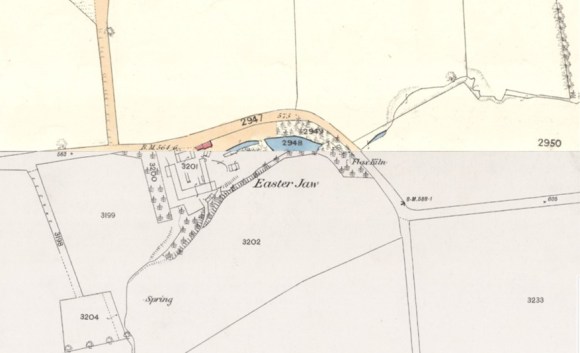
The site lies just to the east of Jaw Mill and only the earthworks can be seen on the ground.
Bibliography
Report of a Court of Session case was originally reported by Lord Fountainhall, Volume 1 pages 801 – 802 but then collected in Brown’s Supplement to Morison’s Dictionary. The case sets out a principle still used today in Scots law.
Aikenhhead of Jaw v Russell of Elrig.
Court of Session 10 December 1697 (1697) 4 Bro. Sup. 391
Court of Session
1697. December 10.
The Lords determined in the mutual declarators depending betwixt Aikenhead of Jaw and Russell of Elrig. Jaw acquired the property of a mill from the Earl of Calander, but the aqueduct of the same runs out of Elrig Loch, and through the ground of Elrig on both sides, which lands belonged to the Duke of Hamilton, and were sold to Russell in 1650. Russell erects a new mill on his own lands, a little above Jaw’s mill, and makes sluices both on the loch and the mill-lead; whereupon Jaw, novi operis nuntiatione , interrupts him, and raises a declarator, that Elrig should demolish his mill, and could not divert the natural course and channel of the water to the prejudice of his more ancient mill, nor make the water flow otherwise than it was wont to do through his aqueduct, whereof he had been in the continual and uninterrupted possession. Elrig opponed his declarator, That it was lawful for him to build a mill upon his own ground, et uti jure suo , it not being in œmulationem vicini; and that the aqueduct was, quoad both sides, on his ground, and he had been in the constant possession thereof; and the drawing the water into his own mill did not prejudge him; and, esto it did, it was but per accidens , and he was not liable for the damage: and the aqueduct passing through his ground, he might stop it as he pleased.
Answered for Jaw,—That he had prescribed the servitude of the mill-lead by forty years’ peaceable possession, which was as sufficient to give him right as Elrig had to the property.
Replied ,—Any possession he had was precarious, and by tolerance of the heritors of Elrig; in so far as it was agreed betwixt them, that Jaw should have the use of the aqueduct, and for that cause Elrig should have his corns ground multure free.
Duplied ,—This can only be proven scripto vel juramento , against his express infeftment, not only in the mill, but its leader. Triplied ,—His old infeftments bear only, The mill with its pertinents: It is true, his last charter from my Lord Calander, in 1668, bears likewise the aqueduct; but Calander, not being heritor or superior of Elrig, could not give it.
The Lords found it relevant for Elrig to prove, by witnesses, that Jaw grinded his corns multure-free; and that it was understood he had this exemption for allowing Jaw the use of the aqueduct, so as there was a synallagma , and the *392 one was the mutual cause of the other, so as to infer an interruption of the prescription of the servitude upon Elrig; and to prove that Jaw’s possession was merely precarious and by tolerance; and that Jaw had failed on his part, by exacting multure from Elrig and his tenants. But Jaw may offer to repair the damages quoad bygones, and to serve him gratis in time coming.
De Molendinis Structis in œmalationem vicini; vid. Snieidewin ad sec. 2. Instit. de Rer. Dir.; Hering. de Molendinis ; and Dirleton, voce Molendinum.
Vol. I. Page 801.
 Falkirk Local History Society