
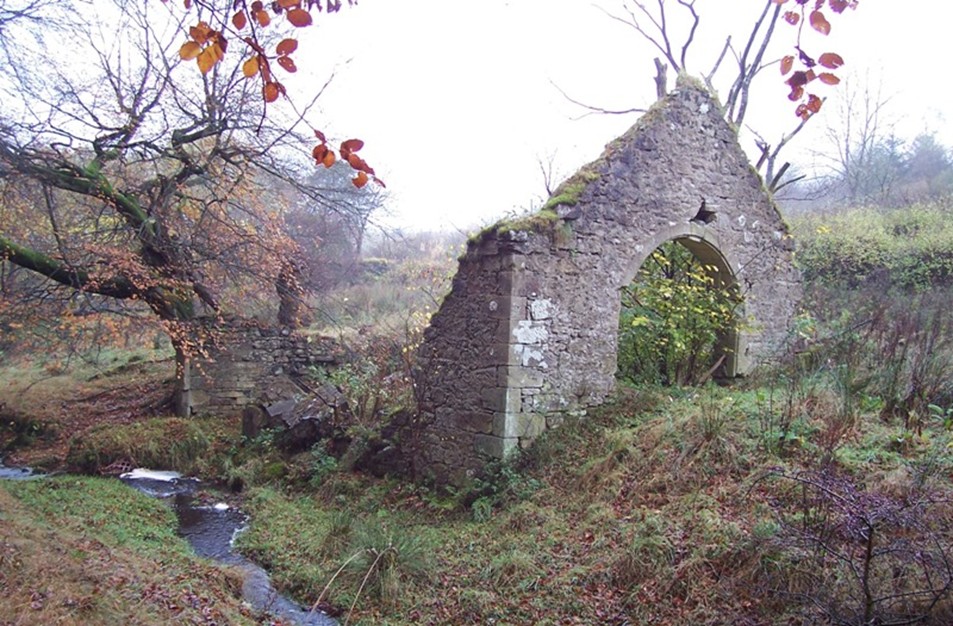
SMR 507 / NS 8727 7458
Along with Lady’s Mill and Larbert Mill this was one of the three baronial mills of Callendar. Jaw served the southern portion of the barony and was located to the south-west of Ellrig Loch which provided the water supply for the wheel. Ellrig Loch was a natural sheet of water which occupied some fifty acres, surrounded on three sides by moss, and stretched from East to West between Gardrum and Darnrigg. The stream from the loch to the mill was known as the Mill Burn. After the mill it continued southward and issued into the River Avon.
In 1642 John Gray in Blackfaulds was fined for taking his produce there instead of to Carmuirs Mill to which he was thirled. William Donaldsone was miller at Jaw Mill in 1677. Aitkenhead acquired the mill from the Earl of Callendar around 1657 and received his charter in 1668. He took his neighbour, Russell of Elridge to the Court of Session in order to preserve his right to the water which passed through the Ellrig lands. When Thomas Russell of Elridge sold his lands to William Coubrough in 1737, the charter included a passage confirming that John Aitkenhead of Jaw had
“the right of servitude which the said John Aitkenhead and his predecessors have enjoyed of bringing water from the said Thomas Russel his Loch of Elridge to the Miln of Jaw and of building and upholding a dam and dam dike at the west end of the said Loch for the better securing the said Miln of Jaw with water from the said Loch“.
The dam at the west end of the loch, with a sluice, raised the level of the water and provided a better head of water at the mill.
Shortly after 1760 another mill was built on the opposite bank of the burn from Jaw Mill and was known as the Miln of Elridge – the stream at this point was the boundary between the two baronies of Callendar and Abbotskerse; that is to say between the lands of Aitkenhead of Jaw and Russell of Ellrigg. It was described as ruinous in 1737 and does not appear to have been rebuilt. Its function was combined with that of Jaw Mill and in 1767 both of the mills and their rights were for sale together:
“To be sold by public voluntary roup… All and Haill the Town and Lands of EASTER JAW, with the Mill and Mill-lands thereof. As also the Mill of Elrig, and sucken of both the said mills, together with certain superiorities of part of the lands of Jaw, all lying within the parish of Slamannan late regality of Callendar, and shire of Stirling. The lands hold of a subject superior for payment of ten merks of feu. They have mostly been in the proprietor’s possession for many years’ past, are of considerable extent, and will admit of great improvements; there is a good going coal in the grounds, besides lime stone and moss.” (Caledonian Mercury 16 February 1767).
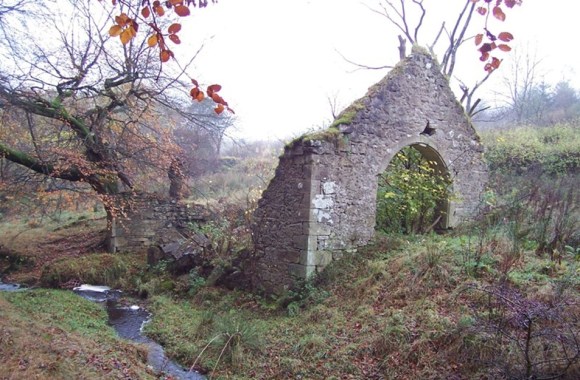
They were also advertised in 1771, 1779 and 1785. It is evident that the possessor of the mills was to supplement their income from the mill by farming the adjoining land. Whilst this was not unusual, the extent of the land attached to the mill echoes the relatively low usage made of the mill in an area dominated by pasture and moss:
“To be SOLD by public voluntary roup, within the Exchange Coffeehouse, Edinburgh, on Wednesday the 3d day of march 1779. The Lands of EASTER JAW, with the Mill and astricted multures thereof, and of the mill of Elrig, lying within the parish of Slamannan and shore of Stirling, within three miles of Falkirk.
These lands are presently out of lease; they hold of a subject, for payment of ten merks Scots of feu-duty and, besides 50 acres of moss they consist of above 100 acres of arable land, inclining south, with a gradual descent to the water of Avon. The soil in general is a rich loam, with a fertile clay bottom, very capable of improvement, There is also a valuable coal in the grounds already opened. The whole is presently possessed by one tenant, at a yearly rent of 80l Sterling.
As it is resolved to sell the lands, they are to be exposed at the upset price of 1600 l Sterling, being only twenty years purchase of the present rent” (Caledonian Mercury 8 February 1779, 4).
The 1793 Statistical Account for the parish notes that the loch supplied a corn mill with water. Its remote location meant that trade was slack and it closed in the early 19th century. Around 1825 a distillery was erected on the site. The buildings were quite substantial and consisted of two and one storeys ranged around a large courtyard. It is said that the water from the loch was not conducive to the production of good whisky – though this may have been to do with them being muddied by mining operations. In any case, the distillery was short-lived and the buildings were converted into a brewery. This fared little better and machinery was inserted to allow it to function as a flax mill. A flax kiln can still be seen to the east of the buildings. Sometime around 1853 the buildings were converted for use as a corn and barley mill with lofts and granaries (Falkirk Herald 24 February 1853). The Carron Company acquired the site for the underlying minerals and the buildings seem not to have been used for milling. The Ordnance Survey Name Book of 1860 describes Easter Jaw as :
“A large farmsteading, dwellinghouse, two storeys, offices one, all slated and in very good repair. Property of the Carron Company, Carron Iron Works, Falkirk. This building was erected for a distillery, and used as such for several years.”
With the completion of the Slamannan Railway in 1840 the surrounding area was opened up for coal mining and over the next decades the population of the parish of Slamannan soared. Together with improvements in agriculture – notably sub-surface drainage – this led to an increased demand for a mill and so Robert Martin, the new occupant of Jaw, decided to re-commission the grain mill. An experienced miller, Mr Wallace, agreed to take a lease of the mill, and Messrs Oliphant of Denny were commissioned to undertake the conversion work. The new mill was officially opened in July 1868 (Falkirk Herald 2 July 1868, 4).
Wallace may only ever have intended to get the mill up and running; in any case it was up for let just over a year later:
“MEAL AND BARLEY MILL TO LET. To be Let, for any number of years which may be agreed upon, not exceeding fifteen, THE JAW MILL, in the Parish of Falkirk and County of Stirling, situated within half a mile of a Siding on the Slamannan Railway. The Mill is driven by water power, has three pairs of stones, and a barley mill, with extensive granary and loft accommodation, and miller’s dwelling house.
Entry at Whitsunday next. For particulars apply to Mr Robert Martin, Easter Jaw, by Falkirk; or Mr James Neilson, auctioneer, & c, Falkirk.” (Falkirk Herald 26 February 1870).
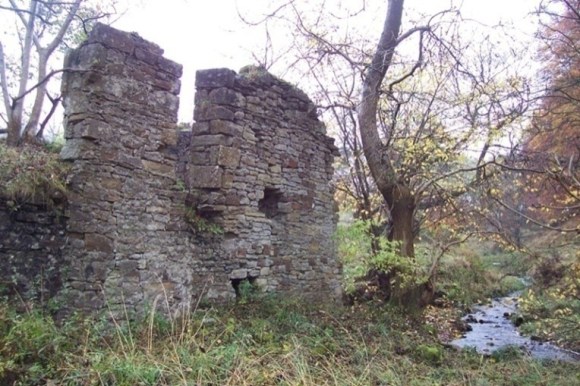
Trade was steady but slow. The railway that brought about the increased population also meant that grain could be easily transported for processing elsewhere and flour brought in. In 1890 a drastic change occurred that meant that the mill could no longer be operational – Ellrig Loch was deliberately and permanently removed by the Redding Colliery Company in order to allow its workings to be extended. The outlet was deepened and the water drained off. The following Ordnance Survey maps show that it disappeared totally (though remarkably it was reinstated some fifty or so years later).
Jaw Mill closed and the fittings were sold off:
“SALE OF MILL MACHINERY, At EASTER JAW MILL, On SATURDAY, 20 MAY. THOMAS BINNIE begs to intimate that he is instructed to Sell by Public Auction, at Easter Jaw Mill, near Slamannan, on Saturday 20th May, 1803, the MACHINERY of the Mill, consisting of 3 pairs mill stones with cases, 1 barley mill, elevators, hoists, fanners, shafting, and other machinery, kiln plates and bearers, & c.” (Falkirk Herald 13 May 1893).
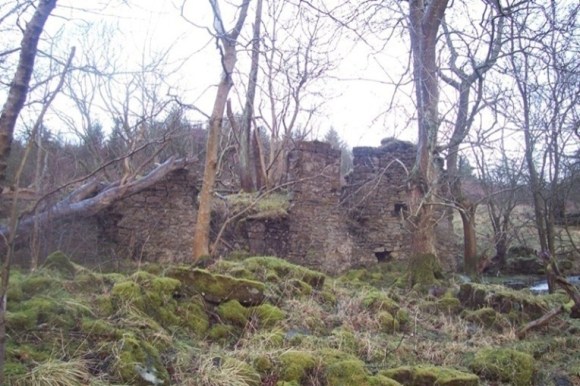
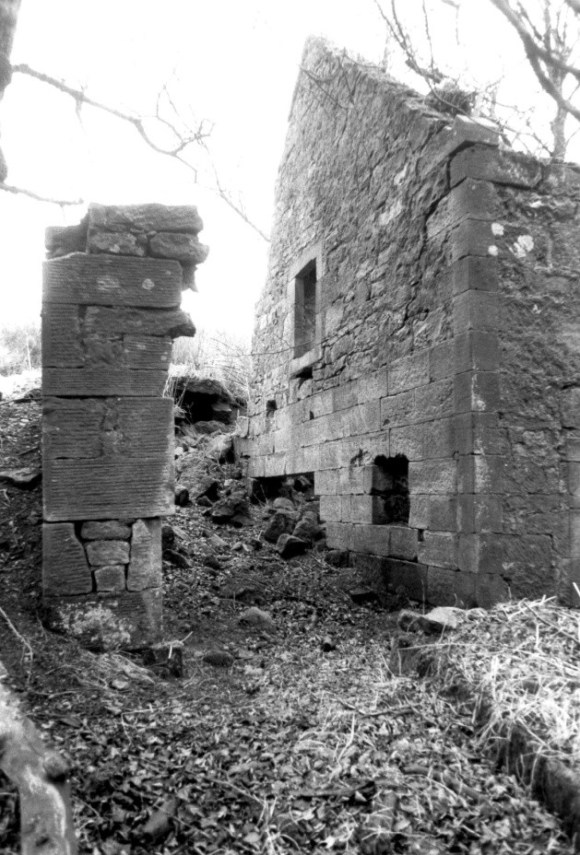
The buildings once again reverted to agricultural use. The farm was a welcoming one and the tenant hosted many balls and social gatherings. It was renowned for its barn dances. This too, however, was destined to be short-lived. The underground operations of the colliery rendered the house uninhabitable and the buildings were demolished some time before 1913.
Millers
- 1677 William Donaldson
- 1690 John Donaldson
- 1868 Mr Wallace
- William Gardner
- 1885 William Graham
- 1886 John Graham
Bibliography
Report of a Court of Session case was originally reported by Lord Fountainhall, Volume 1 pages 801 – 802 but then collected in Brown’s Supplement to Morison’s Dictionary. The case sets out a principle still used today in Scots law.
Aikenhhead of Jaw v Russell of Elrig.
Court of Session 10 December 1697 (1697) 4 Bro. Sup. 391
Court of Session
1697. December 10.
The Lords determined in the mutual declarators depending betwixt Aikenhead of Jaw and Russell of Elrig. Jaw acquired the property of a mill from the Earl of Calander, but the aqueduct of the same runs out of Elrig Loch, and through the ground of Elrig on both sides, which lands belonged to the Duke of Hamilton, and were sold to Russell in 1650. Russell erects a new mill on his own lands, a little above Jaw’s mill, and makes sluices both on the loch and the mill-lead; whereupon Jaw, novi operis nuntiatione , interrupts him, and raises a declarator, that Elrig should demolish his mill, and could not divert the natural course and channel of the water to the prejudice of his more ancient mill, nor make the water flow otherwise than it was wont to do through his aqueduct, whereof he had been in the continual and uninterrupted possession. Elrig opponed his declarator, That it was lawful for him to build a mill upon his own ground, et uti jure suo , it not being in œmulationem vicini; and that the aqueduct was, quoad both sides, on his ground, and he had been in the constant possession thereof; and the drawing the water into his own mill did not prejudge him; and, esto it did, it was but per accidens , and he was not liable for the damage: and the aqueduct passing through his ground, he might stop it as he pleased.
Answered for Jaw,—That he had prescribed the servitude of the mill-lead by forty years’ peaceable possession, which was as sufficient to give him right as Elrig had to the property.
Replied ,—Any possession he had was precarious, and by tolerance of the heritors of Elrig; in so far as it was agreed betwixt them, that Jaw should have the use of the aqueduct, and for that cause Elrig should have his corns ground multure free.
Duplied ,—This can only be proven scripto vel juramento , against his express infeftment, not only in the mill, but its leader. Triplied ,—His old infeftments bear only, The mill with its pertinents: It is true, his last charter from my Lord Calander, in 1668, bears likewise the aqueduct; but Calander, not being heritor or superior of Elrig, could not give it.
The Lords found it relevant for Elrig to prove, by witnesses, that Jaw grinded his corns multure-free; and that it was understood he had this exemption for allowing Jaw the use of the aqueduct, so as there was a synallagma , and the *392 one was the mutual cause of the other, so as to infer an interruption of the prescription of the servitude upon Elrig; and to prove that Jaw’s possession was merely precarious and by tolerance; and that Jaw had failed on his part, by exacting multure from Elrig and his tenants. But Jaw may offer to repair the damages quoad bygones, and to serve him gratis in time coming.
De Molendinis Structis in œmalationem vicini; vid. Snieidewin ad sec. 2. Instit. de Rer. Dir.; Hering. de Molendinis ; and Dirleton, voce Molendinum.
Vol. I. Page 801.
Edinburgh Evening Courier, 11 Feb 1767, 3c: To be sold in house of James Wyse “the Town and Lands of Easter Jaw, with the mill and mill-lands thereof; as also the mill of Elrig, and sucken of both the said mills, together with certain superiorities of part of the Lands of Jaw… The lands hold of a subject superior for payment of ten marks of feu. They have mostly been in the proprietor’s possession for many years past, are of considerable extent, and will admit of great improvements. There is a good going coal on the grounds, besides limestone and moss …” See Bailie John Rennie in Falkirk, amongst others.
Caledonian Mercury, 16 February 1767: To be sold by public voluntary roup… All and Haill the Town and Lands of EASTER JAW, with the Mill and Mill-lands thereof. As also the Mill of Elrig, and sucken of both the said mills, together with certain superiorities of part of the lands of Jaw, all lying within the parish of Slamannan late regality of Callendar, and shire of Stirling. The lands hold of a subject superior for payment of ten merks of feu. They have mostly been in the proprietor’s possession for many year’s past, are of considerable extent, and will admit of great improvements; there is a good going coal in the grounds, besides lime stone and moss. The articles and conditions of roup with the progress of writs to be seen in the hands of James Cunison, writer in Edinburgh, at Walter Ross’s writer to the Signet, James Court; and copies of the articles and inventory of writs to be seen in the hands of William Somerville writer in Glasgow, and Bailie John Rannie in Falkirk. …
[Similar CM 31 July 1771]
Caledonian Mercury, 8 February 1779, 4: To be SOLD by public voluntary roup, within the Exchange Coffeehouse, Edinburgh, on Wednesday the 3d day of march 1779. The Lands of EASTER JAW, with the Mill and astricted multures thereof, and of the mill of Elrig, lying within the parish of Slamannan and shore of Stirling, within three miles of Falkirk.
These lands are presently out of lease; they hold of a subject, for payment of ten merks Scots of feu-duty and, besides 50 acres of moss they consist of above 100 acres of arable land, inclining south, with a gradual descent to the water of Avon. The soil in general is a rich loam, with a fertile clay bottom, very capable of improvement. There is also a valuable coal in the grounds already opened. The whole is presently possessed by one tenant, at a yearly rent of 80l Sterling.
As it is resolved to sell the lands, they are to be exposed at the upset price of 1600 l Sterling, being only twenty years purchase of the present rent…
Caledonian Mercury 30 May 1785, 1: To be SOLD the Lands and Barony of ELPHINSTONE in the parish of Tranent… AND ALSO, the Lands and Mill of JAW, lying within the parish of Slamannan, and sheriffdom of Stirling. These lands consist of about 102 Scots acres, besides 50 acres of moss, are full of coal, and have promising appearances of lime. They are presently under lease, at the low rent of 50 l Sterling…
Falkirk Herald, 24 Feb 1853: “The CORN and BARLEY MILL of EASTER JAW, with LOFTS, GRANARIES, & c in the Parish of Falkirk… Along with the mill will be also Let a DWELLING-HOUSE and BYRE”. Thomas Stark farmer there.
Falkirk Herald, 13 September 1866: “To be let, for such number of years as may be agreed on, with entry at Martinmass, 1866. The Farm of Jaw and Crofandie, in the parish of Falkirk (quoad sacra Slamannan) and County of Stirling, extending to about 220 acres of arable and meadow land, besides pasture, with the extensive mills and other buildings erected upon the property, all as presently possessed by Mr Thomas Stark. The lands are principally of a description superior to what is usual in the district in which they lie. They have a fine southern exposure, being bounded by the River Avon on the south. The mills are supplied with water from Loch Ellrig, and will either be let along with the farm or separately. The Slamannan Railway passes within a mile of the steading, and gives an opportunity not only of bringing forward manure to the farm, but also of easily and cheaply transporting the manufactured produce of the mills to the north, as well as to Airdrie and the other manufacturing districts on the south and west. Farther particulars will be learned on application to Messrs Russel & Aitken, writers, Falkirk…”
Falkirk Herald, 2 July 1868, 4: THE JAW MILL – Agricultural gathering. On the occasion of the completion of the alterations and improvements on the Jaw Mill, the property of the Carron Coy, and the most extensive in the Slamannan district, the Messrs Oliphant of Denny who carried out these, and Mr Martin, the occupant of the mill, entertained a number of gentlemen interested in milling and general agriculture… after inspecting the mill and all the machinery connected with it, unanimous expression was made in reference to the excellent and substantial way in which the Messrs Oliphant had performed the work entrusted to them…
Mr Bailie from Denny Mills…
Falkirk Herald, 10 February 1881: MEAL AND BARLEY MILLS TO LET. To LET, the MEAL and BARLEY MILLS at EASTER JAW, near Slamannan. The Meal Mill contains Three Pairs of Stones, and the Granary accommodation very extensive. The Mills are driven by Water Power, of which there is an excellent supply. A good country trade is done, and the above forms an excellent opening for a person with small capital…
Falkirk Herald, 2 July 1868, 4: THE JAW MILL – Agricultural gathering. On the occasion of the completion of the alterations and improvements on the Jaw Mill, the property of the Carron Coy, and the most extensive in the Slamannan district, the Messrs Oliphant of Denny who carried out these, and Mr Martin, the occupant of the mill, entertained a number of gentlemen interested in milling and general agriculture… after inspecting the mill and all the machinery connected with it, unanimous expression was made in reference to the excellent and substantial way in which the Messrs Oliphant had performed the work entrusted to them…
- Mr Bailie from Denny Mills…
- The interior of this grain mill has been made almost new
- Mr Wallace the miller at Jaw, experienced
- John Hay, Planting Mill
- Mr Webster Mungall Mill
Falkirk Herald, 26 February 1870: MEAL AND BARLEY MILL TO LET. To be Let, for any number of years which may be agreed upon, not exceeding fifteen, THE JAW MILL, in the Parish of Falkirk and County of Stirling, situated within half a mile of a Siding on the Slamannan Railway. The Mill is driven by water power, has three pairs of stones, and a barley mill, with extensive granary and loft accommodation, and Miller’s dwelling house.
Entry at Whitsunday next. For particulars apply to Mr Robert Martin, Easter Jaw, by Falkirk; or Mr James Neilson, auctioneer, & c, Falkirk….
Falkirk Herald, 26 December 1885, 3: William Graham of the Jaw Mill.
Falkirk Herald, 16 April 1890: Colliery operations to the southwards have removed an ancient landmark – Ellrigg Loch – which formed the one bright spot on the verge of a sullen landscape. This sheet of water occupied some fifty acres, surrounded on three sides by moss, and stretched from East to West between Gardrum and Darnrigg, its waters escaping at the western end by a small stream which provided the motive power for the Jaw Mill, and then flowed into the Avon. The coal beneath the moss as well as to the southward on Glenellrig estate, has been worked for a considerable time by Redding Colliery Company, and it is in consequence of the extension of their workings that it has been found necessary to drain the Loch. The consent of the proprietors having an interest in the water has been obtained, and the outlet having been deepened sufficiently, the process has now been all but completed. In course of the the area will be reclaimed for arable purposes…
Falkirk Herald, 13 May 1893: SALE OF MILL MACHINERY, At EASTER JAW MILL, On SATURDAY, MAY. THOMAS BINNIE begs to intimate that he is instructed to Sell Public Auction, at Easter Jaw Mill, near Slamannan, on Saturday 20th May, 1803, the MACHINERY of the Mill, consisting of :
3 pairs mill stones with cases, 1 barley mill, elevators, hoists, fanners, shafting, and other machinery, kiln plates and bearers, & c.
Airdrie & Coatbridge Advertiser, 9 March 1901: Janet Rutherford, widow of Win. Gardner, miller. Jaw Mill, Slamannan.
Falkirk Herald, 15 November 1913, 5: The old Jaw Mill has passed through many vicissitudes in its 150 years’ history. Originally, it is said, it was a distillery, next it was used as a brewery, then as a flax mill, and afterwards as a grain mill. The draining off of the water in Gleneldrick Loch, however, stopped its further uses in this direction. As a farm house, up to its demolition by the underground workings of Easter jaw Colliery, it is better known to the younger generation.
Of it it may be said that in its day it was one of the most prominent places in the district. Balls and social gatherings of every description were periodically held here. Now those dancing halls, as well as places of active industry, are a mass of tumbled-down masonry, inhabited only by a harmless “spook.”
- Millers.
Aitkenhead, Wm., Roughlands, Carron - Graham, John, Jaw mill
- Gray, William, New mill, Slamannan
- Rennie, John C, & Co., Grahamston flour mills
- Smart, William, Millhaugh, Polmont
- Wilson, John, Jink About flour mills, Polmont
- Webster, James, Mungal mill
[Scottish Post Office directory 1886-7]
Ordnance Survey Name Book
EASTER JAW A large farmsteading, dwellinghouse, two storeys, offices one, all slated and in very good repair. Property of the Carron Company, Carron Iron Works, Falkirk. This building was erected for a distillery, and used as such for several years.
East Stirlingshire Mills: Part 2; Mr John Reid 2005; Calatria Notes p.52.
Old Statistical Account
Waugh, J. 1977 Slamannan Parish through the Changing Years.
The last recorded incident of illicit distilling of whisky was in January, 1925 when an illicit still was discovered not very far from where the distilling at Easter Jaw had been a hundred years before. A miner was fined £75. The whisky had been carried to Grangemouth in milk cans. If this illicit industry is still being engaged in, it is one of the best kept secrets in Slamannan. [p.86/87]
Love, J. 1908 Local Antiquarian Notes and Queries. Volume 1.
“In her 107th year, Ann Crosswith is said to be the oldest inhabitant of Stirlingshire. Her father, a miller at the Jaw Farm near Slamannan, left his home to transact business in Edinburgh, but never returned. His sudden disappearance was for a long time a mystery to the people of the district, but it ultimately transpired that he fell in tow with Burke and his confederate in the city, and at their hands met his death.”
 Falkirk Local History Society