
SMR 714 / NS 9694 7752
This palisaded enclosure was discovered from the air in 1977 and the immediate threat of gravel extraction meant that it was excavated in 1981-82 by the Central Excavation Unit. The enclosure lay on a small gravelly knoll to the east of Myrehead Farm and centuries of ploughing had removed almost all of the internal features. External features were found to the south-west in a natural depression. Amongst these were three circular post-settings for the foundations of wooden huts, each with a central post. The huts had concentrations of pits around them related to associated activity, though there was an overlap in time periods. The most distinctive of these features was a series of pits containing burnt material, including turf, which led to their interpretation as cooking pits.
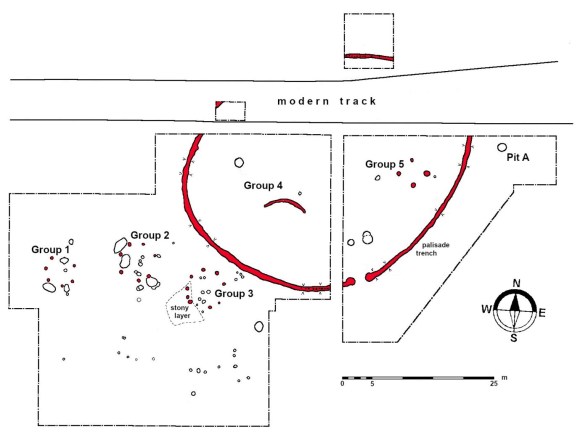
Four main periods of activity were distinguished:
- – Late Neolithic/Early Bronze Age represented by a single Beaker sherd and two cord-decorated sherds.
- – Early/mid first millennium BC occupation – Structures I-III and pits with burnt material.
- – Undated occupation associated with the palisaded enclosure- probably mid/late first millennium BC.
- – Pit A with late first millennium material.
Group 1 features included six post-holes which appear to have form part of a circular hut (Structure I) about 5m in diameter. Five of these contained carbonised plant material which included wheat and barley.
Group 2 contained a similar setting of seven post-holes (Structure II) giving a diameter of 5.9-6.2m. Quernstone fragments were included in the post packing. One of the post-holes produced a radiocarbon date of 660+- 95 BC. 3 burning pits were contained within the circle and their fills also included wheat and barley. 13 other pits in this group were excavated, one of which produced a radiocarbon date of 890 +_ 60 BC. Two saddle querns, a quern rubber and a single potsherd came from one pit.
Group 3 had eight post-holes in a probable circle of 6.5-6.9m diameter (Structure III). Part of a shale bracelet was recovered from this group. Occupation soil contained crude thick pottery of probable late Bronze Age or earl iron Age date.
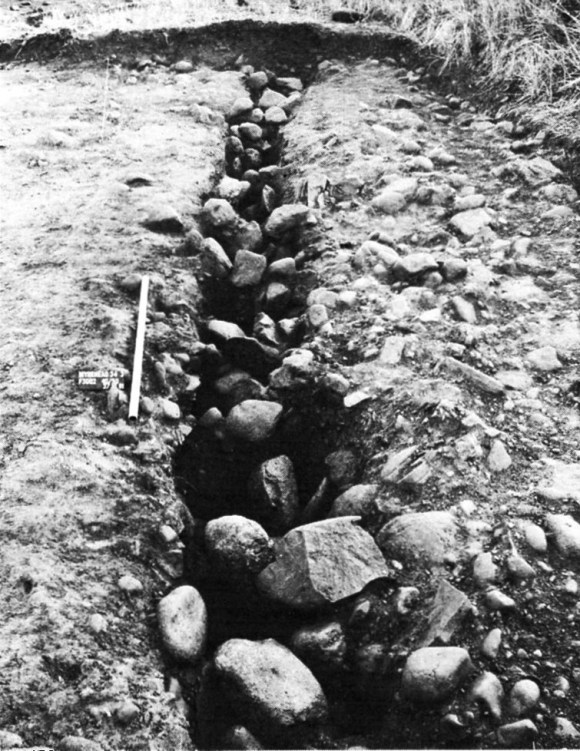
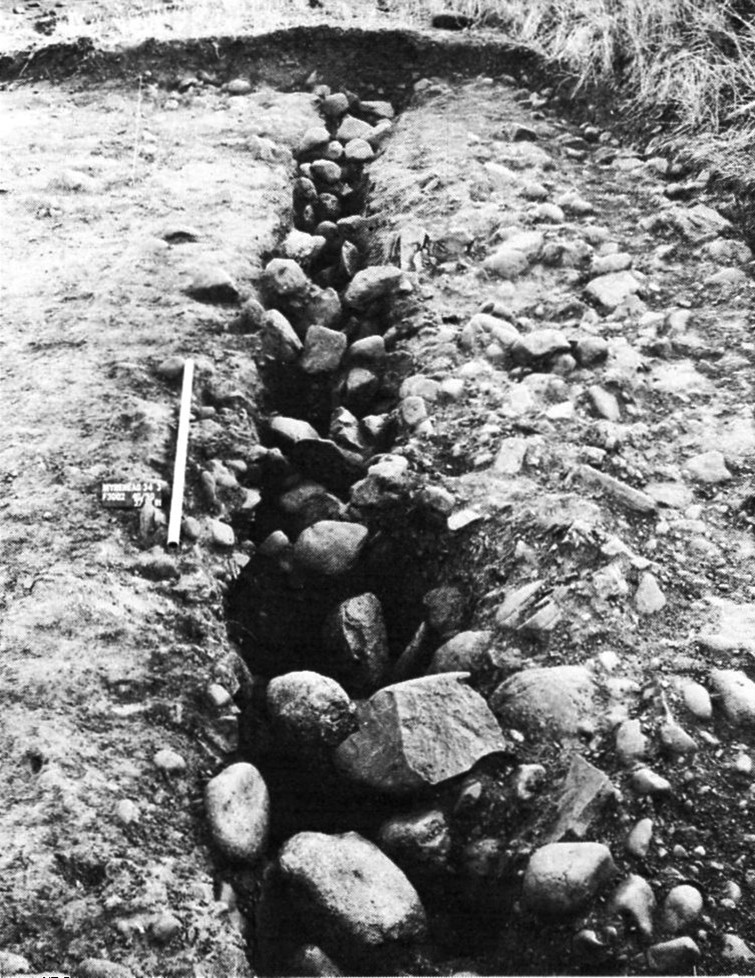
The palisade trench was 133m long and enclosed an oval area of around 1,210 square metres. Some sections of the palisade trench were packed with stones, but others were relatively stone free. It varied in width from 0.3m to 1.2m but the depth varied little from 0.9m. Slight constrictions to the width were found (indicated with arrows on the site plan) and interpreted as the ends of individual construction segments. The nature of the trench shows that it held a stoutly built fence. There was an entrance on the south side where a 1.8m wide gap occurred and the terminals on either side were slightly expanded. The more substantial posts here may indicate that there was a gate. These were the only posts of the enclosure which seem to have been deliberately removed upon abandonment.
There was insufficient charcoal for radiocarbon dating from the trench, though small fragments of pottery suggest a mid first millennium BC date. Inside the palisaded area were the Group 4 features which included an arc of a shallow slot with a diameter of 8.0-8.5m (Structure IV). It varied in breadth from 0.2 to 0.7m, with a depth of only 0.05-0.18m, being shallowest at the two ends where it had evidently been eroded. This too represents a timber hut, but we cannot be sure that it was contemporary with the palisade. Group 5 also lay inside the palisade and here Structure V was a four-post structure 3m square. Traditionally such structures are interpreted as granaries of the Iron Age, but we cannot be certain that was the case here.
Other finds from some of the pits included a cast bronze dagger pommel, 33mm in length, more saddle quern fragments, and crude pottery. Wheat and barley occurred frequently, but only two grains of rye were identified.
Bibliography
| Barclay, G. | 1983 | ‘The Excavation of a Settlement of the Later Bronze Age and Iron Age at Myrehead, Falkirk District,’ Glasgow Archaeological Journal 10, 41-72. |
| Boyd, W. | 1986 | ‘Rye and Ergot in the Ancient History of Scotland.’ Antiquity p.46. |
 Falkirk Local History Society